
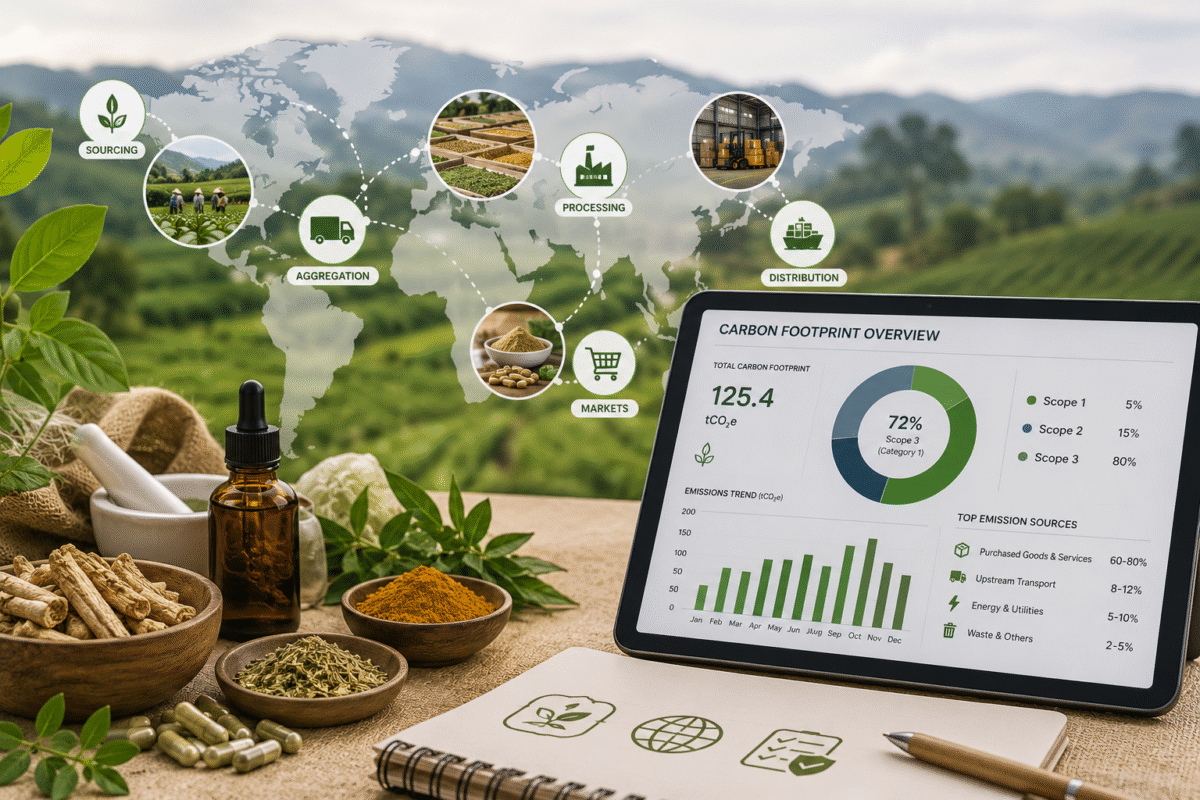
Why Scope 3 Now and Why It Matters for Nutraceuticals
The global sustainability landscape is shifting rapidly, and the nutraceuticals industry stands at a critical inflection point. As regulatory frameworks tighten, institutional buyers raise procurement standards, and consumers demand greater supply chain transparency, companies that cannot demonstrate measurable progress on their carbon footprint will find themselves increasingly locked out of premium markets.
For nutraceutical exporters, the challenge is uniquely complex. Unlike manufacturing-heavy industries where Scope 1 and 2 emissions dominate, the nutraceuticals sector carries 60–80% of its total carbon footprint in Scope 3—specifically in the purchased goods and services of Category 1. This means that farming practices, drying methods, solvent use, and extraction energy for ingredients like turmeric, ashwagandha, and boswellia are not peripheral concerns; they are the emissions story.
“The same ingredient sourced from different farms can produce wildly different carbon intensities. Generic database averages are no longer sufficient—auditors expect primary or hybrid data per ingredient cluster.”
This blog provides a structured, six-pillar roadmap for building a Scope 3 program that can withstand regulatory scrutiny, satisfy buyer due diligence, and drive real emissions reductions across your supply chain. It is designed for companies that source diverse herbal and botanical ingredients from a complex network of farmers, aggregators, and processors.
1) Start Where It Actually Matters: Ingredient-Level Hotspots
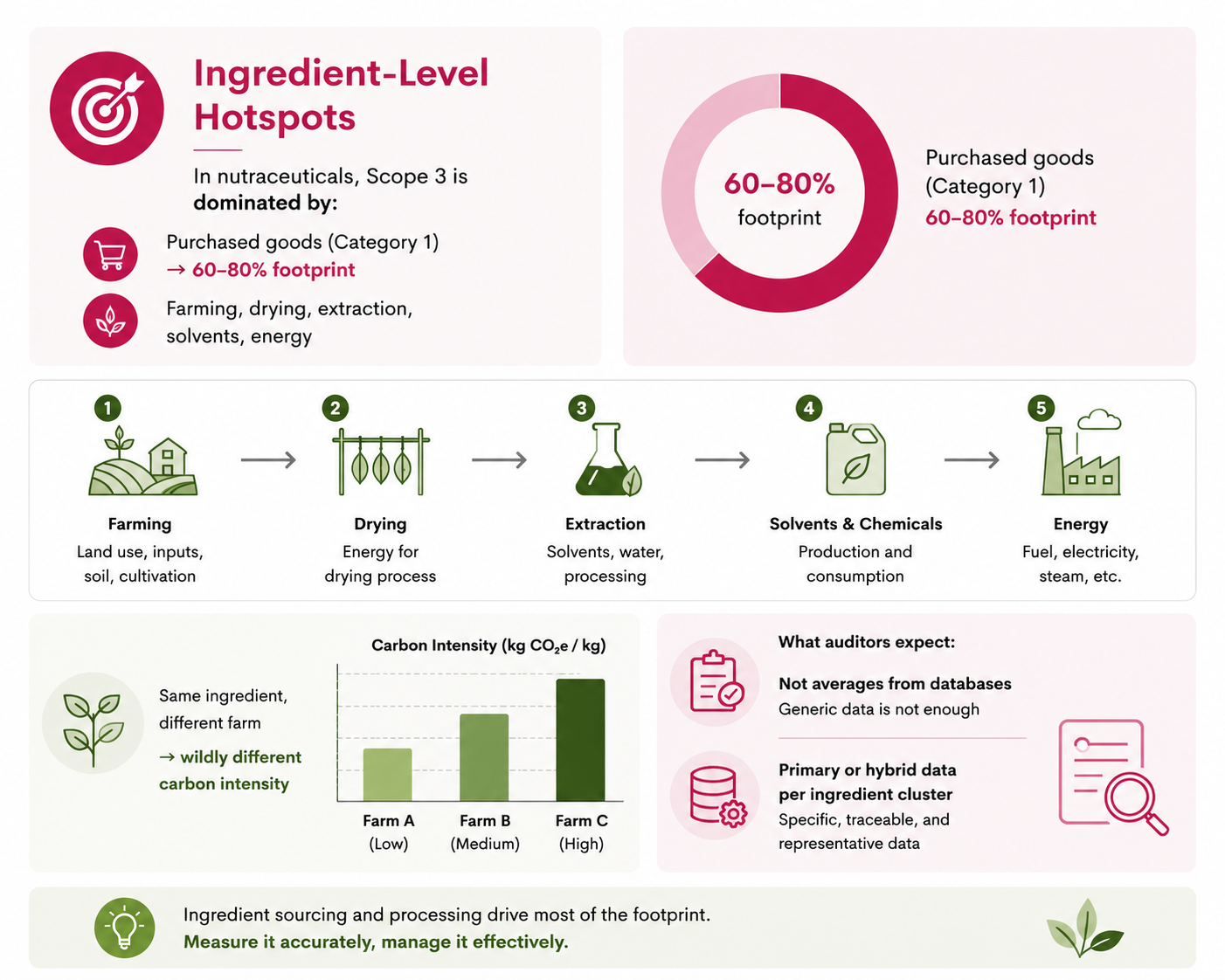
In nutraceuticals, Scope 3 is dominated by:
-
Purchased goods (Category 1) → 60–80% footprint
-
Farming, drying, extraction, solvents, energy
For a Vidya Herbs–type business:
-
Turmeric, Ashwagandha, Boswellia, etc. = high variability in emissions
-
Same ingredient, different farm → wildly different carbon intensity
What auditors expect:
-
Not averages from databases
-
Primary or hybrid data per ingredient cluster
Action:
-
Build a Top 20 ingredient emissions map
-
Prioritize:
-
High volume
-
High export exposure (EU = CBAM risk mindset)
-
High processing intensity
-
2) Clean Up Supplier Data Chaos (Without Slowing Procurement)
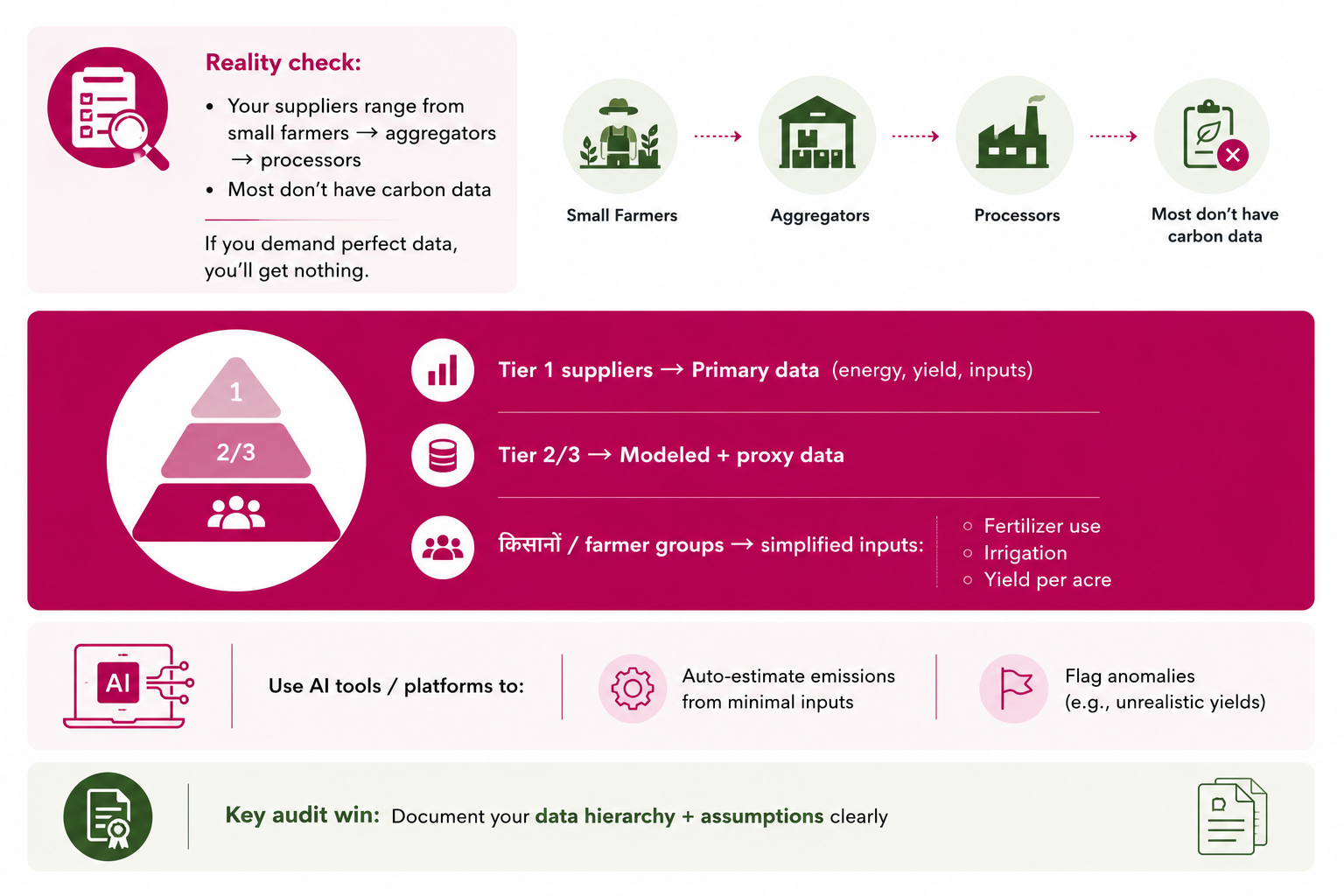
Reality check:
-
Your suppliers range from small farmers → aggregators → processors
-
Most don’t have carbon data
If you demand perfect data, you’ll get nothing.
Instead: Tiered Data Model
-
Tier 1 suppliers → Primary data (energy, yield, inputs)
-
Tier 2/3 → Modeled + proxy data
-
किसानों / farmer groups → simplified inputs:
-
Fertilizer use
-
Irrigation
-
Yield per acre
-
Use AI tools / platforms to:
-
Auto-estimate emissions from minimal inputs
-
Flag anomalies (e.g., unrealistic yields)
Key audit win: Document your data hierarchy and assumptions clearly
3) Build Product Carbon Footprints (PCFs) That Actually Hold Up
For nutraceutical exports, PCFs are becoming non-negotiable.
Each product (e.g., turmeric extract 95%) should include:
-
Farming emissions
-
Transport
-
Extraction (major hotspot)
-
Packaging
Follow standards aligned with:
-
GHG Protocol
-
ISO 14067
Critical insight (often missed):
Extraction = energy + solvent intensive → This is where you can show real reductions fast
4) Turn Suppliers Into Decarbonization Partners (Not Just Data Sources)
If your roadmap stops at measurement, it won’t survive scrutiny.
What works in nutraceuticals:
-
Contract farming programs with:
-
Reduced fertilizer use
-
Water efficiency
-
Organic/regenerative transitions
-
-
Solar drying instead of diesel drying
-
Biomass/green energy in extraction plants
Incentive mechanisms:
-
Price premiums
-
Long-term contracts
-
Preferred supplier status
Audit-proof move:
Tie supplier improvements directly to:
-
Measured emission reductions
-
Documented intervention programs
5) Make It CBAM-Ready (Even If You’re Not Directly Covered Yet)
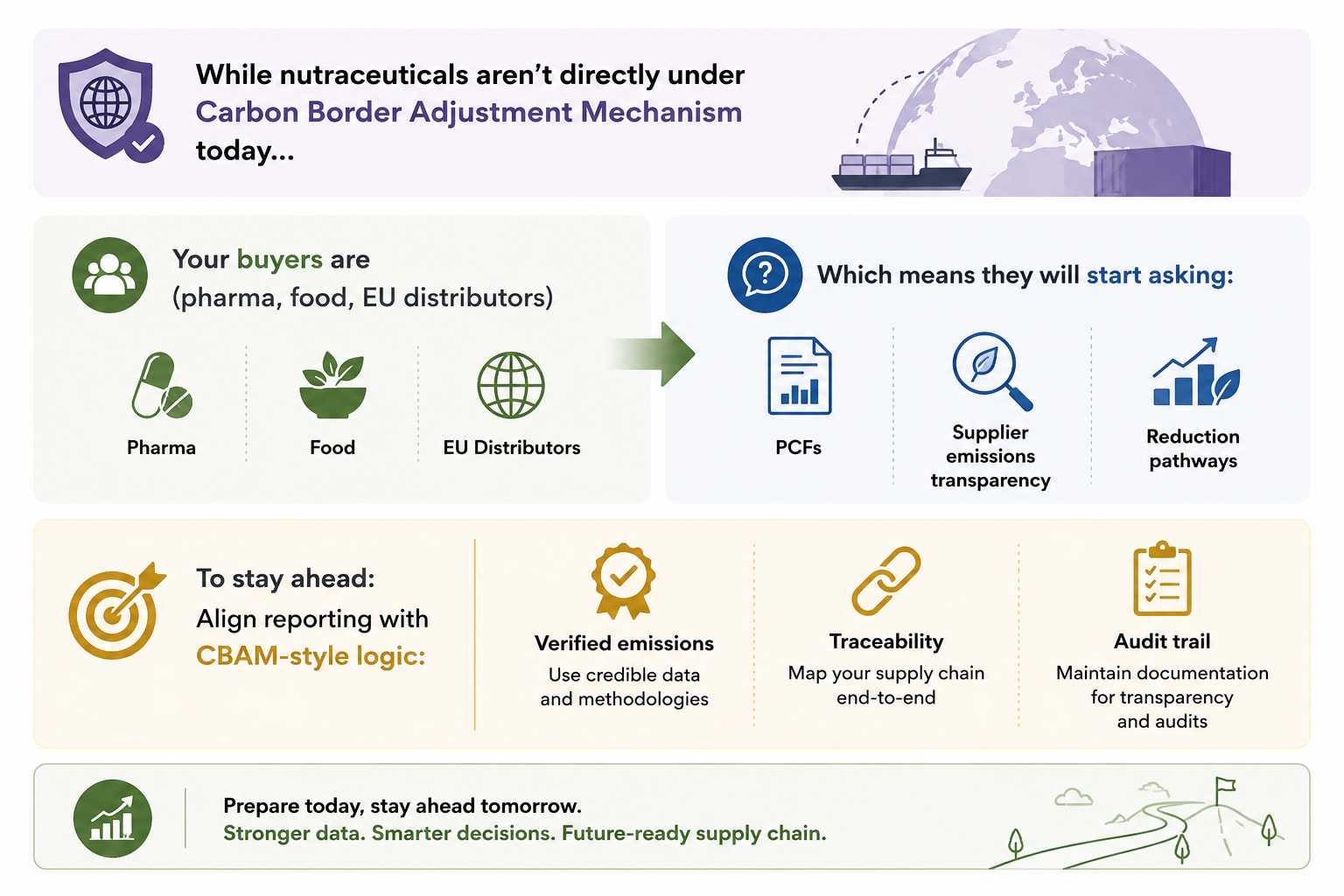
While nutraceuticals aren’t directly under
Carbon Border Adjustment Mechanism today…
Your buyers are pharma, food, EU distributors.
Which means they will start asking the following:
-
PCFs
-
Supplier emissions transparency
-
Reduction pathways
To stay ahead:
-
Align reporting with CBAM-style logic:
-
Verified emissions
-
Traceability
-
Audit trail
-
6) Governance That Survives an Audit
This is where most companies fail.
You need:
-
Documented methodology (not just spreadsheets)
-
Version-controlled emission factors
-
Internal audit trails
-
Third-party verification readiness
Align disclosures with:
-
Science-Based Targets initiative (for credibility)
-
Supplier code of conduct (climate clauses)
Common Mistakes (Avoid These)
-
Using generic emission factors for all herbs
-
Ignoring extraction emissions (big red flag)
-
Treating farmers as “unmeasurable”
-
No linkage between data → action → reduction
-
No audit documentation
Summary
The global sustainability landscape is shifting rapidly, placing the nutraceutical industry at a critical turning point. As regulations tighten and buyers demand greater supply chain transparency, companies that cannot demonstrate measurable carbon performance may face increasing barriers in global markets.
Unlike manufacturing-heavy industries where Scope 1 and 2 dominate, nutraceutical emissions are largely driven by Scope 3 impacts, particularly Purchased Goods and Services (Category 1). Farming practices, drying methods, solvent use, and extraction energy often account for 60-80% of the overall product footprint.
For exporters and ingredient manufacturers, this creates both a challenge and an opportunity:
- Build stronger product-level emissions visibility
- Improve supplier data quality
- Align with emerging buyer and CBAM-style expectations
- Strengthen audit and verification readiness
This blog outlines a practical six-pillar roadmap to help companies build a scalable, audit-ready Scope 3 program capable of supporting supplier engagement, carbon transparency, and long-term export competitiveness.