
Introduction: What is CBAM?
The European Union (EU) has introduced a major trade rule called the Carbon Border Adjustment Mechanism (CBAM). Its official, legally binding rules began on January 1, 2026.
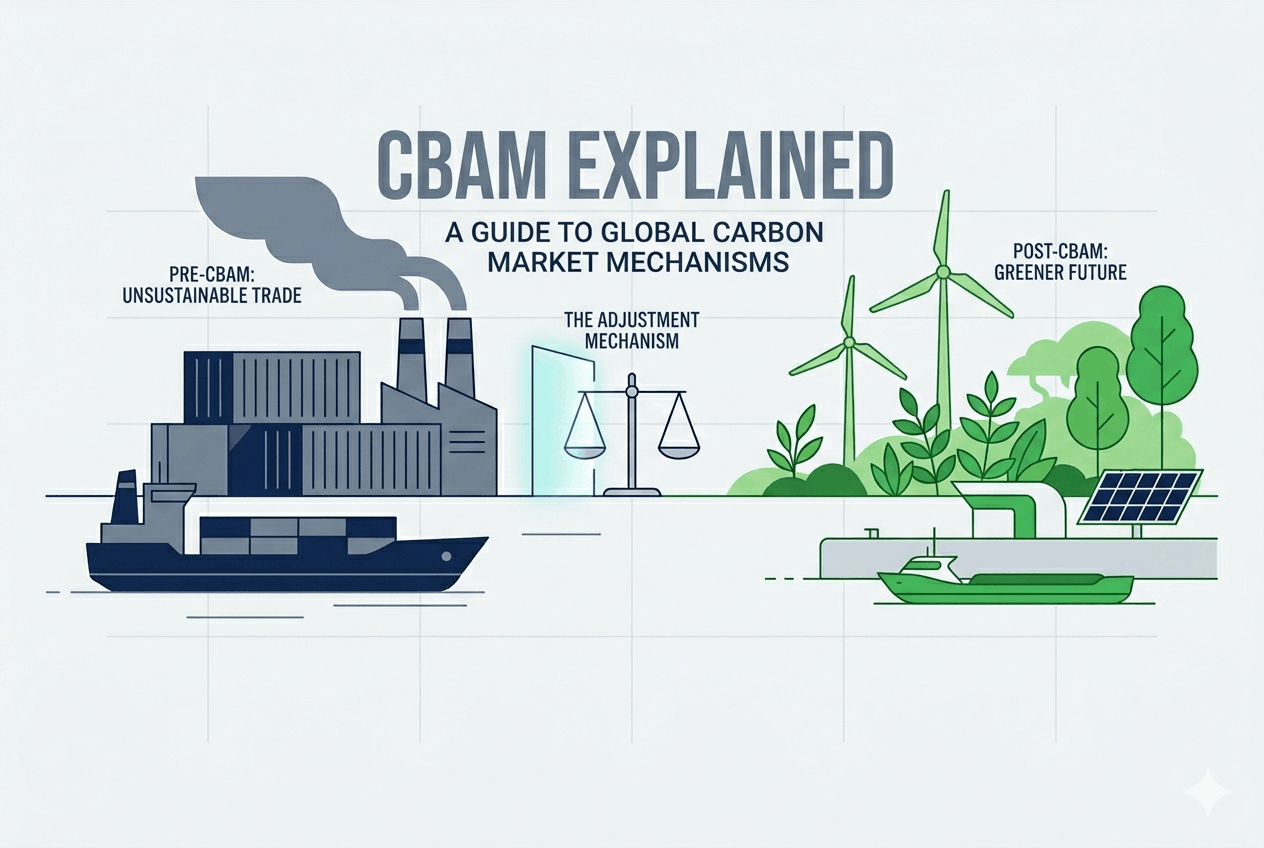
In simple terms, CBAM is a carbon fee placed on specific goods entering the European market. Historically, international trade focused almost entirely on the cost of materials, labor, and shipping. Under CBAM, the amount of greenhouse gas emissions released during a product’s manufacturing process directly affects its final cost at the European border. This rule effectively changes carbon from an abstract environmental metric into a core financial component of global trade.
Policy Context: Why Europe Created CBAM
To address climate change, Europe relies on a domestic system called the Emissions Trading System (ETS). This cap-and-trade program forces industrial plants within Europe to buy allowances for every ton of carbon they emit. As the EU systematically lowers its emission caps to meet climate targets, the cost of these allowances rises, penalizing high-emission operations.
This domestic pricing created a major economic risk known as carbon leakage:
-
Production Relocation: European companies might move their manufacturing operations to countries with weak or non-existent environmental laws to avoid carbon costs.
-
Import Substitution: Cheaper, high-emission products manufactured abroad could displace the cleaner, more expensive goods produced under strict European regulations.
To prevent this, Europe is systematically phasing out the free carbon allowances it historically gave its own industries to keep them competitive. CBAM was introduced to equalize the playing field. By charging an equivalent carbon fee on imports, the EU ensures that foreign products face the exact same financial carbon liabilities as domestic European goods.
Scope of Application: Covered Sectors and Product Types
CBAM does not apply to all imports. It specifically targets six energy-intensive sectors that face the highest risk of carbon leakage:
-
Iron & Steel: Covers raw steel, semi-finished products, and finished items like screws, bolts, and nuts.
-
Aluminium: Covers unwrought aluminum, alloy sheets, foils, and tubes.
-
Cement: Covers hydraulic cements, calcined clay, and cement clinker.
-
Fertilizers: Covers ammonia, nitric acid, urea, and mixed mineral compounds.
-
Electricity: Covers electrical energy imported directly into the EU power grid.
-
Hydrogen: Covers pure hydrogen and specific chemical derivatives.
Simple vs. Complex Goods
The regulation categorizes products into two distinct data groups:
-
Simple Goods: Products manufactured using raw materials that produced zero emissions during their own extraction or creation.
-
Complex Goods: Products made using input materials that already contain embedded carbon. For example, a manufactured steel component cannot be evaluated purely on the final assembly emissions. The producer must calculate the emissions from their own processing plus the embedded carbon generated earlier when the raw steel billet was first made. This requires manufacturers to secure transparent data from their upstream suppliers.
Exemptions
-
De Minimis Threshold: Shipments where the total value of CBAM-covered goods does not exceed a combined weight of 50 kilograms are exempt from the mechanism to reduce administrative burdens on small consignments.
-
Geographic Exemptions: Countries fully integrated into the EU ETS or those with direct carbon-market linkage agreements (such as Norway, Iceland, Liechtenstein, and Switzerland) are excluded from CBAM fees.
The Implementation Timeline
The rollout of CBAM was divided into two distinct operational phases to give global supply chains time to adapt:
-
The Transitional Phase (October 2023 – December 2025): This served purely as a data-gathering window. Importers were required to submit quarterly reports detailing import volumes and embedded emissions, but no financial fees or certificates were required.
-
The Definitive Phase (Started January 1, 2026): The compliance and financial mechanisms are now fully active. Customs authorities are linked directly with the central CBAM registry. Importers cannot bring covered goods into Europe unless they hold the official status of an Authorized CBAM Declarant.
Carbon Accounting Rules and Data Mandates
Calculating embedded emissions under CBAM requires verified, granular data rather than broad corporate sustainability estimates.
Direct vs. Indirect Emissions
Emissions tracking must be split into two technical categories:
-
Direct Emissions: Greenhouse gases released during the physical production of the goods, such as burning fuel or executing chemical reactions inside the factory.
-
Indirect Emissions: Emissions generated by the external power plants supplying the electricity consumed during the manufacturing process.
The 80/20 Actual Data Rule
To eliminate unverified or generalized reporting, the European Commission enforces a strict data threshold:
-
Primary Data Requirement: At least 80% of the reported embedded emissions for any good must be derived from actual, primary monitoring data measured directly at the production plant.
-
Cap on Estimates: A maximum of 20% of the total carbon footprint can rely on country-specific or industry-wide “default values” published by the EU. If a manufacturing plant lacks calibrated tracking systems, it cannot meet this compliance threshold.
Financial Architecture: Certificates and Pricing
CBAM does not collect a flat cash tariff at the border. Instead, it operates via a dynamic certificate framework.
-
Certificate Value: One CBAM certificate corresponds to one metric ton of embedded CO2 equivalent CO2e.
-
Weekly Pricing: The cost of a certificate is directly pegged to the EU ETS. The European Commission calculates and publishes the official certificate price every week based on the average auction prices of domestic European carbon allowances.
-
Surrender Timeline: Importers must accumulate certificates throughout the year. The first formal surrender of certificates occurs by September 30 of each year, covering the total embedded emissions of all goods imported during the previous calendar year.
-
Quarterly Liquidity Rules: Importers must maintain a rolling balance in their registry accounts equal to at least 55% of the embedded emissions of their imports since the start of the year, evaluated at the end of each quarter.
Deductions for Foreign Carbon Costs
A key element of CBAM is the provision for foreign carbon cost deductions. If a foreign manufacturer has already paid a financial penalty for carbon emissions within their home country, that cost can be used to reduce their final CBAM liability.
To successfully claim this deduction, the importer must provide verified, audited evidence proving:
-
The exact domestic carbon tax, trading scheme, or pricing mechanism applied to the production lot.
-
The actual monetary amount paid per ton of emissions.
-
Proof that the local government did not offset this cost through export rebates, subsidies, or financial workarounds.
If the European carbon price is €90 per ton and the exporter already paid a verified €20 per ton locally, the importer only purchases certificates to cover the remaining €70 delta.
Enforcement and Fines
The penalties for non-compliance, misreporting, or failing to secure certificates are severe:
-
Reporting Failures: Providing incomplete or inaccurate emissions data during the compliance cycle carries fines of up to €50 per ton of unrecorded or misreported carbon.
-
Certificate Deficits: Failing to surrender the required number of certificates by the annual September deadline triggers an automatic financial penalty matching the standard EU ETS penalty—currently set at a base of €100 per ton of CO2e—and the importer remains legally obligated to purchase the missing certificates.
Macroeconomic and Global Trade Impacts
CBAM has fundamentally altered the landscape of international commerce:
-
Erosion of Low-Cost Advantages: Developing nations that rely heavily on coal-intensive energy grids face a significant disadvantage. The high carbon intensity of their production translates directly into high certificate costs at the border, diminishing the cost advantages they traditionally held through lower labor and operational expenses.
-
Geopolitical Friction: Many emerging economies argue that CBAM violates international climate agreements, specifically the principle of Common But Differentiated Responsibilities. Critics frequently label the policy as “green protectionism.” However, the EU maintains that the system is fully compliant with World Trade Organization (WTO) rules because it treats foreign and domestic products identically.
-
Catalyzing Local Carbon Markets: To keep tax revenues from flowing directly to Europe, nations worldwide are rapidly establishing their own domestic carbon compliance systems, such as India’s Carbon Credit Trading Scheme (CCTS). By taxing carbon locally, governments ensure these funds remain in the home treasury to finance their own industrial decarbonization.
Future Trajectory (2026–2034)
The impact of CBAM will intensify steadily over the next decade through explicit legal phases:
-
The Free Allowance Drawdown: Between 2026 and 2030, the financial impact will scale up annually as Europe systematically reduces the free allowances given to its domestic industries, increasing the net certificate costs for importers.
-
Product Scope Expansion: The EU is already reviewing plans to expand CBAM to include organic chemicals, polymers, and plastics before 2030, which will significantly expand the number of manufacturing sectors bound by these rules.
-
The 2034 Deadline: By 2034, all domestic free allowances inside Europe will hit zero. CBAM will operate at 100% capacity, meaning manufacturing emissions will serve as an absolute, unmitigated factor in a product’s market cost.
Core Action Plan for Global Manufacturers
To maintain uninterrupted market access to Europe, manufacturing operations must prioritize four clear steps:
-
Map Product Carbon Footprints (PCFs): Implement precise tracking systems to monitor fuel and electricity consumption at the factory-floor level, replacing generalized estimates with audit-ready, primary data.
-
Audit Supply Chain Inputs: Secure verified carbon data from all upstream component and raw material suppliers, as their footprints directly compound the final product’s CBAM liability.
-
Document Domestic Carbon Payments: Keep detailed, audited records of any local environmental fees, carbon taxes, or green levies paid domestically to ensure buyers can successfully claim deductions at the European border.
-
Accelerate Factory Decarbonization: Shift capital investment toward emissions-reduction technologies. This includes integrating resource-efficient loops like Zero Liquid Discharge (ZLD) systems, sourcing electricity via renewable Power Purchase Agreements (PPAs), and upgrading heavy equipment from fossil-fuel combustion to clean electric or gas alternatives.