
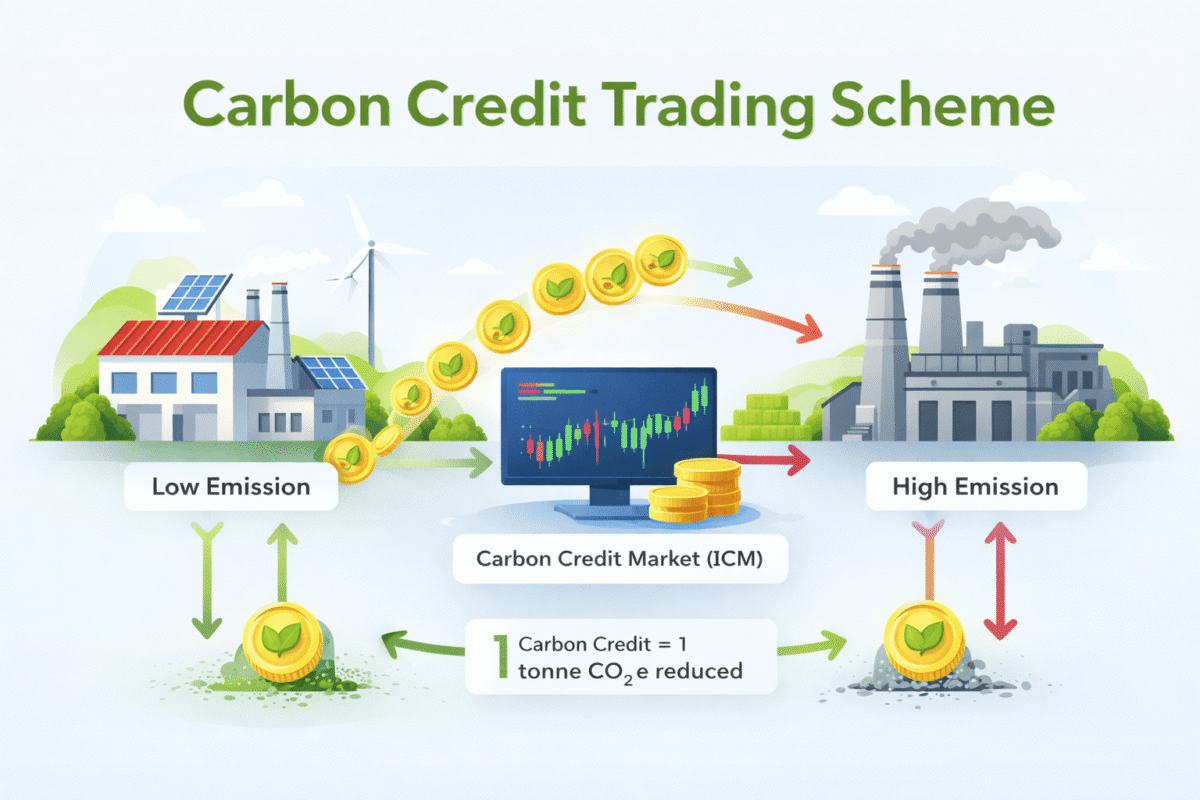
As nations grapple with the economic and environmental realities of climate change, the traditional regulatory approach—simply telling industries to stop emitting greenhouse gases—has proven insufficient for developing economies. To bridge the gap between industrial expansion and climate mitigation, India has introduced a market-driven framework: the Carbon Credit Trading Scheme (CCTS).
Established under the framework of the Energy Conservation (Amendment) Act, the CCTS serves as the backbone of the newly minted Indian Carbon Market (ICM). Rather than treating carbon dioxide (CO2) and other greenhouse gases as localized “pollution” (like toxic smog, particulate matter, or chemical waste), the CCTS treats them as global atmospheric liabilities that carry a measurable financial cost.
By creating a regulated marketplace where emissions efficiency translates directly into corporate profit or loss, India aims to systematically lower its emissions intensity while keeping its industrial engines running.
Core Mechanics: Absolute Caps vs. Carbon Intensity
Many international carbon markets, such as the European Union’s Emissions Trading System (EU ETS), operate on a strict “Cap-and-Trade” model. In those systems, the government sets an absolute ceiling on the total metric tonnes of carbon a country can emit. If a nation’s industry grows, the cap becomes a hard bottleneck.
India’s CCTS utilizes a fundamentally different model tailored for a rapidly developing economy: an intensity-based baseline-and-credit system.
Under this framework, the Ministry of Environment, Forest and Climate Change (MoEFCC) does not limit a factory’s total production volume. Instead, it regulates the Greenhouse Gas Emission Intensity (GEI). This metric calculates exactly how many tonnes of carbon dioxide equivalent (tCO2e) are released per unit of product manufactured (such as a tonne of steel or a bag of cement).
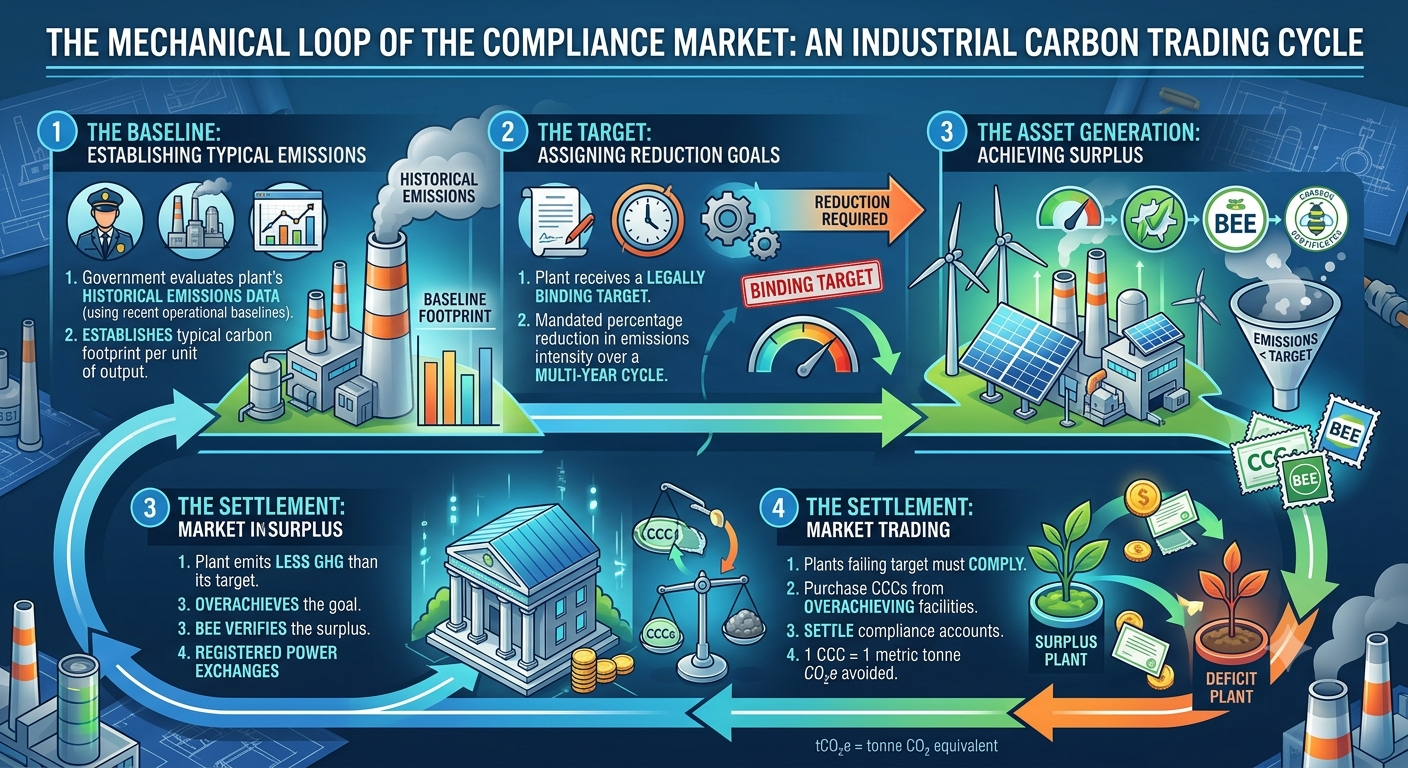
The mechanical loop of the compliance market operates as follows:
-
The Baseline: The government evaluates an industrial plant’s historical emissions data using recent operational baselines to establish its typical carbon footprint per unit of output.
-
The Target: The plant is assigned a legally binding target to reduce its emissions intensity by a specific percentage over a multi-year cycle.
-
The Asset Generation: If a facility modernizes its boilers, integrates renewable energy, or optimizes its chemical reactions to emit less greenhouse gas per unit of product than its assigned target, it overachieves. The Bureau of Energy Efficiency (BEE) verifies this surplus and converts it into Carbon Credit Certificates (CCCs).
-
The Settlement: One CCC is mathematically equal to one metric tonne of carbon dioxide equivalent (tCO2e) avoided. Plants that fail to meet their intensity targets must enter registered power exchanges to purchase these CCCs from overachieving facilities to settle their compliance accounts.
Sectoral Scope: The Mandatory and Voluntary Pillars
A common misconception is that the carbon market applies universally to all businesses. In reality, the Indian Carbon Market is divided into two distinct, highly organized pillars: the Compliance Mechanism and the Voluntary Offset Mechanism.
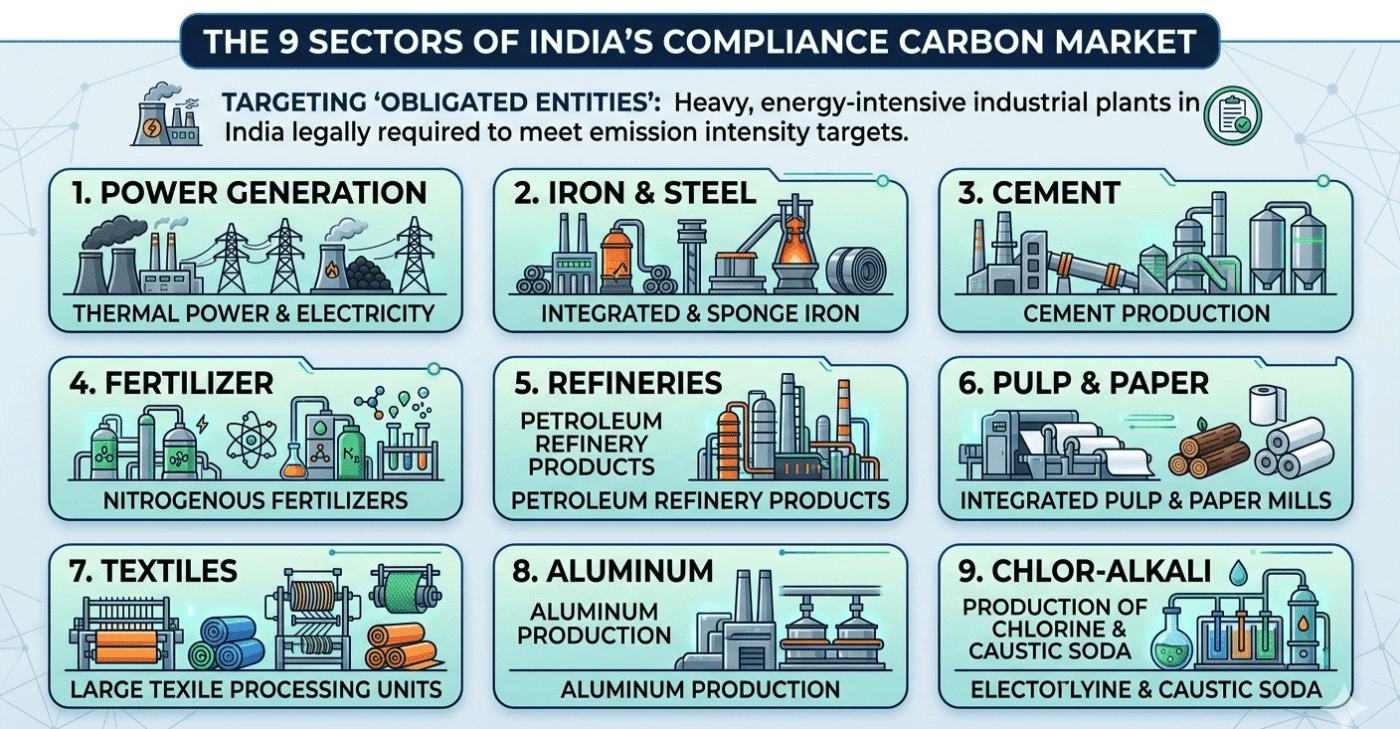
The 9 Sectors of the Compliance Market
The compliance side targets the “Obligated Entities”—heavy, energy-intensive industrial plants that collectively account for the vast majority of India’s industrial carbon footprint. These entities are legally required to meet intensity targets. The framework transitions and scales up coverage across nine primary industrial sectors:
-
Iron & Steel: A highly carbon-intensive sector encompassing blast furnaces, sponge iron plants, and secondary steel processing units.
-
Cement: Both an energy-intensive and process-emission-heavy industry (releasing CO2 directly during the calcination of limestone).
-
Aluminum: Including primary smelters and secondary recycling units, which require immense electrical currents for metal extraction.
-
Fertilizers: Heavily dependent on natural gas and fossil fuels to synthesize ammonia, a key ingredient in agricultural nutrients.
-
Petroleum Refineries: Facilities that crack and refine crude oil into transport fuels, operating massive direct-fired heaters and distillation units.
-
Petrochemicals: Plants transforming hydrocarbons into plastics, synthetic rubbers, and intermediate industrial chemicals.
-
Pulp & Paper: Heavily reliant on chemical recovery boilers, wood-processing machinery, and massive industrial steam generation.
-
Textiles: Facilities processing raw fibers, spinning, weaving, and dyeing fabrics, all of which consume large volumes of thermal and electrical energy.
-
Chlor-alkali: A highly electricity-intensive sector that utilizes electrolysis to manufacture critical basic chemicals like caustic soda, chlorine, and hydrogen.
The 10 Sectors of the Voluntary Offset Mechanism
For businesses, agricultural groups, and startups operating outside these heavy industrial sectors, the CCTS offers a Voluntary Offset Mechanism. Non-obligated entities can design greenhouse gas mitigation projects using government-approved methodologies. If these projects successfully remove or avoid carbon emissions, they “mint” high-integrity CCCs that can be sold to heavy industries. The government has approved ten specific sectors for voluntary project registration:
-
Energy: Grid-connected renewable electricity generation (such as utility-scale solar and wind).
-
Industries: Energy efficiency and fuel switching in manufacturing plants not covered by the mandatory cap.
-
Agriculture: Methane-reduction projects in rice cultivation and low-carbon soil management.
-
Waste Handling and Disposal: Landfill methane gas recovery, flaring, and organic waste composting.
-
Forestry: Mangrove restoration, afforestation, and reforestation projects that sequester carbon naturally.
-
Transport: Deployment of electric vehicle fleets, mass transit optimizations, and charging infrastructure.
-
Fugitive Emissions: Detection and prevention of unintended gas leaks in pipelines and processing facilities.
-
Construction: Low-carbon green buildings and energy-efficient building designs.
-
Solvent Use: Technological replacements for industrial volatile solvents that release carbon equivalents.
-
Carbon Capture, Utilization, and Storage (CCUS): High-tech systems that actively scrub $CO_2$ from industrial flue gases and store it permanently underground or convert it into useful materials.
Institutional Governance: Who Runs the Market?
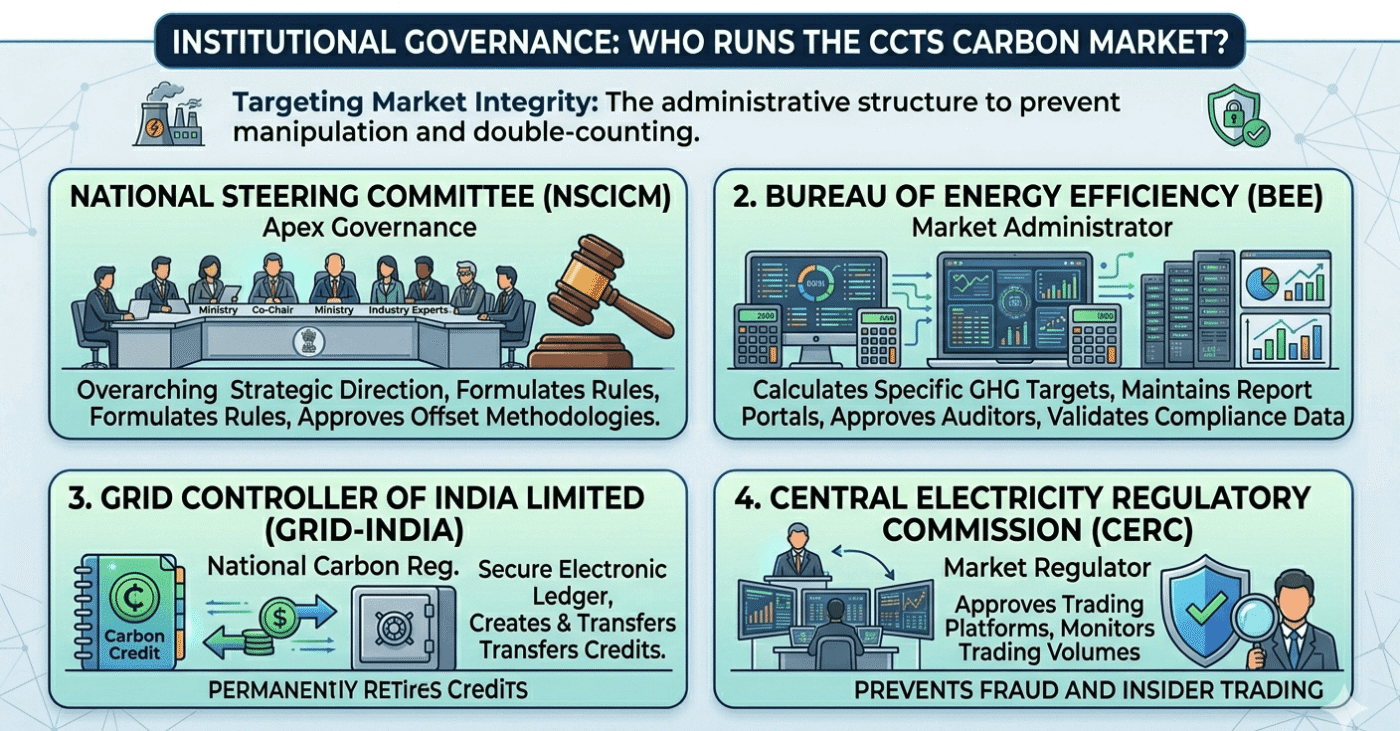
To prevent market manipulation, double-counting of credits, and fraudulent reporting, the CCTS divides its administrative duties across four primary institutional pillars:
National Steering Committee for the Indian Carbon Market (NSCICM)
This is the apex governance body, co-chaired by senior officials from the Ministry of Power and the Ministry of Environment, Forest and Climate Change. The committee features representatives from across various ministries and industry experts. The NSCICM provides overarching strategic direction, approves new offset methodologies, and formulates the rules for carbon credit issuance.
Bureau of Energy Efficiency (BEE)
The BEE acts as the Market Administrator. Its responsibilities include calculating the specific greenhouse gas emission intensity targets for every single obligated facility, maintaining the technical reporting portals, approving third-party auditors, and validating compliance data at the end of each cycle.
Grid Controller of India Limited (Grid-India)
Grid-India serves as the National Carbon Registry. Think of this as the central bank for carbon credits. It creates and maintains secure electronic ledger accounts for every participant. When a credit is generated, the registry creates it; when a credit is bought or sold, the registry transfers it; and when a credit is used to meet a target, the registry permanently “retires” it to prevent it from ever being sold again.
Central Electricity Regulatory Commission (CERC)
The CERC acts as the Market Regulator for trading activities. It approves the specific trading platforms (such as the Indian Energy Exchange or Power Exchange India Limited) where credits are listed, monitors trading volumes to prevent price gouging or insider trading, and protects market participants from financial fraud.
The Anatomy of an Emissions Boundary: Scope 1 vs. Scope 2
The CCTS applies a strict Gate-to-Gate approach. When an independent auditor evaluates a facility, they place a metaphorical glass box over the factory grounds and evaluate two distinct types of emissions:
-
Scope 1 (Direct Emissions): This includes the direct combustion of fossil fuels (like coal or diesel) within the facility’s boilers, furnaces, and company-owned vehicles. It also accounts for direct chemical process emissions, such as the carbon dioxide released when limestone is heated to form clinker in a cement kiln.
-
Scope 2 (Indirect Emissions): This accounts for the greenhouse gases released by external utilities to generate the electricity, grid power, or imported steam that the factory purchases to run its machinery.
Important Data Exclusions: To prevent penalizing green practices, biogenic carbon emissions—such as burning sustainable biomass, bagasse from sugarcane, or agricultural waste—are excluded from a facility’s compliance intensity calculations, though they must still be reported transparently.
The Compliance Cycle and the Penalties for Failure
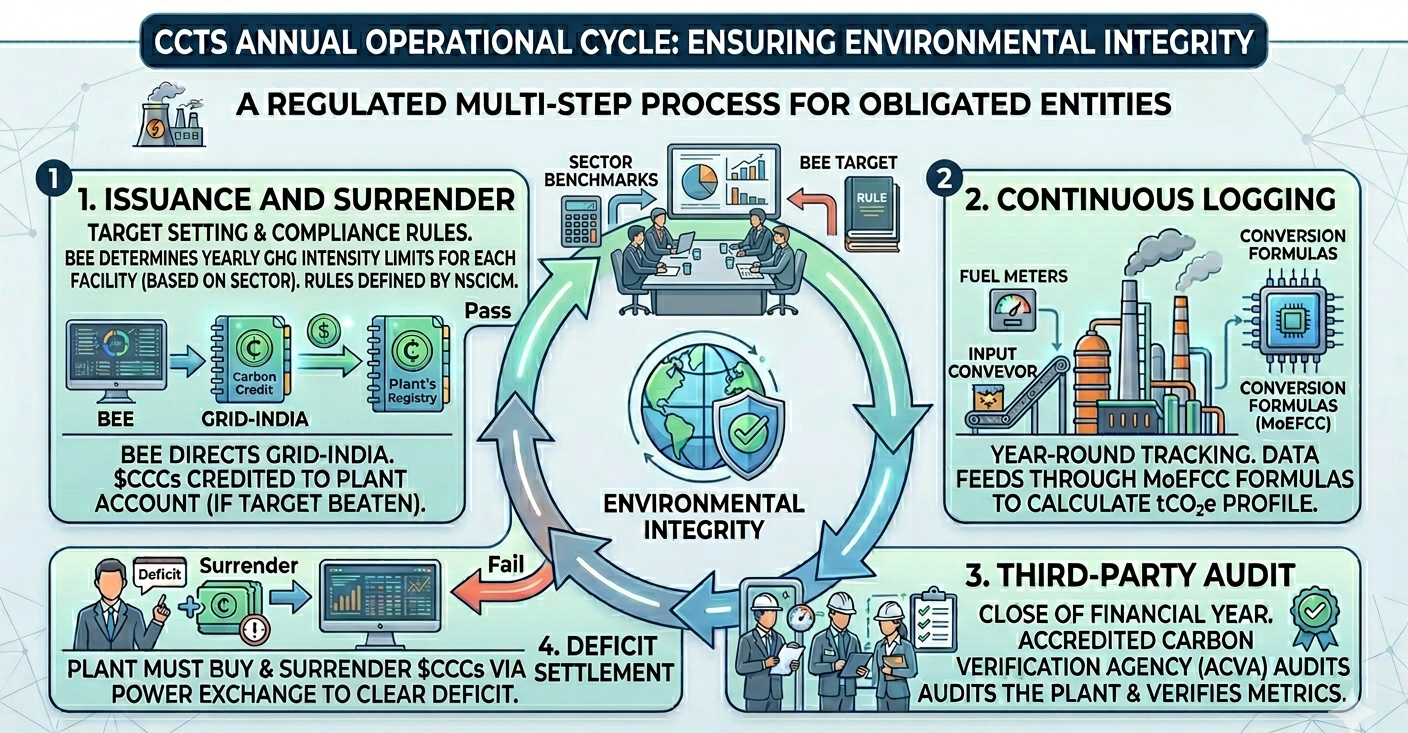
The operational schedule of the CCTS is a highly regulated, annual multi-step process designed to ensure absolute environmental integrity.
The Four-Step Annual Cycle
-
Monitoring Plan Submission: Within three months of a compliance cycle’s start, every obligated entity must submit a highly technical Monitoring Plan to the BEE. This plan maps out every meter, sensor, and sampling point within the factory walls.
-
Continuous Logging: Throughout the year, the factory tracks its fuel consumption, raw material inputs, and grid power draw, feeding the data through conversion formulas approved by the MoEFCC to calculate its ongoing tCO2e profile.
-
The Third-Party Audit: At the close of the financial year, the data is handed over to an Accredited Carbon Verification Agency (ACVA). These are independent, highly trained engineering firms that physically audit the plant, check meter calibrations, verify purchase logs, and sign off on the final emission intensity metrics.
-
Issuance and Surrender: The certified report is uploaded to the registry. If the plant beat its target, the BEE directs Grid-India to credit the plant’s registry account with CCCs within a few weeks. If the plant failed, it is given a strict deadline to buy and surrender enough credits via the power exchanges to cover its deficit.
The Penalty Mechanism
The CCTS features a strict financial penalty for non-compliance. If a facility overshoots its emission intensity target and refuses or fails to purchase enough market credits to cover its shortfall by the designated deadline, it faces formal legal action.
The Central Pollution Control Board (CPCB) is empowered to levy an environmental compensation fine. This fine is calculated at a rate equal to twice the average market trading price of CCCs for that specific compliance year for every single tonne of carbon deficit left unfulfilled.
The Strategic Shift: Transitioning from the PAT Scheme
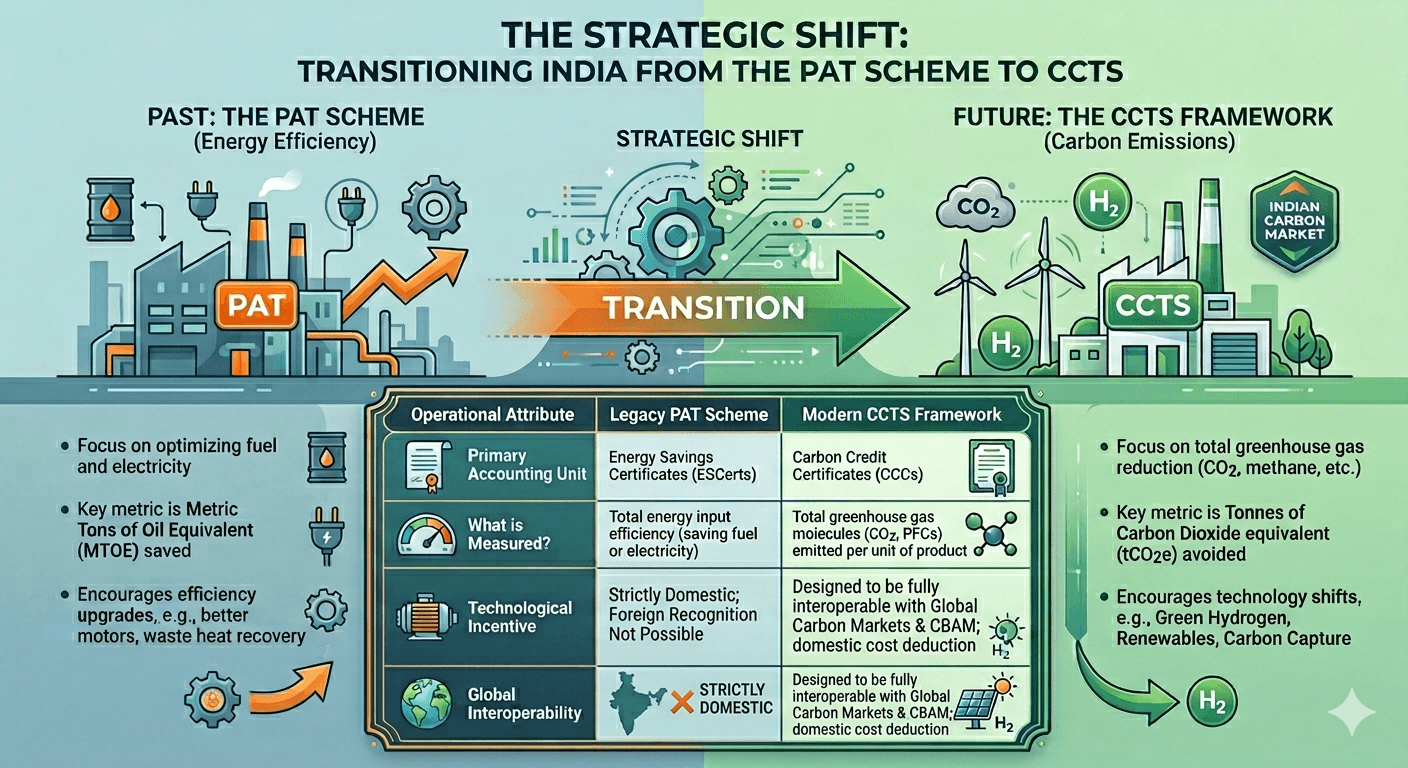
To appreciate why India built the CCTS, one must understand how it improves upon the country’s legacy environmental framework: the Perform, Achieve, and Trade (PAT) scheme.
For over a decade, the PAT scheme served as India’s premier industrial efficiency program. It was remarkably successful, but it operated under a major limitation: it measured energy consumption (calculated in Metric Tons of Oil Equivalent), not direct carbon emissions.
| Operational Attribute | Legacy PAT Scheme | Modern CCTS Framework |
| Primary Accounting Unit | Energy Savings Certificates (ESCerts). | Carbon Credit Certificates (CCCs). |
| What is Measured? | Total energy input efficiency (saving fuel or electricity). | Total greenhouse gas molecules (CO2, PFCs) emitted per unit of product. |
| Technological Incentive | Incentivizes factories to buy more efficient motors or recycle heat within the plant. | Incentivizes factories to change their primary fuel source entirely (e.g., transitioning to Green Hydrogen, implementing biomass blending, or setting up Carbon Capture plants). |
| Geopolitical Linkage | Purely domestic; foreign buyers and international markets cannot trade or recognize ESCerts. | Designed to be fully interoperable with global carbon markets and carbon border tax systems. |
The Global Picture: Why the CCTS is Critical for Trade
The transition to a domestic carbon market is driven by international trade survival just as much as domestic climate policy.
Major global trading blocks, most notably the European Union, are implementing carbon border taxes, such as the Carbon Border Adjustment Mechanism (CBAM). Under these rules, when an Indian manufacturer exports high-emission materials like steel, aluminum, or iron to Europe, the EU levies a steep tax at the border based on the carbon footprint generated during production.
However, international trade laws generally allow an exemption: if the exporting country has already charged the company a fair price for its carbon emissions at home, that domestic cost can be deducted from the foreign border tax.
By operationalizing the CCTS compliance mechanism, India ensures that the financial value of carbon remains within its own domestic economy—incentivizing local industries to clean up their production methods rather than paying penalties to foreign treasuries.
Implementation Timeline
The deployment of this massive market infrastructure is rolling out in structured, deliberate phases:
-
Phase 1 (Preparation & Infrastructure Development): This phase focused on finalizing the Measurement, Reporting, and Verification (MRV) protocols, setting up the digital registry software with Grid-India, and releasing data collection baselines.
-
Phase 2 (Compliance Sector Rollout): The MoEFCC officially finalized legally binding two-year intensity targets for the initial wave of heavy industrial sectors (including Cement, Aluminium, Chlor-Alkali, Pulp & Paper, Petroleum Refineries, Petrochemicals, and Textiles), bringing hundreds of major plants under the mandatory umbrella.
-
Phase 3 (Trading Operations & Market Integration): The platform transitions into active commercial trading. CCCs are issued directly onto the power exchanges, initiating formal market pricing and establishing a true national price on carbon emissions.
Through this carefully coordinated combination of intensity-based compliance, voluntary offset funding, and strict multi-institutional oversight, the CCTS ensures that reducing greenhouse gases is no longer just a corporate social responsibility initiative—it is a core requirement for commercial survival in a modern economy.