
Introduction
For global nutraceutical brands and herbal extraction enterprises, securing a consistent supply of premium, traceable, and chemical-free raw materials is a baseline requirement. As international regulatory frameworks tighten and global consumer demand shifts toward certified organic botanicals, standardized plant extracts, and clean-label wellness ingredients, the pressure to transition cultivation supply chains away from synthetic inputs has intensified.
However, scaling an organic transition across extensive contract farming networks is a complex operational challenge. The journey from conventional, chemical-dependent agriculture to international certified organic standards is rarely a smooth progression. It introduces immediate agronomic and financial disruptions that can destabilize a farmer network before the environmental, carbon reduction, and premium price benefits are ever realized.
For ingredient manufacturers managing contract cultivation, success requires moving beyond environmental idealism. The transition must be treated as a phased, de-risked industrial infrastructure project. By implementing structured risk-mitigation frameworks, nutraceutical enterprises can protect their raw material extraction yields, insulate contract farmers from sudden economic shocks, and significantly lower their upstream Scope 3 emissions while radically improving the Product Carbon Footprint (PCF) of their finished products.
The Core Vulnerability: The 3-Year Transition Bottleneck
The primary obstacle in any large-scale organic transition is the regulatory holding zone required by international certifying bodies. For a harvest to be labeled and sold as certified organic, the land must undergo a strict three-year detoxification period free from prohibited synthetic fertilizers, chemical pesticides, and growth regulators.
During this three-year window, a dangerous mismatch occurs between farm-level economics, procurement needs, and carbon accounting:
1. The Ecological Yield Shock
Conventional soils are often structurally dependent on highly soluble synthetic NPK fertilizers and chemical plant protection. When these inputs are abruptly withdrawn, the depleted soil microbiome cannot immediately compensate. Until the natural biological nutrient cycles are restored, crop yields for high-value medicinal herbs typically drop by 20% to 35%.
2. The Product Carbon Footprint Inflation
While an organization’s sustainability team wants to eliminate chemical inputs immediately to show rapid progress on decarbonization roadmaps, enforcing an abrupt halt without a safety net destroys farm efficiency. If a contract farmer’s yield collapses, the embedded Product Carbon Footprint (PCF) per kilogram of the harvested botanical actually spikes. This occurs because the fixed agricultural energy, transport logisitics, and land use yield significantly less output, inflating the emissions intensity of the raw ingredient entering the extraction facility.
3. Supply Chain Attrition
Without proactive enterprise intervention, this economic pressure triggers high attrition rates within contract farming networks. Smallholders and marginal farmers frequently abandon the program in years one or two, returning to chemical dependencies to secure immediate survival. For the contracting manufacturer, this results in broken supply agreements, wasted agronomic training investments, a volatile raw material pipeline into the extraction factory, and a failure to meet strategic climate targets.
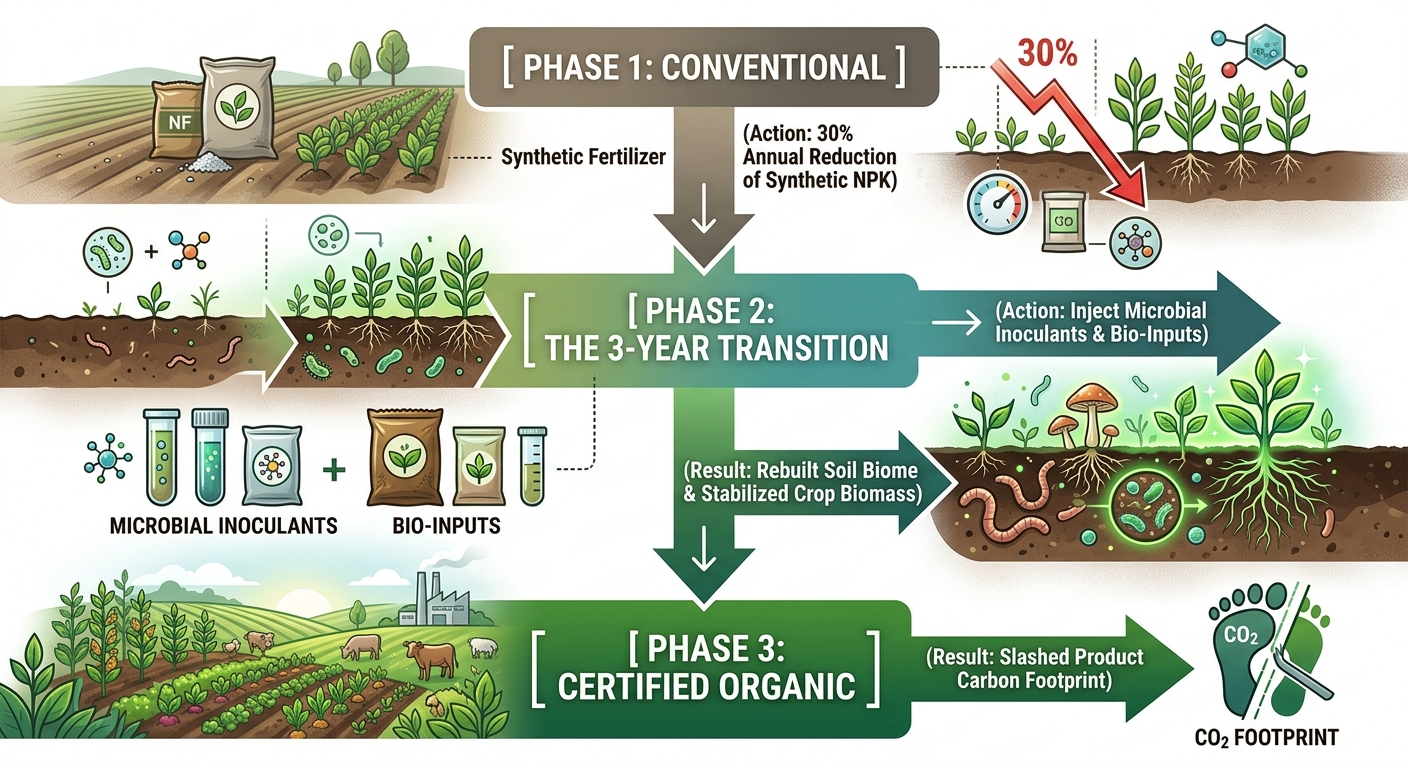
1. Agronomic Mitigation: The Phased Bio-Input Substitution Protocol
To prevent the initial ecological yield shock from collapsing farm economics and inflating emissions intensity, nutraceutical companies must design a structured, step-by-step substitution protocol rather than enforcing an overnight cessation of inputs.
The Huge Carbon Win: Eliminating Synthetic Nitrogen
Manufacturing synthetic nitrogen fertilizers is an incredibly carbon-intensive chemical process dependent on fossil fuels. Furthermore, when applied to fields, these fertilizers release nitrous oxide (N₂O)—a greenhouse gas nearly 300 times more potent than carbon dioxide (CO₂). By implementing a phased taper (e.g., reducing synthetic chemicals by 30% annually), the nutraceutical manufacturer removes the primary driver of its agricultural carbon footprint, directly lowering the Scope 3 data attached to its raw material sourcing.
2. Financial Mitigation: Interim Multi-Cropping and Diversified Revenue
A critical strategy for maintaining farmer compliance is ensuring that the farm unit remains profitable every single month of the three-year transition, independent of the primary botanical crop’s final yield.
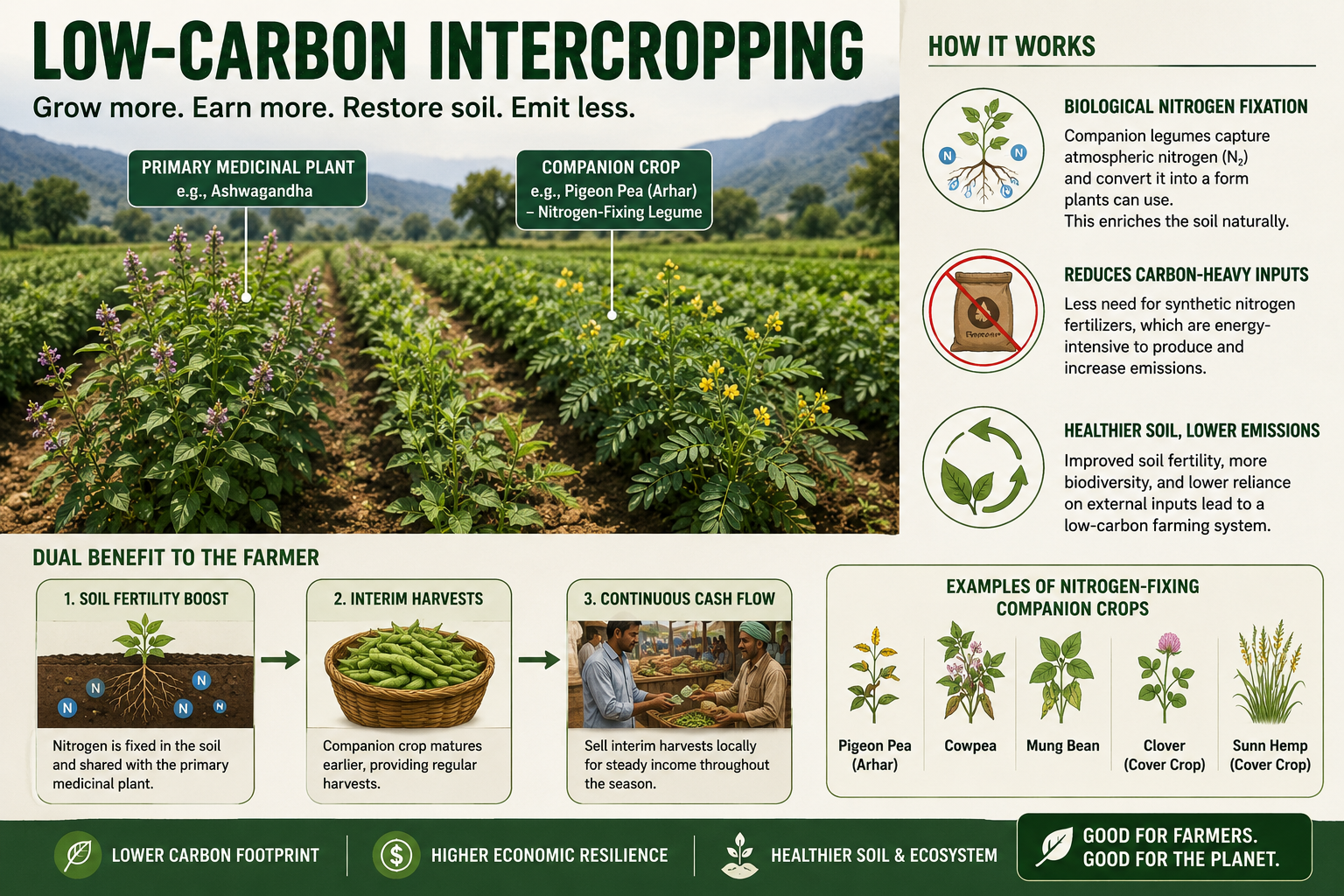
Monoculture increases economic and environmental vulnerability. Agronomists can introduce short-cycle, nitrogen-fixing companion crops—such as specific pulses, legumes, or fast-growing cover crops—interplanted with the primary medicinal plant. These secondary crops serve a dual purpose: they biologically fix atmospheric nitrogen into the soil (naturally replacing carbon-heavy synthetic fertilizers) and provide the farmer with regular, interim harvests that can be sold locally for continuous cash flow.
Utilizing Non-Contaminated Field Margins
Monoculture increases economic and environmental vulnerability. Agronomists can introduce short-cycle, nitrogen-fixing companion crops—such as specific pulses, legumes, or fast-growing cover crops—interplanted with the primary medicinal plant. These secondary crops serve a dual purpose: they biologically fix atmospheric nitrogen into the soil (naturally replacing carbon-heavy synthetic fertilizers) and provide the farmer with regular, interim harvests that can be sold locally for continuous cash flow.
3. Commercial Mitigation: Structured Transitional Contracts
The ultimate tool for de-risking the contract network lies in the commercial agreement itself. If a business expects a farmer to endure a multi-year transition to achieve zero-chemical, low-carbon standards, it must provide an institutional safety net.
a) Transitional Pricing Mechanisms
Forward-thinking ingredient manufacturers are rewriting standard contract terms to include a “Transitional Premium.” While the crop cannot be sold to global clients as certified organic yet, the contracting company pays a tiered price above the conventional market rate during years one, two, and three. This targeted investment bridges the yield gap and guarantees that the farmer’s net income per acre remains stable while the supply chain builds its decarbonization equity.
b) Long-Term Off-Take Guarantees
Fear of market volatility prevents farmers from embracing long-term soil changes. Contracts should offer legally binding, long-term off-take guarantees extending five to seven years out. Knowing that a prominent nutraceutical manufacturer is contractually committed to purchasing the certified crop at a guaranteed premium price from year four onward gives the farmer the financial confidence to absorb short-term transitional adjustments.
Conclusion: Securing a Low-Carbon Supply Pipeline
Ultimately, transitioning a contract farming cultivation network toward certified organic standards is an exercise in engineering a climate-resilient supply chain. By replacing standard chemical-heavy practices with structured biological transitions, nutraceutical and herbal extraction manufacturers protect both their raw material processing volumes and their farming communities. De-risking this three-year transition window ensures an uninterrupted pipeline of high-purity botanicals while driving down the overall product carbon footprint of the final extracts. Enterprises that master this operational balance do more than protect their sourcing; they establish a highly competitive, decarbonized supply network built to withstand the scrutiny of a carbon-conscious global marketplace.