
Introduction
The Digital Product Passport (DPP) represents the most significant shift in global trade and manufacturing transparency in the 21st century. Born out of the European Green Deal, specifically the Ecodesign for Sustainable Products Regulation (ESPR), it is a policy mechanism designed to decouple economic growth from resource consumption. By creating a standardized “digital twin” for physical goods, the EU aims to make every product’s lifecycle transparent, traceable, and sustainable.
As of April 2026, the framework has moved from legislative theory to technical reality. For any business exporting to or operating within Europe, the DPP is no longer a future concept—it is a current operational requirement.
1. What is a Digital Product Passport?
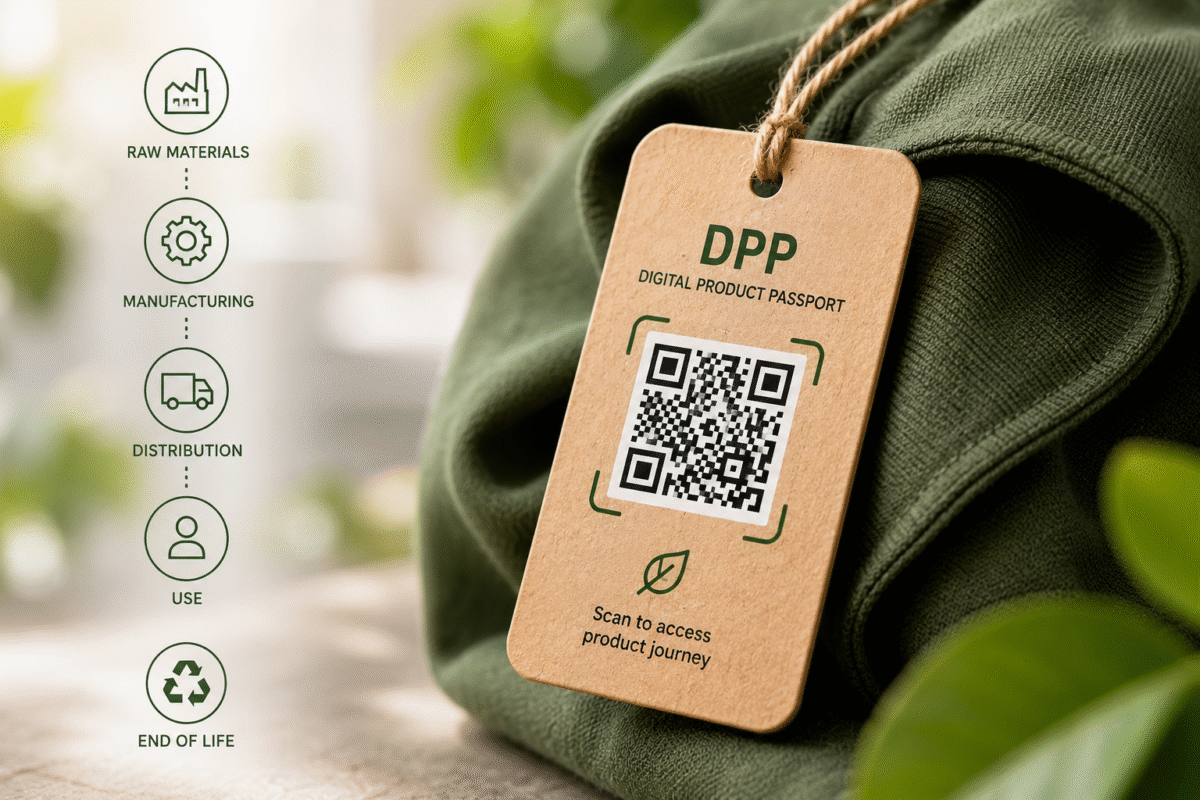
At its core, a DPP is a structured collection of product-related data that is digitally accessible via a physical carrier on the product. It acts as a “life story” for a product, documenting every stage from raw material extraction and manufacturing to use, repair, and eventual recycling.
Unlike traditional labels that provide a static snapshot (like a “Made in India” tag), the DPP is dynamic. It follows the product through various owners and lifecycle events. If a product is repaired, the repair history is updated; if a component is replaced, the material composition data is adjusted.
The Three Pillars of DPP Architecture
-
Unique Identifiers (UID): Every product, manufacturing facility, and operator is assigned a unique digital code. This ensures that data is not lost or confused as goods move across international borders.
-
Data Carriers: The physical link on the product—typically a QR code, RFID tag, or NFC chip—that allows anyone with a reader (or smartphone) to access the digital record.
-
The Decentralized Registry: The EU does not store all the data. Instead, the data remains with the manufacturer or in a decentralized network, but it must be “machine-readable” and interoperable. This means different software systems must be able to “talk” to one another using standardized protocols finalized in March 2026.
2. Who is the DPP relevant for?
The DPP is designed to serve a diverse ecosystem of users. Its relevance depends on who is scanning the code:
a) Manufacturers and Importers
For the “Economic Operator” (the brand or importer), the DPP is a compliance tool. It is their responsibility to ensure the passport exists and is accurate. They must map their entire supply chain to gather the necessary data. Without a valid DPP, products will be blocked at EU customs starting in the high-impact waves of 2027-2028.
b) Consumers and End-Users
The DPP empowers consumers to make sustainable choices. By scanning a product in a store, a buyer can see its “Circularity Score,” its carbon footprint, and how long spare parts will be available. It transforms sustainability from a marketing claim into a verifiable fact.
c) Recyclers and Remanufacturers
One of the biggest hurdles in recycling is not knowing what is inside a product. The DPP provides recyclers with a “Chemical Bill of Materials.” They will know exactly which flame retardants were used in a laptop’s plastic or the specific chemistry of an EV battery, allowing for higher recovery rates of critical raw materials.
d) Market Surveillance Authorities
For regulators, the DPP is a tool for enforcement. Authorities can instantly verify if a product complies with hazardous substance limits (REACH) or energy efficiency standards without needing to perform destructive testing on every batch.
3. What Information Must Be Included?
The data requirements are divided into several “layers,” ranging from public information to highly sensitive data accessible only to regulators.
Data Category |
Specific Requirements |
|
a) Identity & Origin |
Product name, model, batch number, manufacturer location, and Global Trade Item Number (GTIN). |
|
b) Sustainability Metrics |
Product Carbon Footprint (PCF) covering Scope 1, 2, and 3; water consumption; and land-use impact. |
|
c) Material Composition |
Detailed breakdown of raw materials, percentage of recycled content (pre-consumer and post-consumer), and the presence of “Substances of Concern.” |
|
d) Circularity Data |
Disassembly maps, repair manuals, software update guarantees, and a “Reparability Index.” |
|
e) Compliance Docs |
EU Declaration of Conformity, certificates of origin, and test reports.
|
4. Implementation Timeline and Sector Roadmap
The EU is rolling out the DPP in waves. While the overarching law (ESPR) is in place, specific “Delegated Acts” define the rules for each industry.
-
2024–2025 (The Design Phase): Legislation was finalized, and the technical standards for data exchange were developed.
-
2026 (The Infrastructure Milestone): As of July 19, 2026, the EU Central Registry becomes operational. This registry stores the “metadata” and unique identifiers for every product on the market. Also, the “Destruction Ban” for unsold textiles and footwear takes effect, requiring companies to use DPP data to track where their unsold stock is sent.
-
February 2027 (The Battery Wave): The Industrial and EV Battery Passport becomes the first mandatory application. Every battery over 2kWh sold in the EU must have a digital record of its chemistry and carbon footprint.
-
2027–2028 (The High-Impact Wave): Mandatory rollout for Textiles, Iron, and Steel. This is particularly relevant for global exporters, as these sectors have the most complex supply chains.
-
2029–2030 (The Mass Market Wave): Electronics, ICT equipment, Furniture, Aluminum, and Tires are integrated into the system.
5. Recent Strategic Updates
Several critical updates have changed the landscape in the last six months:
-
Standardization Finalization (March 2026): The European Committee for Standardization (CEN) finalized the eight core standards that define how the DPP works. This means the “language” of the DPP is now set. Whether a product is made in India or Germany, the data must be formatted in a way that the EU Central Registry can read.
-
SME Connect Program: Recognizing that small and medium enterprises (SMEs) struggle with the cost of digitalization, the EU has launched subsidized “API bridges.” These tools allow smaller manufacturers to link their existing spreadsheets or simple ERP systems to the DPP network without hiring expensive consultants.
-
Customs Automation: European customs have begun a “silent pilot” of the Integrated Customs System. By late 2026, the system will automatically cross-reference a shipment’s UID with the Central Registry. If the UID is missing or the passport is incomplete, the shipment is flagged for a “no-entry” status.
-
Iron and Steel Delegated Act: A new requirement was added requiring steel manufacturers to report the “Scrap Ratio.” This is intended to incentivize the use of recycled steel in high-end manufacturing like automotive components.
6. Impact on Global Supply Chains
The DPP is a “Digital License to Trade.” Its impact ripples far beyond the borders of Europe, affecting every factory that feeds into the European market.
a) From Audits to Live Data
The era of the “Annual Sustainability Report” or the “Third-Party PDF Audit” is ending. The DPP requires primary data. Manufacturers can no longer use industry averages to calculate their carbon footprint; they must get actual energy use and material data from their Tier 2 and Tier 3 suppliers.
b) The Shift to “Circular Design”
Because the DPP makes a product’s “Reparability Score” public, brands are being forced to redesign their goods. If a product is glued shut and impossible to repair, its low score will be visible to every consumer and may lead to higher “Eco-modulation” fees (a tax on less sustainable products).
c) Data Sovereignty vs. Transparency
A major challenge remains the balance between transparency and trade secrets. The EU has addressed this by creating “Access Tiers.” A consumer might only see a repair manual, while a government inspector can see the exact chemical formula of a coating. This protects intellectual property while ensuring safety.
7. Conclusion
The DPP is the ultimate “ground-truth” tool. It moves ESG from the marketing department to the shop floor. To be “DPP-Ready,” a manufacturing facility must achieve the following:
-
Digital Maturity: Moving from paper logs to digital production tracking.
-
Supplier Engagement: Building new contracts that require sub-suppliers to provide machine-readable carbon and material data.
-
Audit Readiness: Ensuring that every claim made in the digital passport can be backed up by on-ground execution, such as Zero Liquid Discharge (ZLD) performance or steam recycling efficiency.
The Digital Product Passport is not just a regulatory hurdle; it is a blueprint for the future of manufacturing. Companies that embrace this transparency in 2026 will find themselves with a massive competitive advantage as the global economy shifts toward a verifiable circular model.