
The Grid Dilemma: The Unseen Carbon in Industrial Growth
- The Core Conflict: For generations, industrial manufacturing has tied its success to a reliable grid. As factories scale, their power consumption surges.
- The Hidden Liability: In an era defined by aggressive climate commitments and evolving ESG regulations, this reliance introduces a significant business risk: Scope 2 emissions (indirect greenhouse gas footprints from purchased electricity).
- The Stakeholder Pressure: Scope 2 emissions often constitute the lion’s share of a manufacturer’s immediate carbon profile. As global brands demand low-carbon supply chains and investors scrutinize environmental disclosures, leaving your grid-tied footprint to the whims of fossil-heavy utility mixes is no longer viable.
- The Strategic Mandate: Top management must decouple industrial growth from carbon intensity. Relying on rooftop solar panels rarely provides the scale required for heavy manufacturing, and unbundled Renewable Energy Certificates (RECs) are increasingly criticized as greenwashing.
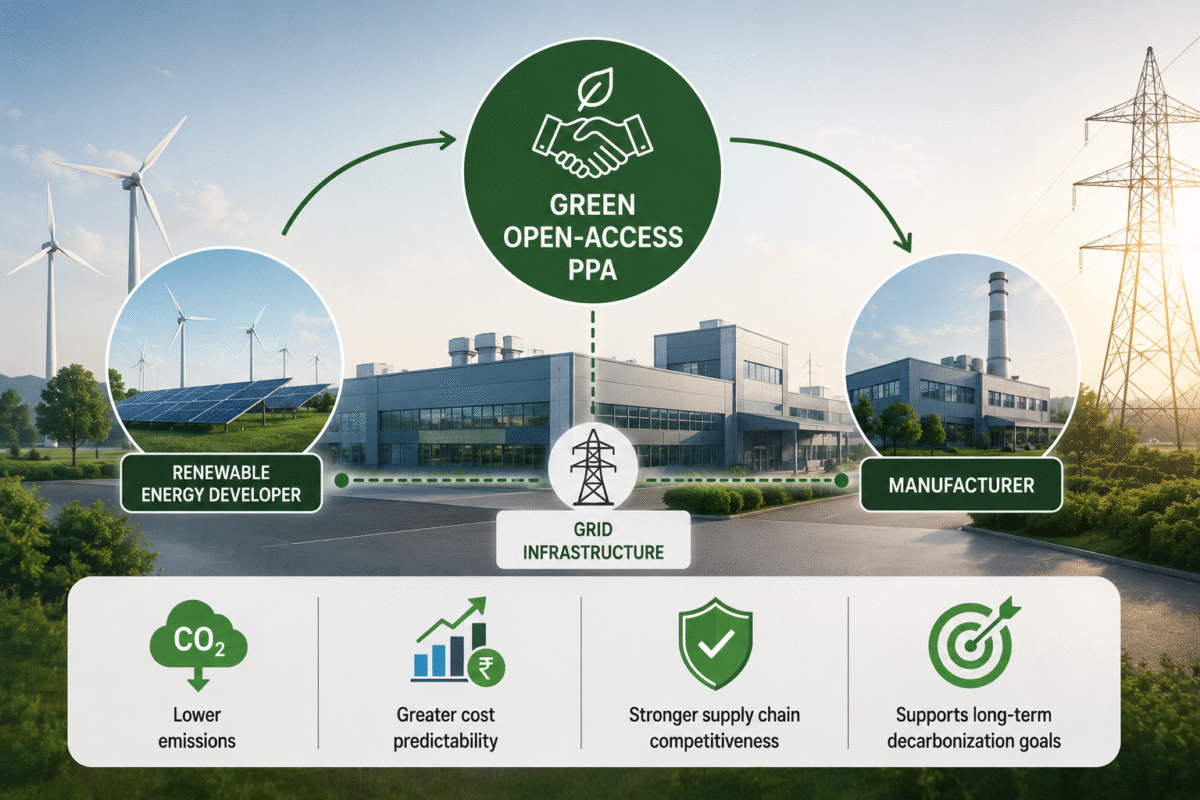
The Solution: To achieve meaningful, auditable decarbonization, forward-thinking industrial leaders are turning to a more powerful mechanism: Green Open-Access Power Purchase Agreements (PPAs).
Understanding the Mechanism: What is a Green Open-Access PPA?
At its core, a Green Open-Access PPA is a long-term contract between an industrial consumer and a renewable energy developer.
The Agreement: The developer builds, operates, and maintains a clean energy asset (such as a utility-scale solar or wind farm). The manufacturer commits to purchasing the electricity generated by this asset at a predetermined, fixed rate over an extended period, typically 10 to 25 years.
The “Open-Access” Framework: This regulatory framework allows bulk electricity consumers to bypass traditional, state-run utility monopolies and buy power directly from third-party renewable generators, using the existing grid infrastructure to transport that energy to their factories.

PPA Structural Comparison
Manufacturers can deploy these agreements using two primary structures depending on regional grid regulations:
|
Feature |
Physical (Sleeved) PPAs |
Virtual (Financial) PPAs |
|
Power Delivery |
The renewable energy is physically scheduled and delivered to your facility through the grid. |
No power is physically delivered. The agreement acts as a financial contract (a contract for differences). |
|
Financial Mechanism |
The manufacturer pays the developer for the power and pays the grid operator a wheeling or transmission fee. |
The renewable energy is sold into the wholesale market; financial returns and green attributes are credited to the manufacturer. |
|
Best Suited For |
Facilities operating within the same regional grid infrastructure as the renewable asset. |
Operational footprints spread across regions with fragmented regulatory frameworks. |

The Strategic Business Case: Beyond Just “Doing Good”
Investing in a Green Open-Access PPA is a sophisticated risk-management and cost – optimization strategy that delivers three core business advantages:
1. Long-Term Tariff Certainty and Cost Savings: Industrial electricity tariffs from traditional grids are notoriously volatile, subject to fuel price spikes and geopolitical instability. A PPA locks in a fixed levelized cost of electricity (LCOE) for up to two decades. By substituting unpredictable operational expenses with a predictable, flat-line energy cost, CFOs can achieve unprecedented budgetary
2. Radical Scope 2 Reduction and Regulatory Compliance: Because PPAs directly result in new renewable capacity being added to the grid — a concept known as additionality — the carbon reductions are highly credible. These agreements provide a bulletproof audit trail for ESG reporting under frameworks like the Greenhouse Gas (GHG) Protocol, helping companies comfortably stay ahead of strict carbon taxes and mandatory disclosure laws.
3. Strengthening Supply Chain Competitiveness: Global consumer brands and automotive giants are actively weeding out carbon-intensive suppliers to meet their own Scope 3 upstream targets. Manufacturers that proactively decarbonize their operations using PPAs transform their low-carbon operations into a competitive advantage, securing preferred supplier status and protecting core revenue streams.

Mitigating Risk: Navigating the Complexities
While the rewards are substantial, entering into a 15-year energy contract requires careful due diligence. Managing a PPA requires balancing three critical operational risks:
|
Risk Category |
The Challenge |
Mitigation Strategy |
|
Solar and wind generation fluctuates based on weather, leaving gaps during peak manufacturing hours. |
Implement Hybrid PPAs (combining wind and solar) or negotiate “firming” clauses where the developer or a utility covers the gaps with baseload power. |
|
Open-access charges, cross-subsidy surcharges, and wheeling fees can be altered by regional regulators overnight. |
Structure contracts with clear clauses that define which party absorbs regulatory cost changes, or focus on Virtual PPAs to bypass regional grid charges. |
|
If the developer goes bankrupt or experiences construction delays, your decarbonization timeline stalls. |
Partner exclusively with tier-1, well-capitalized developers and include strict performance guarantees and delay-liquidated damages in the contract. |

A Leadership Blueprint for Implementation
Transitioning to a green open-access model requires a coordinated approach across sustainability, finance, procurement, and legal teams.
1. Load Profiling and Goal Definition:
Phase 1: Analyze your multi-facility hourly load data to understand your baseline energy consumption. Define your appetite for risk and clarify your decarbonization timeline. Determine if you are aiming for a 50% reduction in Scope 2 emissions by 2030 or a 100% RE100 compliance goal.
2. Sourcing and Request for Proposal (RFP):
Phase 2: Issue a structured RFP to reputable renewable energy developers. Look beyond the lowest price. Evaluate developers based on their track record of project execution, financial health, grid-connection approvals, and the technological diversification of their portfolio.
3. Contract Structuring and Negotiation:
Phase 3: Work with specialized legal and energy advisors to draft the power purchase agreement. Ensure key clauses regarding take-or-pay structures, minimum guaranteed generation, curtailment rights, and the ownership transfer of environmental attributes are explicitly defined.
4. Accounting and Ongoing ESG Disclosure:
Phase 4: Set up robust data-tracking systems to monitor the hourly generation of the asset against your real-time consumption. Ensure your corporate carbon accounting team accurately logs the green attributes to showcase verifiable emissions reductions in annual sustainability reports.

Future-Proofing the Industrial Enterprise
The transition toward a decarbonized economy is accelerating. Waiting for national grids to naturally clean up their power mix is a passive strategy that exposes your business to rising carbon penalties and fluctuating energy market prices.
By utilizing Green Open-Access PPAs, manufacturing executives can take control of their energy sourcing. This strategy delivers reliable, long-term cost control while achieving verifiable reductions in Scope 2 emissions. True sustainability leadership lies in turning environmental necessity into a resilient financial strategy — ensuring your enterprise remains competitive, compliant, and profitable in a net-zero future.