Introduction
Industrial sustainability is transitioning rapidly from incremental operational efficiency to fundamental structural redesign. For decades, traditional batch processing served as the default manufacturing archetype across fine chemicals, pharmaceuticals, specialty materials, and food processing. While batch systems provided operational flexibility during eras of low energy costs and lenient environmental mandates, their inherent structural inefficiencies present significant obstacles in today’s low-carbon economy.
The transition to Continuous Manufacturing (CM) represents one of the most effective levers for Scope 1 and Scope 2 emissions reduction available to processing industries today. By replacing multi-step, start-stop batch cycles with streamlined continuous flows, industrial facilities can systematically eliminate structural thermal losses, drastically reduce raw material waste, and dramatically compress their physical plant footprint.
Key Operational Benchmarks
-
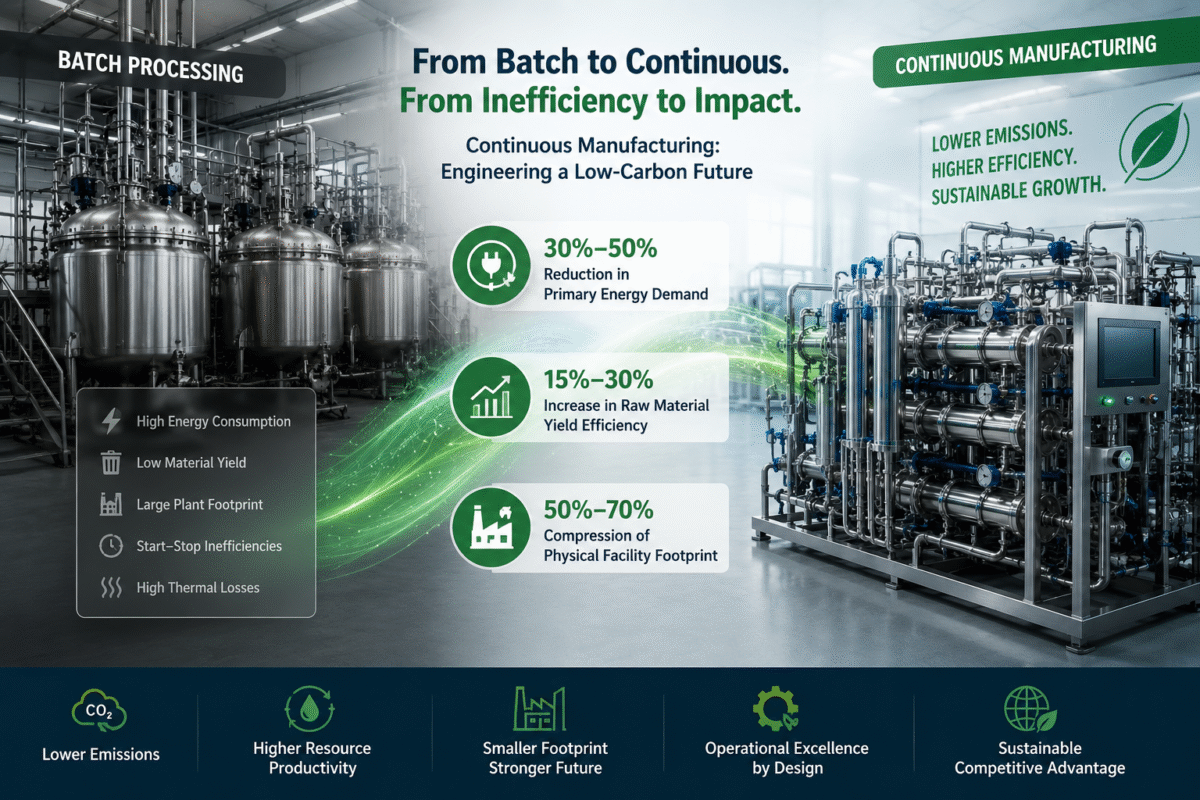
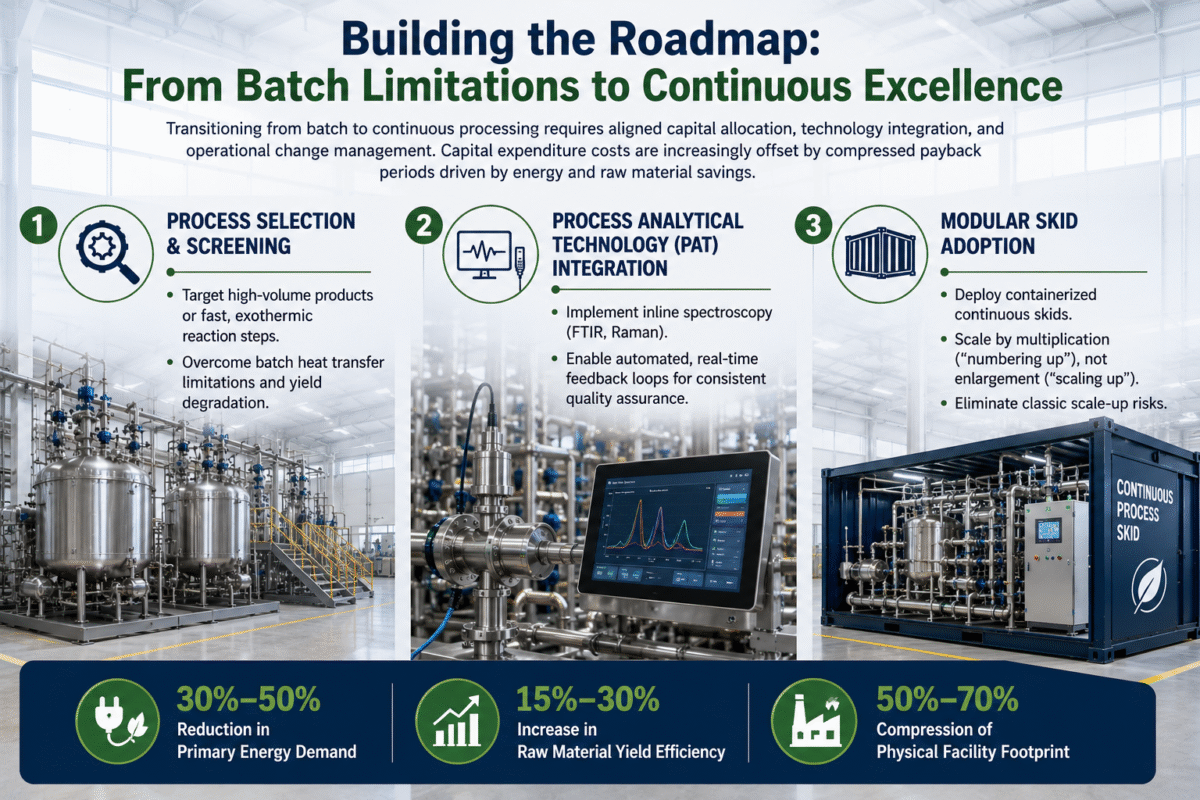
30%–50% Reduction in Primary Energy Demand
-
15%–30% Increase in Raw Material Yield Efficiency
-
50%–70% Compression of Physical Facility Footprint
Decarbonizing Energy: Eliminating Thermal and Mechanical Inefficiencies
Batch processing is intrinsically energy-intensive due to its cyclical thermal dynamics. In a traditional batch reactor, vessel mass, reactants, and solvents must be repeatedly heated to reaction temperatures, held for specific dwell times, and subsequently cooled down to quench reactions or allow safe discharging. This thermodynamic cycle incurs substantial energy losses through repeated sensible heat losses and idle thermal maintenance.
Continuous flow reactors and processing units reverse these dynamic losses through steady-state operation:
-
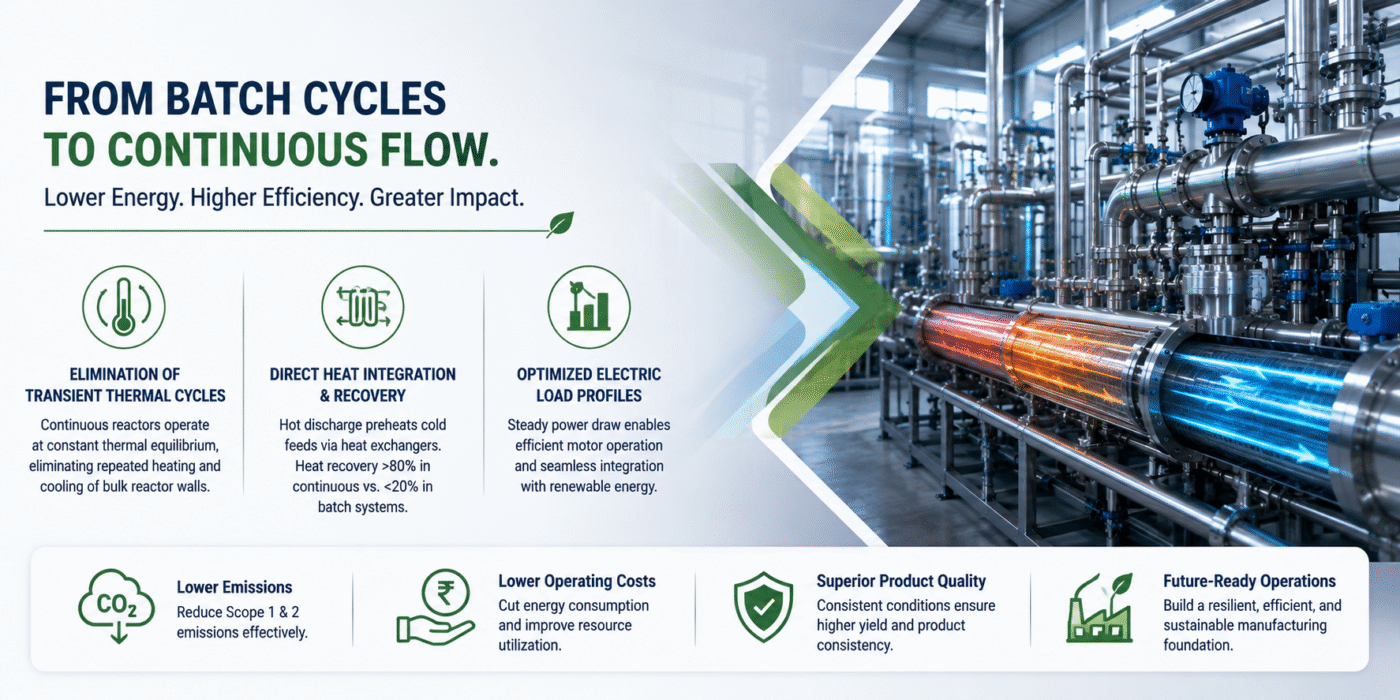
Elimination of Transient Thermal Cycles: Continuous reactors operate at constant thermal equilibrium. Energy is applied only to sustain the precise endothermic or exothermic requirements of the ongoing reaction, eliminating the massive auxiliary thermal loads required to heat and cool bulk reactor walls.
-
Direct Heat Integration & Recovery: Because continuous systems maintain constant inlet and outlet streams, hot discharge products can pass directly through microchannel or plate heat exchangers to preheat cold incoming feedstocks. Heat recovery efficiencies in continuous setups routinely exceed 80%, compared to under 20% in standard batch systems.
-
Optimized Electric Load Profiles: Pumping continuous fluid streams requires a steady, predictable power draw, allowing for highly efficient motor operation and direct integration with renewable power generation. Conversely, batch mixing, agitation, and rapid vacuum cycles create volatile peak-demand spikes that strain electrical distribution grids.
Material Conservation: Reducing Upstream and Downstream Embodied Carbon
Raw material efficiency is a primary driver of industrial decarbonization. Every kilogram of wasted reactant, solvent, or catalyst carries embedded Scope 3 emissions accumulated during its extraction, refining, and transportation. Furthermore, off-spec batch disposal requires high-emissions waste treatment and incineration.
Continuous manufacturing mitigates raw material waste through superior transport phenomena and real-time process control:
-
Enhanced Mass and Heat Transfer: Continuous reactors feature exceptionally high surface-area-to-volume ratios (often 1,000 to 10,000), compared to 1–10 in large batch stirred tanks). This facilitates near-instantaneous mixing and precise temperature control, suppressing side reactions and yield-degrading hot spots.
-
Elimination of Off-Spec Volumetric Waste: When a batch cycle fails quality specifications, the entire volume of the vessel—often tens of thousands of liters—must be scrapped. In continuous systems, Process Analytical Technology (PAT) monitors output quality in real time. Diverter valves isolate only the brief fraction of out-of-spec material during start-up or minor upsets, saving over 95% of material relative to a batch failure.
-
Solvent Minimization: Continuous crystallizations, extractions, and reactions frequently operate at higher concentrations or solvent-free conditions due to efficient heat removal, dropping solvent demand and associated distillation/recovery emissions by up to 40%.
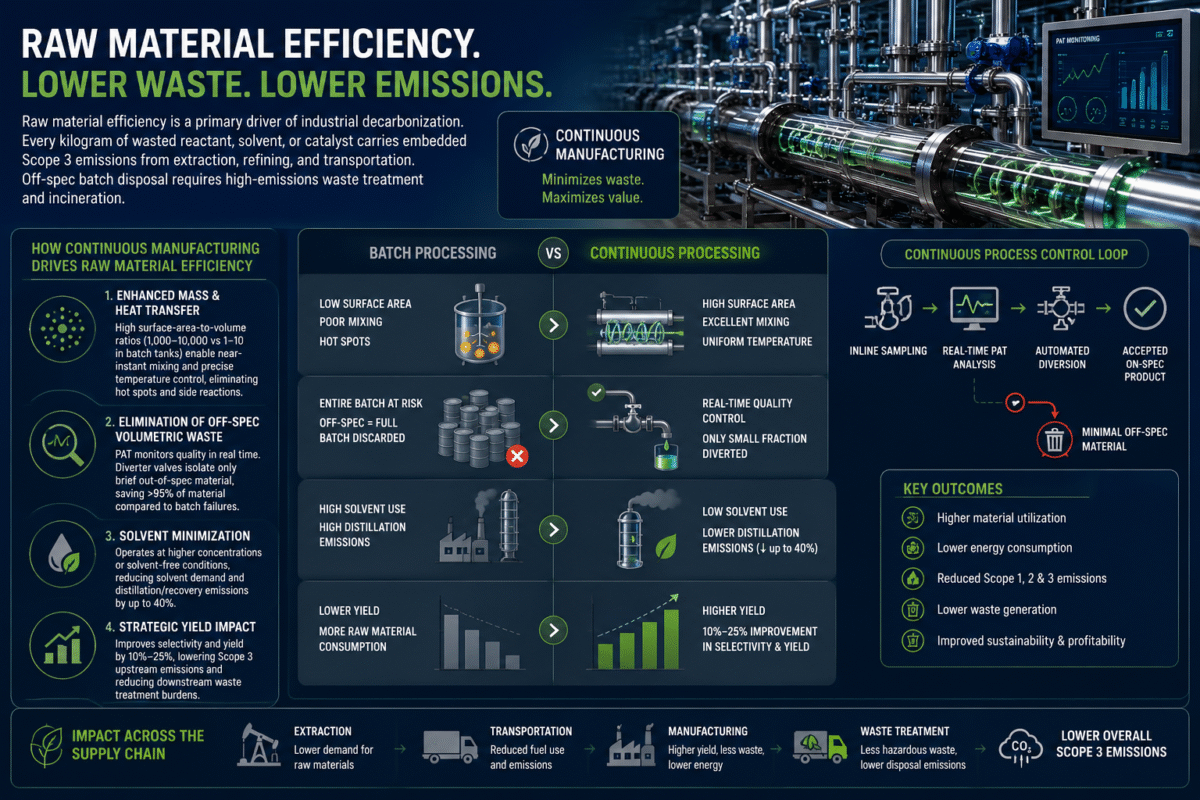
Strategic Yield Impact: By increasing reaction selectivity and yield by 10% to 25%, continuous manufacturing directly lowers Scope 3 upstream supply chain emissions while simultaneously scaling down downstream hazardous waste processing loads.
Facility Compression: Shrinking Built Footprints and Embedded Carbon
The carbon footprint of a manufacturing site extends beyond daily operations to include the initial embodied carbon of building materials—concrete, structural steel, and specialized cleanroom paneling. Traditional batch facilities require vast physical footprints to accommodate massive reaction vessels, intermediate storage holding tanks, and extensive cleaning suites.
|
Metric & Environmental Vector |
Traditional Batch Processing |
Continuous Flow Processing |
Decarbonization Impact |
|
Equipment Size & Volume |
Large vessels (1,000L – 20,000L+) with massive thermal inertia. |
Compact flow channels (Milliliters to tens of Liters capacity). |
Reduces capital equipment embodied steel and alloy emissions by 60%–80%. |
|
Cleanroom & HVAC Load |
Expansive floor spaces requiring heavy HVAC and air turnover. |
Enclosed, modular skid units occupying minimal cleanroom area. |
Drives a 40%–60% reduction in continuous HVAC electricity consumption. |
|
Intermediate Storage |
Requires large buffer tanks for holding off-line quality holds. |
Direct inline transfer; zero intermediate inventory required. |
Eliminates tank embodied carbon, floor space, and fugitive emissions. |
|
Cleaning Requirements (CIP/SIP) |
Repeated batch cleaning using tons of heated water and solvents. |
Campaign runs for weeks/months without shutdown; minimal CIP. |
Cuts water consumption and wastewater energy burdens by up to 80%. |
Implementation Challenges: Strategic Hurdles in Transitioning to CM
While the sustainability and operational efficiency benefits of CM are substantial, shifting from traditional batch operations introduces strategic and execution hurdles that demand careful risk management:
-
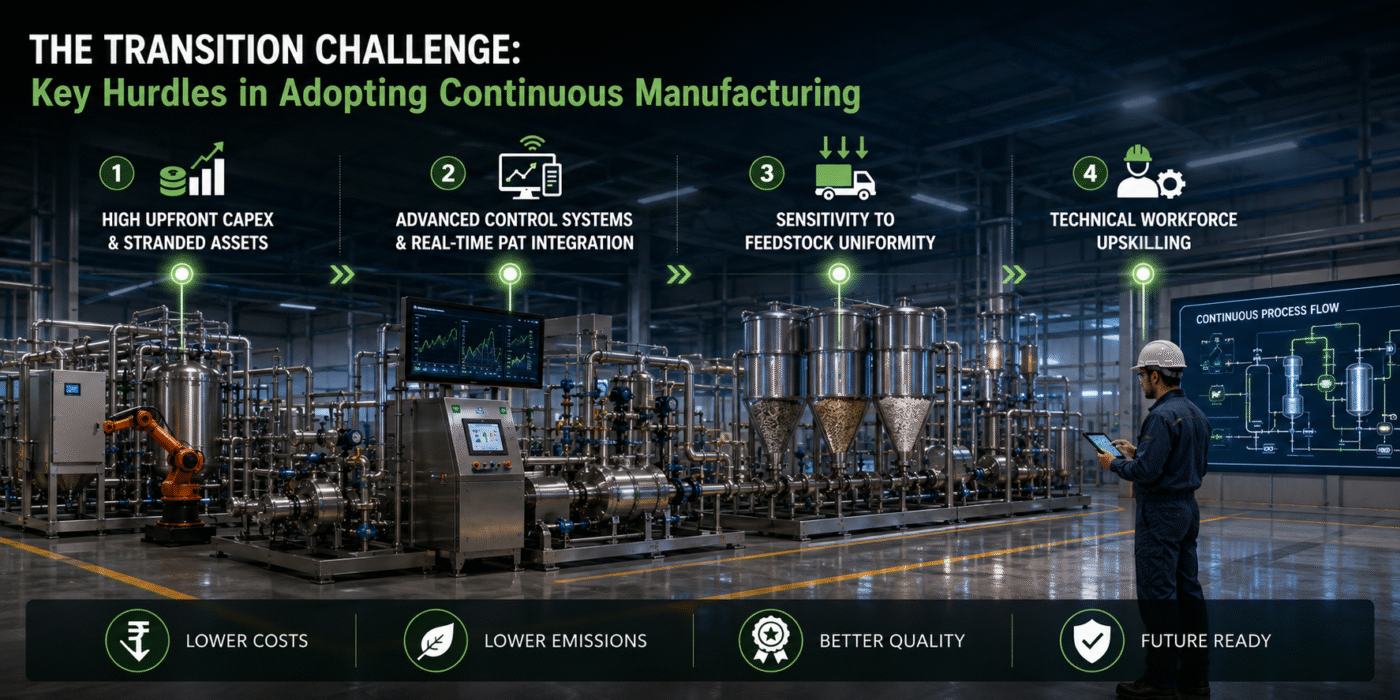
High Upfront Capital Expenditure (CapEx) & Stranded Assets: Transitioning requires capital outlay for continuous skids, PAT hardware, and micro-reactors. Additionally, writing off existing, fully amortized batch equipment can create financial friction on corporate balance sheets.
-
Advanced Control Systems & Real-Time PAT Integration: CM relies heavily on real-time Process Analytical Technology (PAT)—such as inline FTIR or Raman spectroscopy—and automated feedback control loops. Detecting and diverting out-of-spec material within seconds requires robust digital automation maturity.
-
Sensitivity to Feedstock Uniformity: In steady-state continuous flow, minor variations in incoming raw material quality (e.g., moisture levels or particle size) can disrupt the process down the entire line. This necessitates strict supplier quality standards and upstream supply chain coordination.
-
Technical Workforce Upskilling: Operating flow systems requires deep technical familiarity with fluid dynamics, heat exchange efficiency, and residence time distribution (RTD) rather than traditional batch mixing mechanics.
Operationalizing the Shift: Strategic Implementation Roadmap
Transitioning from batch to continuous processing requires aligned capital allocation, technology integration, and operational change management. Capital expenditure costs are increasingly offset by compressed payback periods driven by energy and raw material savings.
Organizations capitalizing on continuous processing follow a structured roadmap:
-
Process Selection & Screening: Target high-volume products or fast, exothermic reaction steps where batch heat transfer limits throughput or causes yield degradation.
-
Process Analytical Technology (PAT) Integration: Implement inline spectroscopy (FTIR, Raman) and automated real-time feedback loops to establish automated quality assurance.
-
Modular Skid Adoption: Deploy containerized continuous skids that allow rapid scaling by multiplication (“numbering up”) rather than physical enlargement (“scaling up”), eliminating classic scale-up risks.
Conclusion
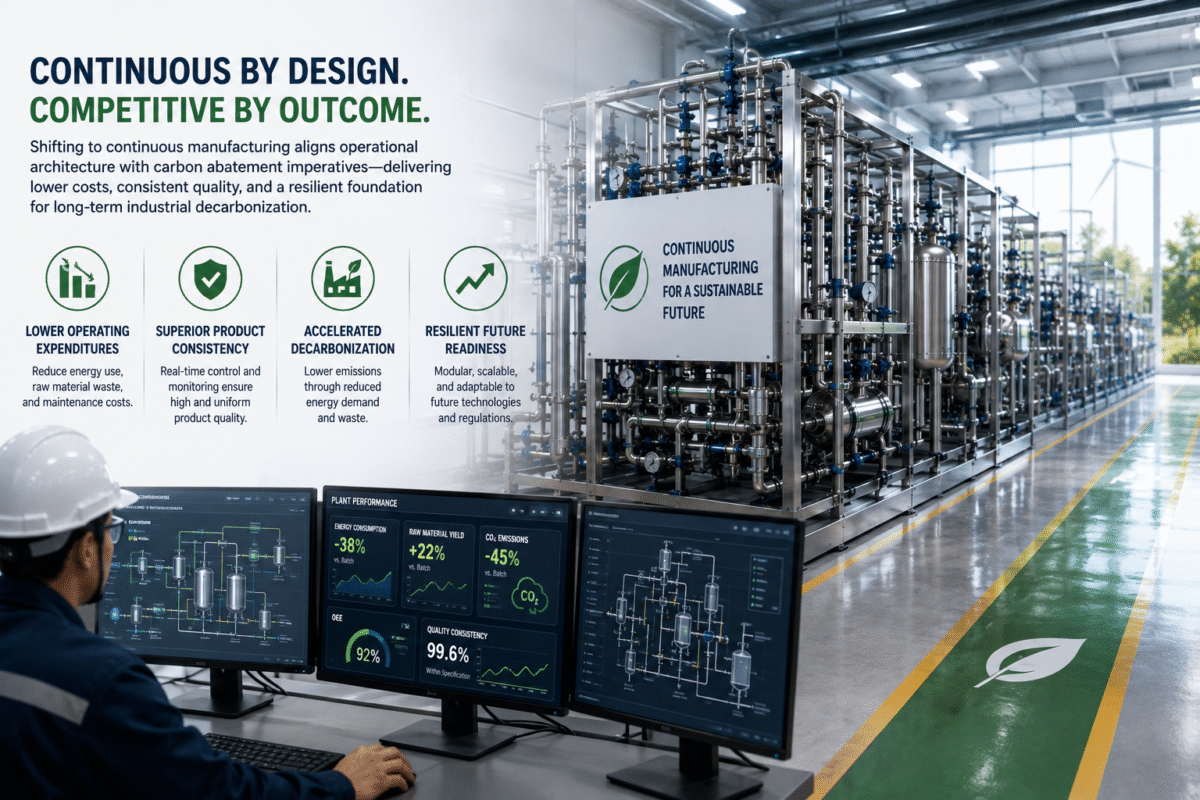
Ultimately, shifting to continuous manufacturing provides industrial enterprises with a structural competitive advantage. By aligning core operational architecture with carbon abatement imperatives, organizations achieve lower operating expenditures, superior product consistency, and a resilient foundation for long-term industrial decarbonization.