Introduction
Across the modern industrial landscape, compressed air is often referred to as the “fourth utility.” It is as vital to heavy production, precision machining, and automated assembly lines as electricity, water, or natural gas. Yet, from a thermodynamic standpoint, it is incredibly inefficient: approximately 80% to 90% of the electrical energy input to an air compressor is lost as waste heat.
For Industrial & Precision Manufacturing operations, the remaining 10% to 20% of useful kinetic energy is routinely squandered before it ever reaches a pneumatic tool, actuator, or end-effector. The culprit? High shop-floor baseloads driven by structural air leaks and poorly managed compressor configurations.
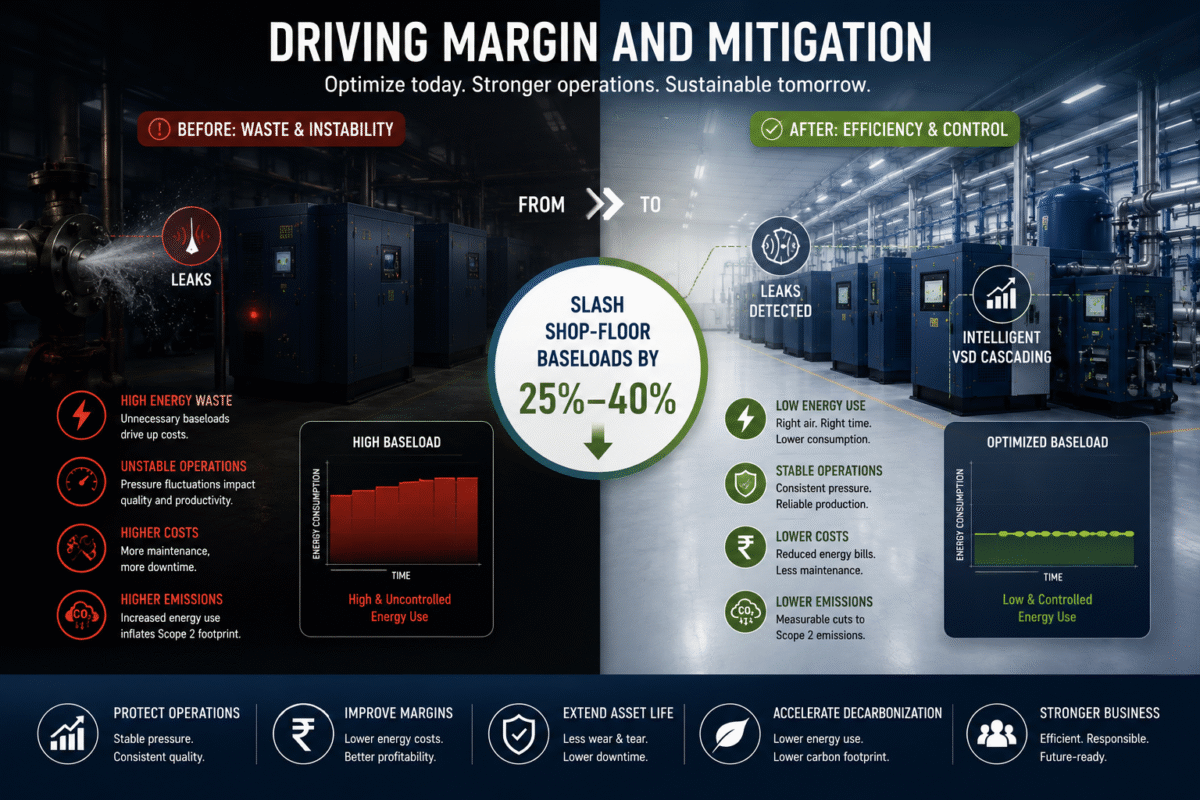
When a facility’s production lines are idle over a weekend, yet the compressor room runs at 30% to 40% capacity, profitability is bleeding into the atmosphere, and Scope 2 carbon emissions are needlessly inflating. Balancing operational resilience, margin preservation, and aggressive corporate decarbonization mandates requires tackling this hidden waste. It represents a high-yield, low-risk opportunity.
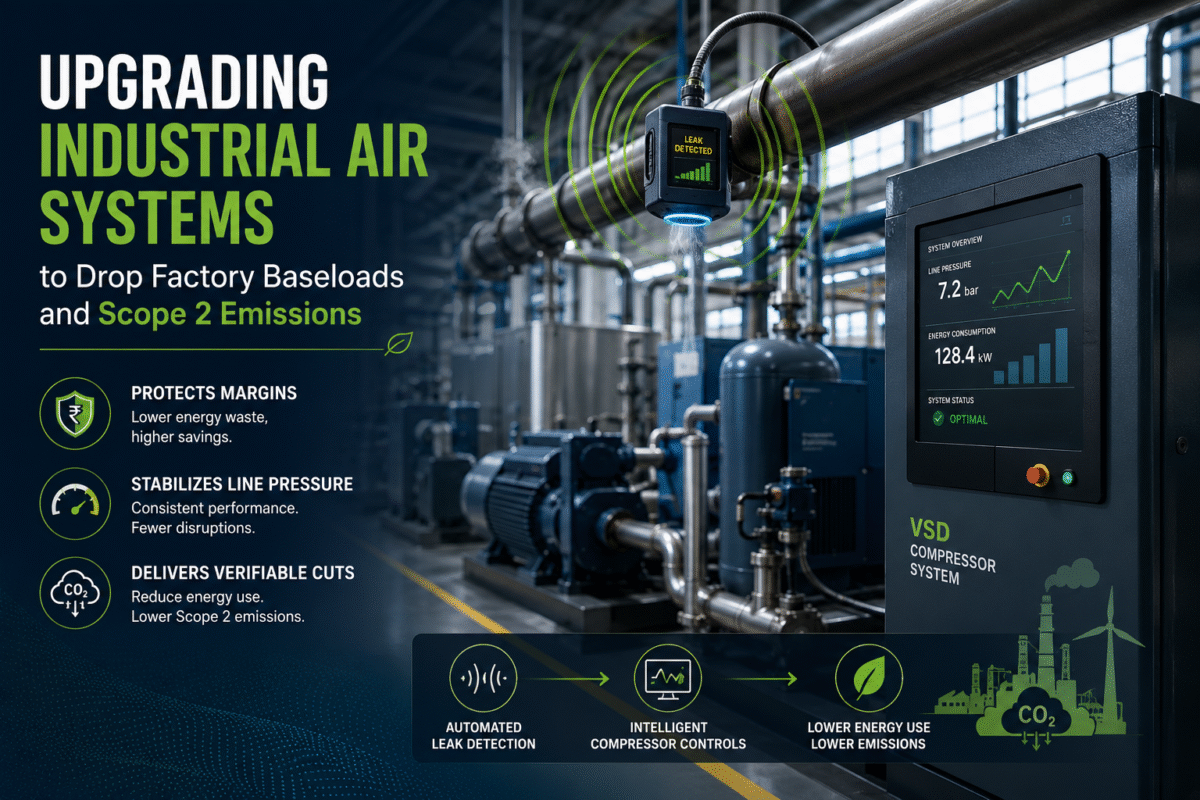
By pairing Automated Ultrasonic Leak Detection with Intelligent Variable Speed Drive (VSD) Compressor Cascading, facilities can execute a dual-pronged strategy that drastically drops shop-floor baseloads, boosts financial performance, and delivers quantifiable progress toward Net-Zero goals.
The Strategic Perspective: Operations, Finance, and Carbon
To appreciate the value of pneumatic optimization, the compressed air system must be evaluated across three core corporate pillars:
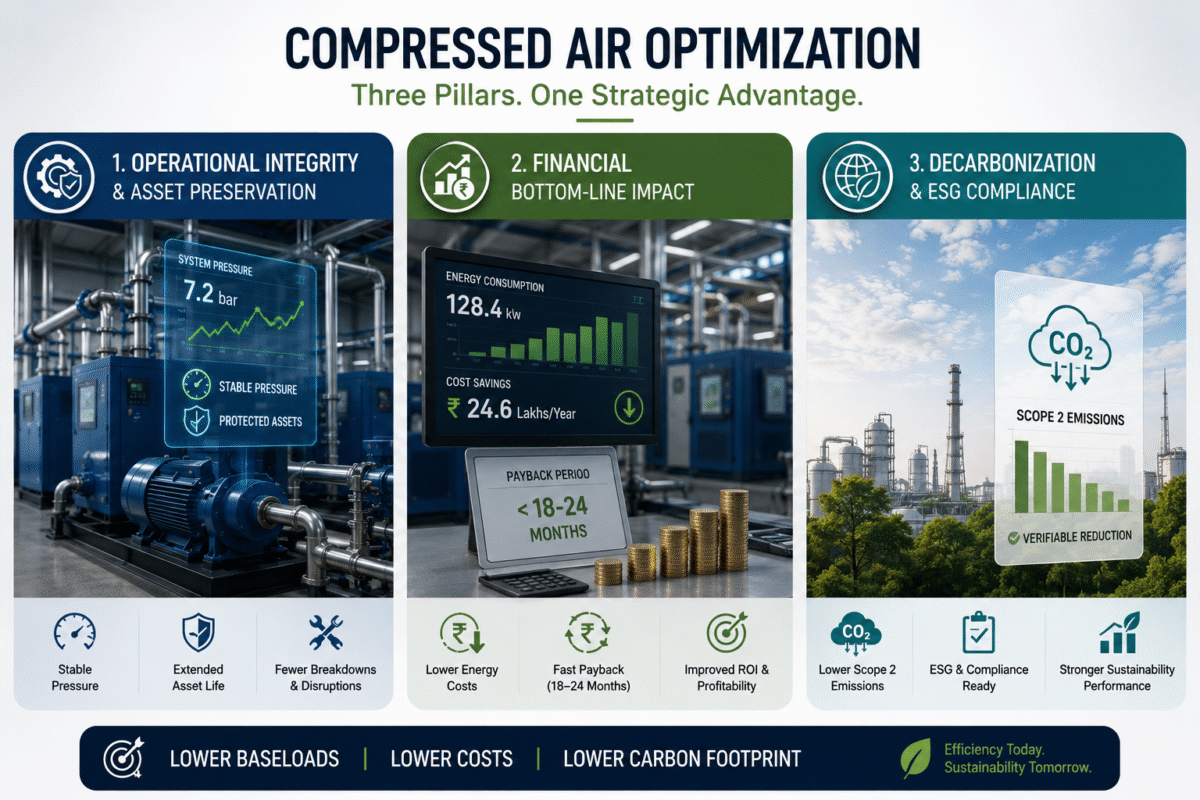
1. Operational Integrity and Capital Expense Preservation:
An unoptimized compressed air system forces equipment to run harder and cycle more frequently than necessary. This artificial demand accelerates mechanical wear, triggers premature component failure, and causes unpredictable line pressure drops that stall precision manufacturing lines. Minimizing the baseload stabilizes system pressure, extends the operational lifecycle of multi-million-dollar compressor assets, and defers hefty capital expenditures for equipment replacement.
2. Financial Bottom-Line Impact:
Compressed air can account for up to 10% to 30% of a manufacturing facility’s total electricity bill. Because a significant portion of this energy is consumed by “phantom loads” (leaks operating during non-production hours), eliminating this waste drops operating expenses immediately. These optimizations typically yield a payback period of less than 18 to 24 months, transforming the compressor room from a cost center into an efficiency driver.
3. Decarbonization and ESG Compliance:
As global supply chains demand stricter carbon accounting, reducing indirect (Scope 2) greenhouse gas emissions is a corporate imperative. Because industrial compressors are driven by heavy-duty electric motors, their carbon footprint is tied directly to the grid. Lowering the pneumatic baseload is one of the most direct, verifiable ways to slash megawatt-hours (MWh) and demonstrate immediate carbon reduction to stakeholders and ESG auditors.
Pillar 1: Automated Ultrasonic Leak Detection
The fastest way to curb pneumatic waste is to eliminate the artificial demand caused by structural air leaks.
-
The Science of Acoustic Imaging:
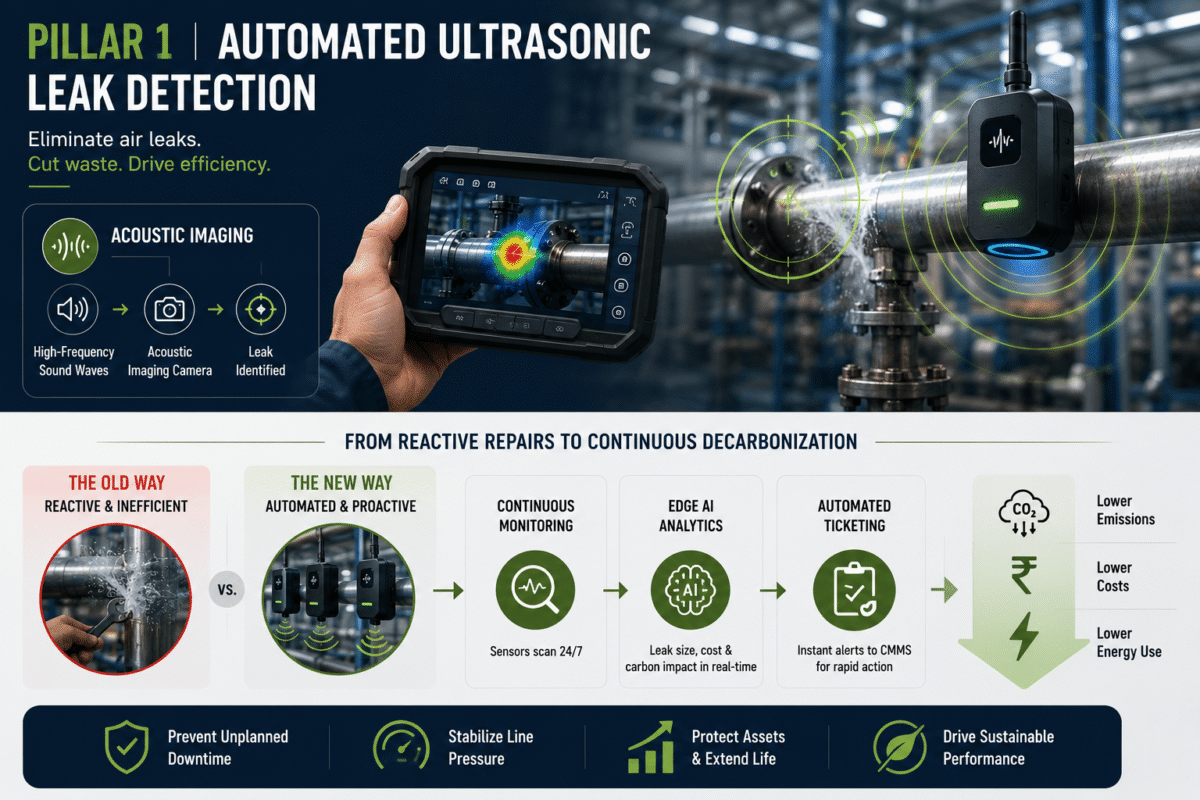
- When compressed air escapes a pressurized pipe into the lower-pressure ambient environment, it generates turbulent flow. This turbulence creates friction, producing high-frequency acoustic waves typically ranging between 20kHz and 100kHz. This range is well above the threshold of human hearing and distinct from the low-frequency background noise of stamping presses or CNC machines.
- Modern automated solutions utilize fixed or handheld acoustic imaging cameras equipped with an array of sensitive micro-electro-mechanical systems (MEMS) microphones. These devices overlay a visual “heat map” of the sound source directly onto a live video feed of the shop floor.
-
From Reactive Repairs to Continuous Decarbonization
Historically, locating these leaks required manual “soap-and-water” testing or acoustic sweeps during rare, scheduled plant shutdowns. By the time a technician patched a leak on one side of a facility, three new ones had formed on the other.
The cutting edge of precision manufacturing relies on fixed, automated acoustic sensors mounted near critical distribution manifolds and high-vibration machinery.
-
- Continuous Monitoring: These IoT-enabled sensors constantly scan the acoustic environment.
- Edge AI Analytics: Built-in algorithms analyze the decibel level and frequency spectrum to calculate the estimated leak volume, financial cost, and associated carbon footprint in real-time.
- Automated Ticketing: The moment a sensor detects a leak, it logs the location and severity into the facility’s Computerized Maintenance Management System (CMMS), dispatching a technician before the leak can inflate the weekend energy baseload.
Pillar 2: Intelligent VSD Compressor Cascading
Fixing the leaks cures the system’s “bleeding,” but optimizing how air is generated cures its structural inefficiency.
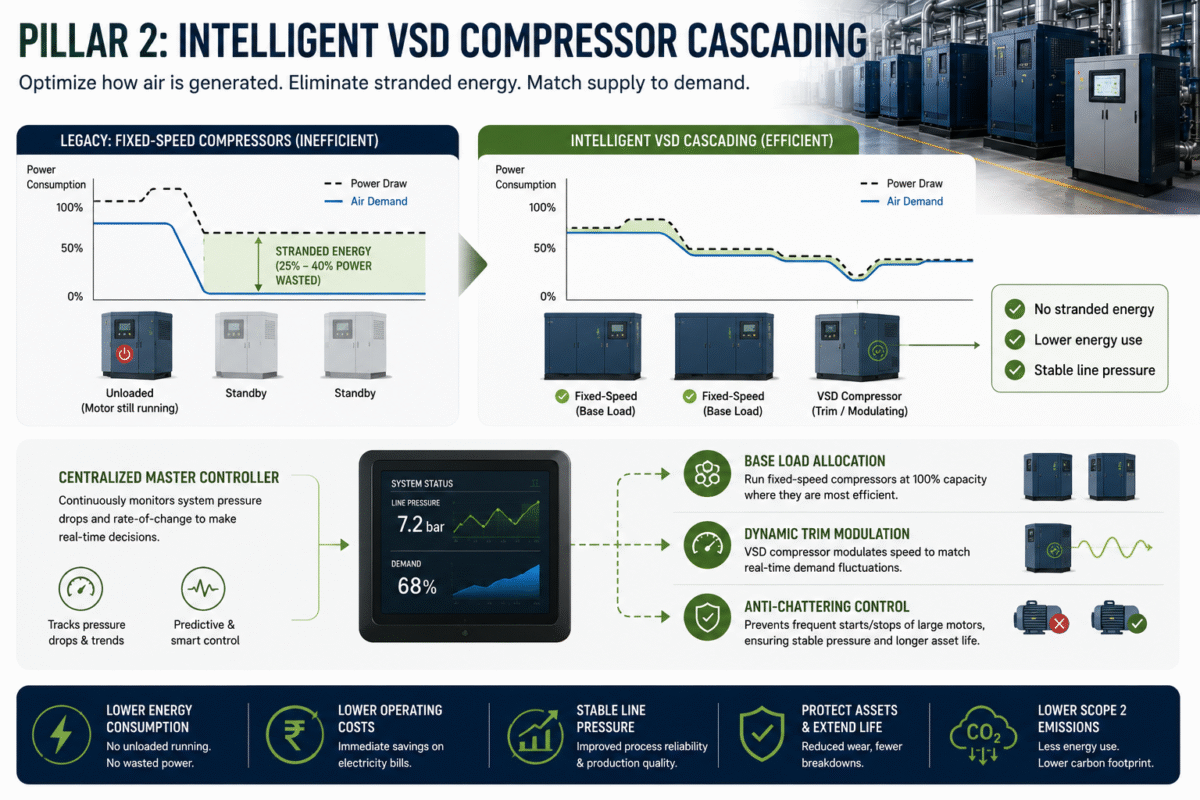
In legacy configurations, multiple fixed-speed (On/Off or Load/Unload) compressors run in parallel. When plant demand drops slightly, a fixed-speed compressor unloads—meaning it stops producing air but its motor continues to spin, consuming roughly 25% to 40% of its full-load power while delivering zero utility. This is the definition of stranded energy and unnecessary carbon emission.
Integrating Variable Speed Drive (VSD) compressors changes the equation. A VSD compressor utilizes an inverter to precisely adjust the motor’s rotational speed, matching its air output to the real-time demand of the plant. However, true efficiency requires Intelligent Cascading managed by a centralized master controller.
The master controller constantly tracks system pressure drops and rate-of-change metrics rather than relying on simple pressure bands, enforcing strict operational roles:
- Base Load Allocation: The controller runs highly efficient, fixed-speed compressors at 100% capacity, where they operate at peak thermodynamic efficiency.
- Dynamic Trim Modulation: A VSD compressor is designated as the “trim” unit, absorbing minor fluctuations by continuously ramping up or down.
- Anti-Chattering Control: Advanced algorithms prevent the rapid, wear-inducing starting and stopping of large motors, maintaining a highly stable line pressure.
The Compounding Operational Value
When automated ultrasonic leak detection and intelligent VSD cascading are combined, a powerful compounding efficiency loop occurs, optimizing operations, finance, and sustainability simultaneously.
The master controller constantly tracks system pressure drops and rate-of-change metrics rather than relying on simple pressure bands, enforcing strict operational roles:
- Protects System Pressure Stability: Ensures tight pressure control while avoiding unnecessary compressor activity.
- Minimizes Energy Consumption: Runs only the required capacity at the most efficient operating points.
- Reduces Operational Costs: Lowers energy bills, maintenance needs, and equipment wear.
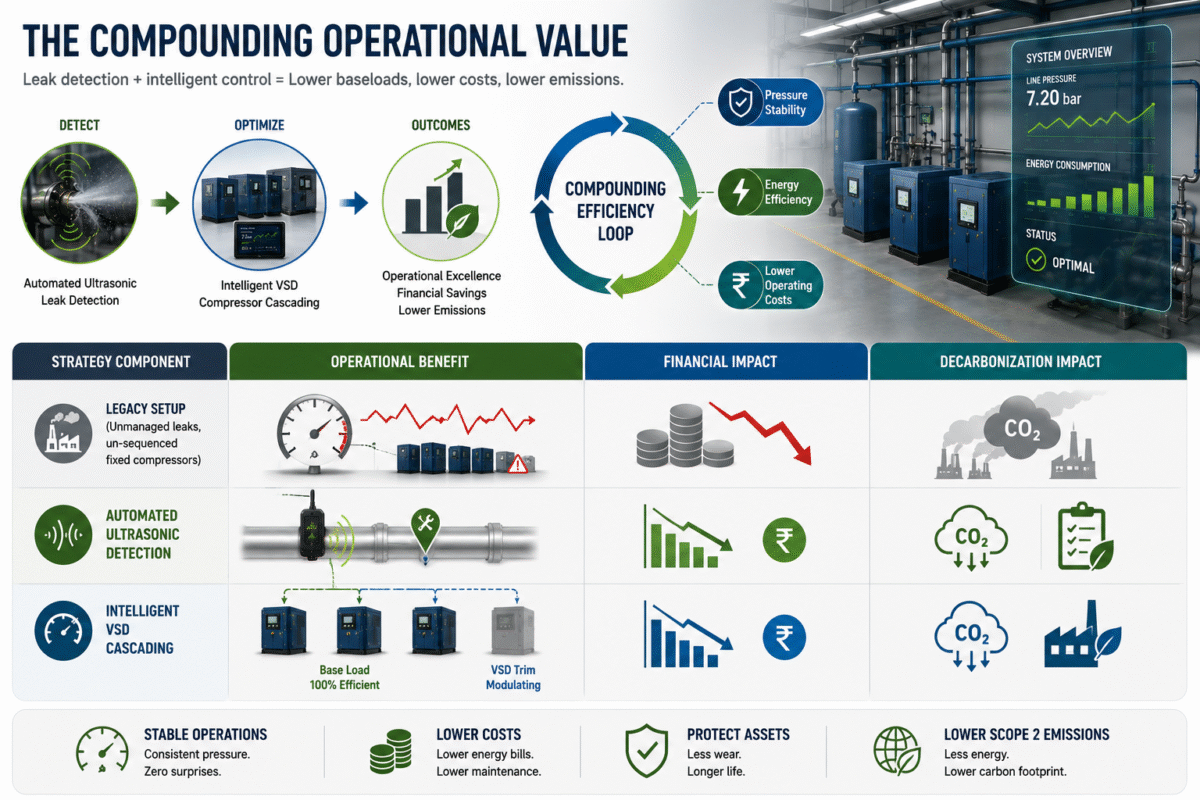
|
Strategy Component |
Operational Benefit |
Financial Impact |
Decarbonization Impact |
|
Legacy Setup (Unmanaged leaks, un-sequenced fixed compressors) |
High equipment wear; erratic line pressure drops affecting product quality. |
Severe energy waste; high overhead; short equipment lifecycles. |
Unnecessary grid reliance; inflated, unmitigated Scope 2 footprint. |
|
Automated Ultrasonic Detection |
Targeted, predictive maintenance; minimized unplanned downtime. |
Direct utility savings; reduces artificial air demand by up to 20% to 30%. |
Verifiable reduction in wasted MWh; automated carbon logging for ESG reporting. |
|
Intelligent VSD Cascading |
Maximizes motor health; stabilizes shop-floor pressure to within pm 0.01 MPa. |
Minimizes unloaded power consumption down to near-zero. |
Eliminates “idle” energy burn, aligning carbon output perfectly with production output. |
Conclusion: Driving Margin and Mitigation
Optimizing compressed air systems represents low-hanging fruit with high-yielding returns. It avoids the disruption of major manufacturing process overhauls while delivering immediate, measurable improvements.
By deploying automated ultrasonic leak detection to cut down artificial demand and utilizing intelligent VSD cascading to optimize supply, precision manufacturing operations can slash shop-floor baseloads by 25% to 40%. In doing so, the plant’s operational stability is protected, the corporate bottom line directly improves, and a measurable, highly visible step forward is taken on the roadmap toward decarbonization.