The Background
For heavy manufacturing sectors like forging and casting, industrial decarbonization is no longer merely a compliance obligation—it is a core determinant of long-term margin resilience and competitive position. As global supply chains face mounting climate regulations, rising carbon taxation, and heightened scrutiny over environmental, social, and governance (ESG) performance, plant-level operational efficiency directly impacts enterprise valuation.
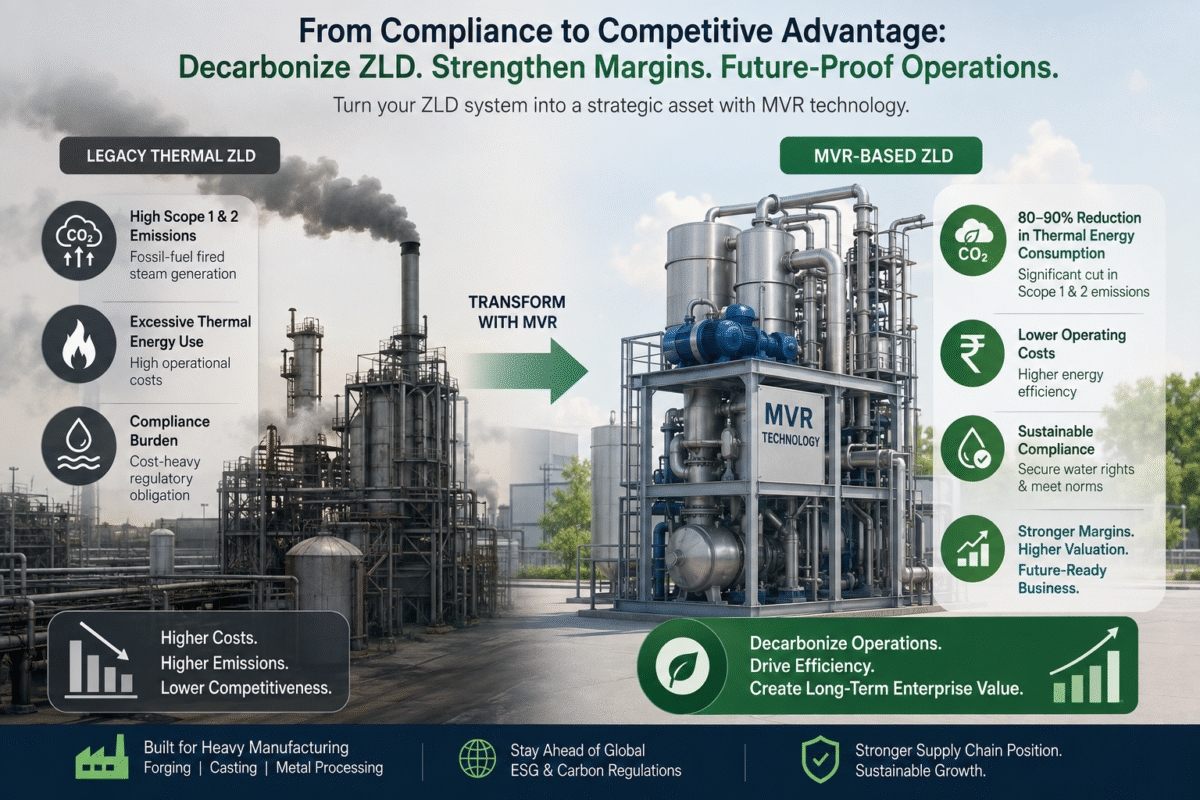
Zero Liquid Discharge (ZLD) systems have long been essential for meeting stringent environmental discharge norms and securing local water rights. However, traditional thermal ZLD architectures present a critical strategic bottleneck: excessive Scope 1 direct emissions and elevated Scope 2 indirect carbon footprints driven by fossil-fuel-fired steam generation.
Replacing legacy thermal evaporators with Mechanical Vapour Recompression (MVR) technology transforms ZLD from a cost-heavy regulatory burden into an asset for operational decarbonization, delivering up to an 80–90% reduction in thermal energy consumption and a compelling return on investment (ROI).
The Strategic Bottleneck: Thermal Intensity in Heavy Manufacturing
Forging and casting facilities consume substantial volumes of water across core operational zones, including cooling circuits, quench tanks, surface conditioning, and equipment washing. The resulting industrial effluent carries a complex mix of suspended solids, emulsified oils, residual lubricants, and heavy chemical compounds.
To comply with Zero Liquid Discharge mandates, facilities route this effluent through multi-stage treatment trains. While physical pre-treatment and Reverse Osmosis (RO) recover the initial 70–80% of clean water, the final concentration and crystallization phases require thermal evaporation to convert the remaining high-TDS (Total Dissolved Solids) brine into clean condensate and dry salt cake.
In conventional setups, thermal evaporation relies on Multi-Effect Evaporators (MEE) powered by coal, gas, or furnace-oil boilers. This creates three distinct organizational challenges:
- High Variable Cost Structure: Continuous boiler operation ties plant OPEX directly to volatile fuel prices.
- Carbon Intensity: Thermal evaporation accounts for up to 60–70% of total ZLD energy consumption, inflating Scope 1 emissions from onsite boilers or Scope 2 emissions from grid-powered steam boilers.
- Regulatory Exposure: Impending carbon accounting metrics (such as the Carbon Border Adjustment Mechanism and national carbon markets) penalize high thermal intensity across exported industrial goods.
Architectural Comparison: MEE vs. MVR Evaporation
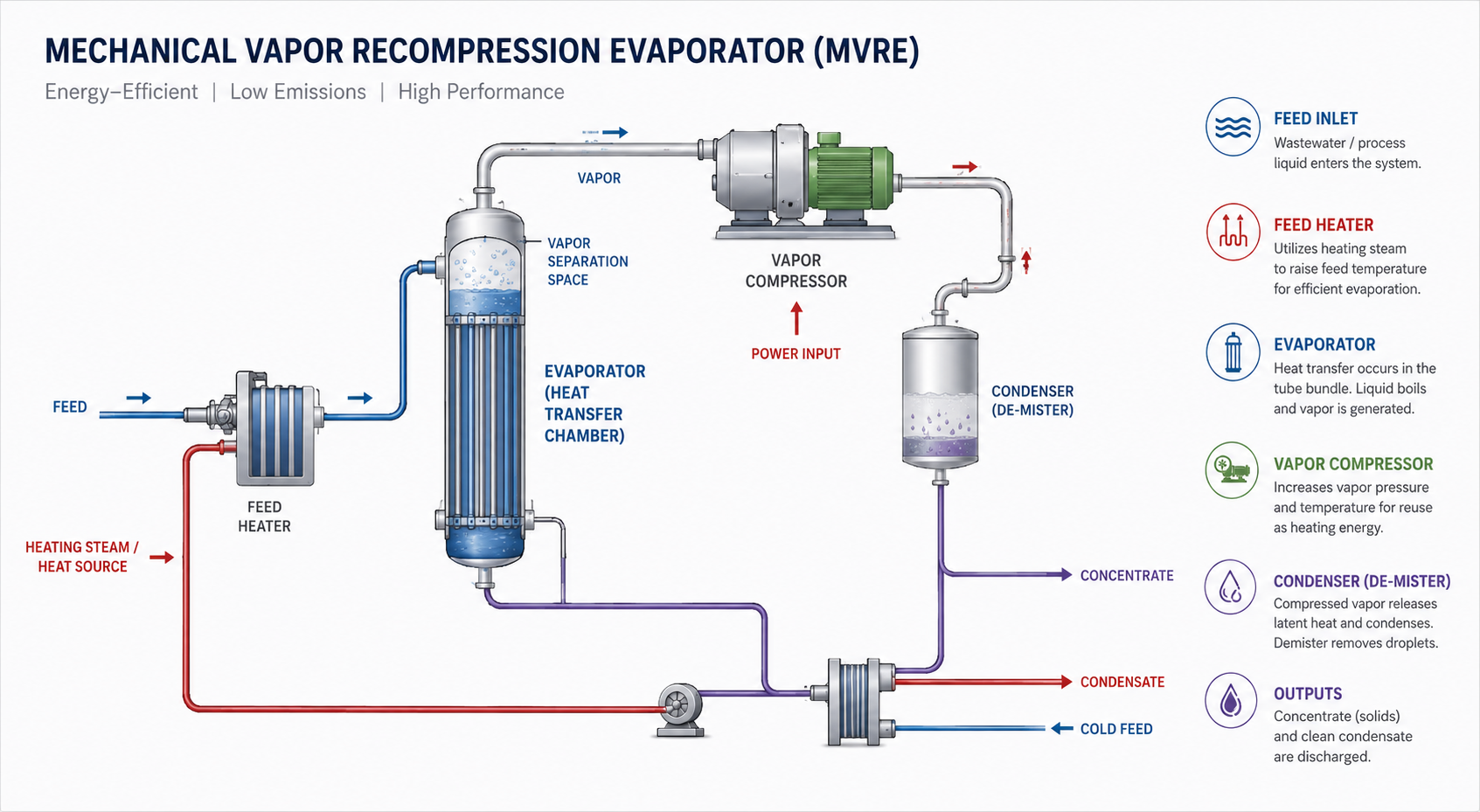
Upgrading to Mechanical Vapour Recompression fundamentally alters the energy economics of industrial wastewater recovery. Rather than generating fresh low-pressure steam continuously, MVR utilizes electrical energy to recompress latent heat already present within the process vapour.
|
Performance Indicator |
Conventional Multi-Effect Evaporator (MEE) |
Mechanical Vapour Recompression (MVR) |
Strategic Advantage |
|
Primary Energy Source |
Thermal (Steam from coal, gas, or oil boiler) |
Electrical (Mechanical compressor powered by grid/renewables) |
Enables 100% electrification and integration with onsite solar/green power. |
|
Specific Energy Consumption |
300-650 kWh equivalent / m3 evaporated |
20 – 45 kWh / m3 evaporated |
80–90% reduction in primary thermal energy demand. |
|
Steam Requirement |
Continuous external steam feed (0.25 – 0.4 t/m3) |
Minimal (Start-up steam only) |
Eliminates continuous boiler load and associated fuel logistics. |
|
Cooling Tower Duty |
High (Requires massive condenser cooling water loop) |
Near Zero (Process vapour condenses against incoming feed) |
Saves auxiliary power and water losses from cooling tower evaporation. |
|
Carbon Footprint |
High Scope 1 / Scope 2 thermal footprint |
Low Scope 2 (Zero Scope 1, scalable to Net-Zero via green power PPA) |
Directly aligns with corporate science-based targets (SBTi). |
|
Payback Period |
Baseline reference |
Typically 18 to 36 months based on local fuel costs |
High internal rate of return (IRR) on capital expenditure. |
Process Mechanics: How MVR Achieves Thermal Efficiency
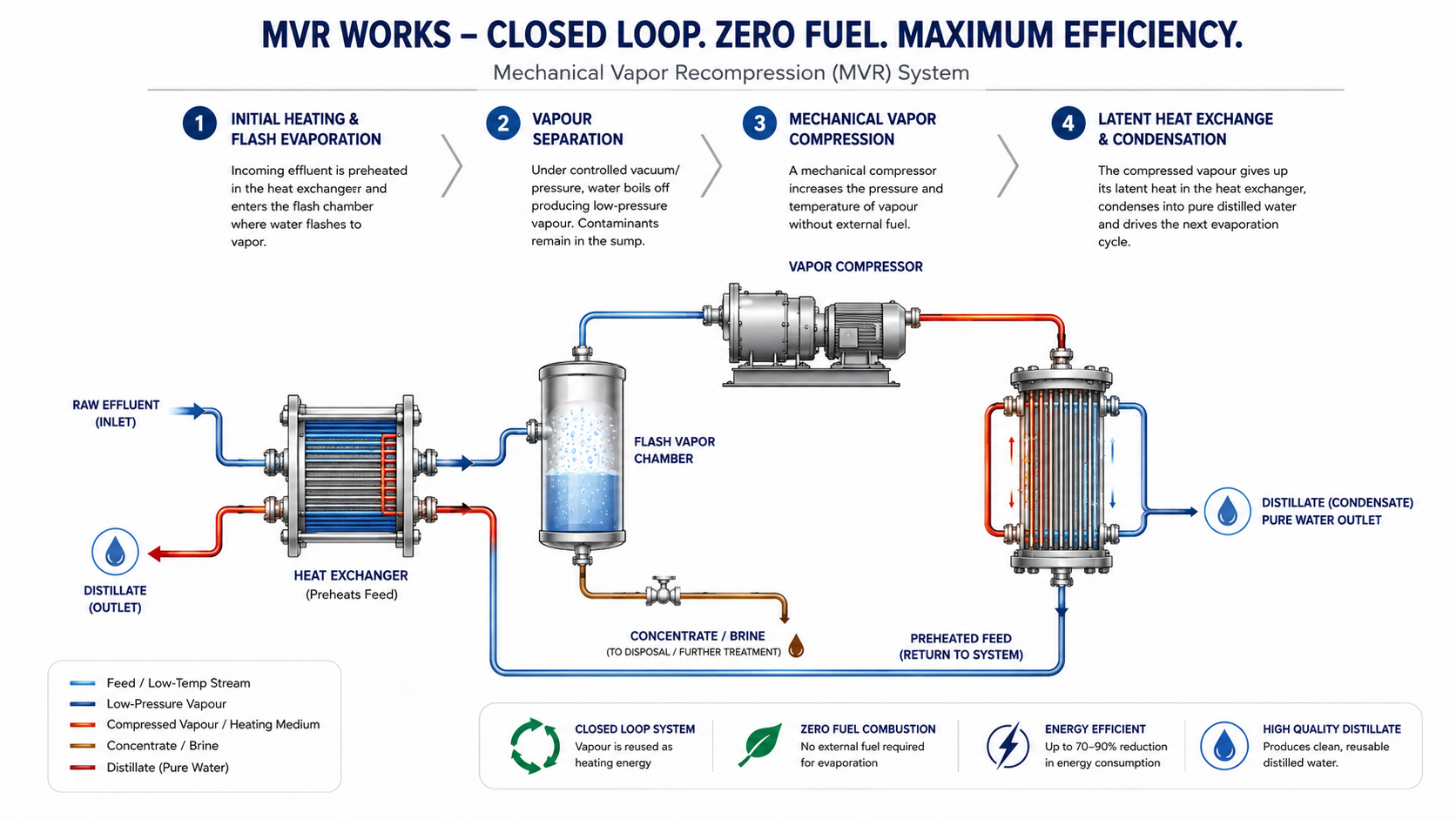
MVR operates on a closed-loop thermodynamic principle where process vapour generated during evaporation is compressed, elevated in enthalpy, and recycled as the primary heating medium.
- Initial Effluent Heating & Flash Evaporation: Phase 1.
Pre-treated forging/casting wastewater enters the main heat exchanger. Sensible heat from outgoing distillate preheats incoming feed before entering the flash vapor chamber.
2. Vapour Separation: Phase 2.
Under controlled vacuum/pressure conditions, water boils off, producing low-pressure process vapour while concentrated heavy contaminants remain at the sumps.
3. Mechanical Vapor Compression: Phase 3.
A high-efficiency mechanical fan or roots compressor compresses the low-pressure vapour. Compression increases both the temperature and saturation pressure of the vapour without requiring external fuel inputs.
4. Latent Heat Exchange & Condensation: Phase 4.
The superheated, compressed vapour is routed back into the shell side of the heat exchanger. It surrenders its latent heat to the raw incoming effluent, condensing into pure distilled water while driving the next evaporation cycle.
Decarbonization and Business Impact Matrix
Transitioning to MVR technology generates measurable performance gains across strategic, financial, and environmental metrics:
1. Capital Expenditure vs. Operating Expenditure Optimization
While MVR systems carry a higher upfront equipment cost than basic MEE units, the OPEX differentials alter lifecycle financial metrics. By shifting from thermal energy (steam) to electrical energy, facilities decouple wastewater treatment from fossil fuel markets. When paired with corporate Power Purchase Agreements (PPAs) or rooftop solar arrays, the marginal cost per cubic meter of treated water drops sharply.
2. Direct Scope 1 & Scope 2 Abatement
-
Scope 1 Mitigation: Eliminates boiler fuel burn dedicated to wastewater treatment, directly reducing onsite CO2, SOx, and NOx stack emissions.
-
Scope 2 Optimization: Lowering total energy inputs dramatically reduces indirect grid emissions per ton of finished forging or casting output.
3. Supply Chain & Regulatory Resilience
As tier-1 automotive, aerospace, and industrial OEMs mandate audited carbon footprints across their supplier base, demonstrated energy intensity reductions safeguard enterprise order pipelines and qualify facilities for green supply chain preferences.
Implementation Pathway & Risk Management
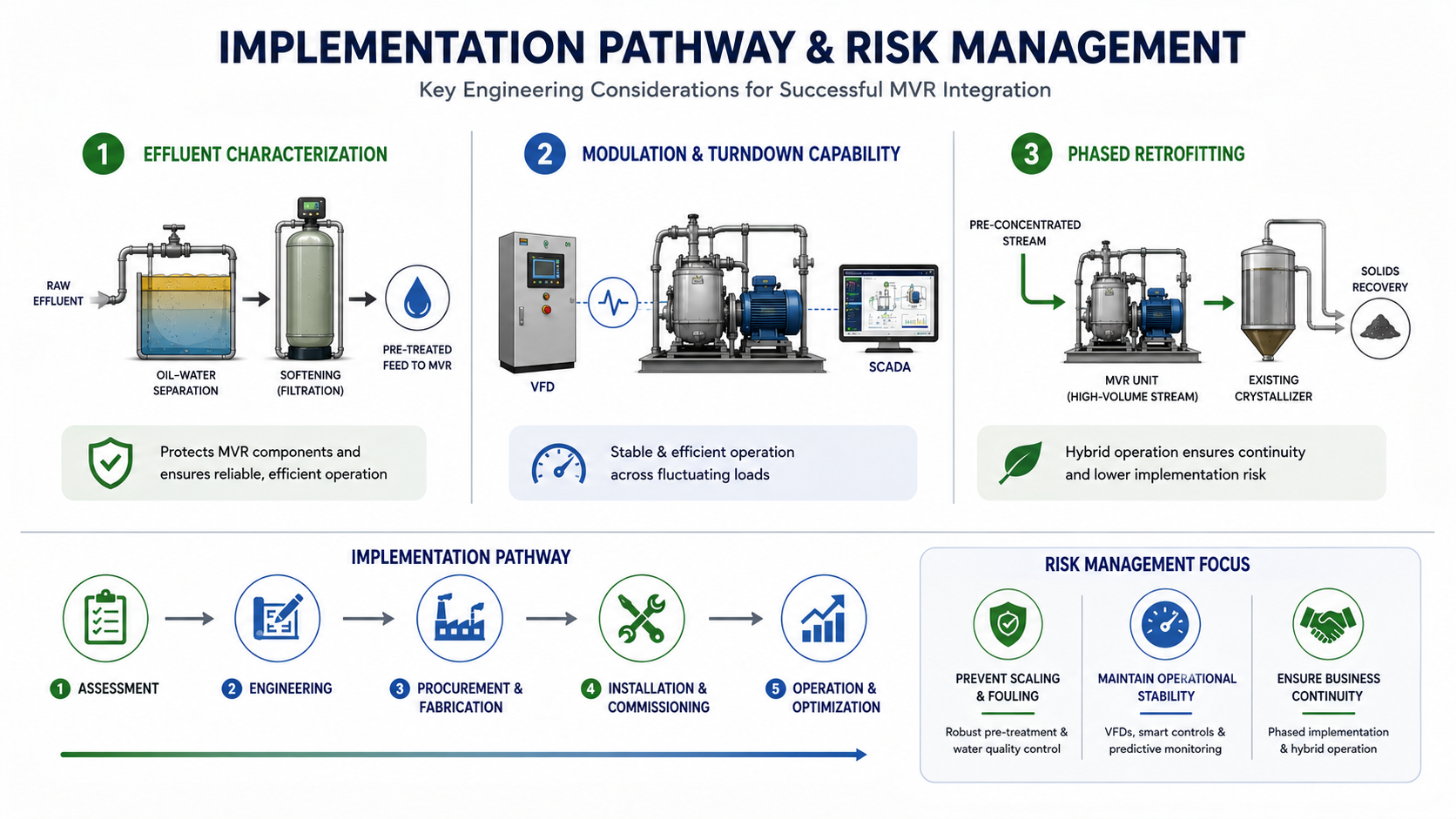
Successfully integrating MVR technology into an existing forging or casting plant requires addressing key engineering considerations during the planning phase:
-
Effluent Characterization: Heavy metals, tramp oils, and scaling agents common in metallurgy effluent must be addressed via effective pre-treatment (oil-water separation and softening) to prevent fouling of high-efficiency compressor impellers and heat exchanger tubes.
-
Modulation & Turndown Capability: Variable production volumes in job-shop foundries require MVR systems equipped with Variable Frequency Drives (VFDs) and smart supervisory control (SCADA) to maintain stable operation across fluctuating loads.
-
Phased Retrofitting: Modular MVR designs allow facilities to run hybrid setups during transition periods, routing high-volume pre-concentrated streams through MVR while utilizing existing crystallization assets for final solids recovery.
Strategic Outlook
Upgrading ZLD infrastructure to Mechanical Vapour Recompression bridges the gap between environmental compliance and fiscal performance. For executive leadership in forging and casting industries, MVR deployment yields immediate operational cost reductions, insulates against future carbon pricing structures, and provides a clear, verifiable pathway toward industrial net-zero manufacturing.