
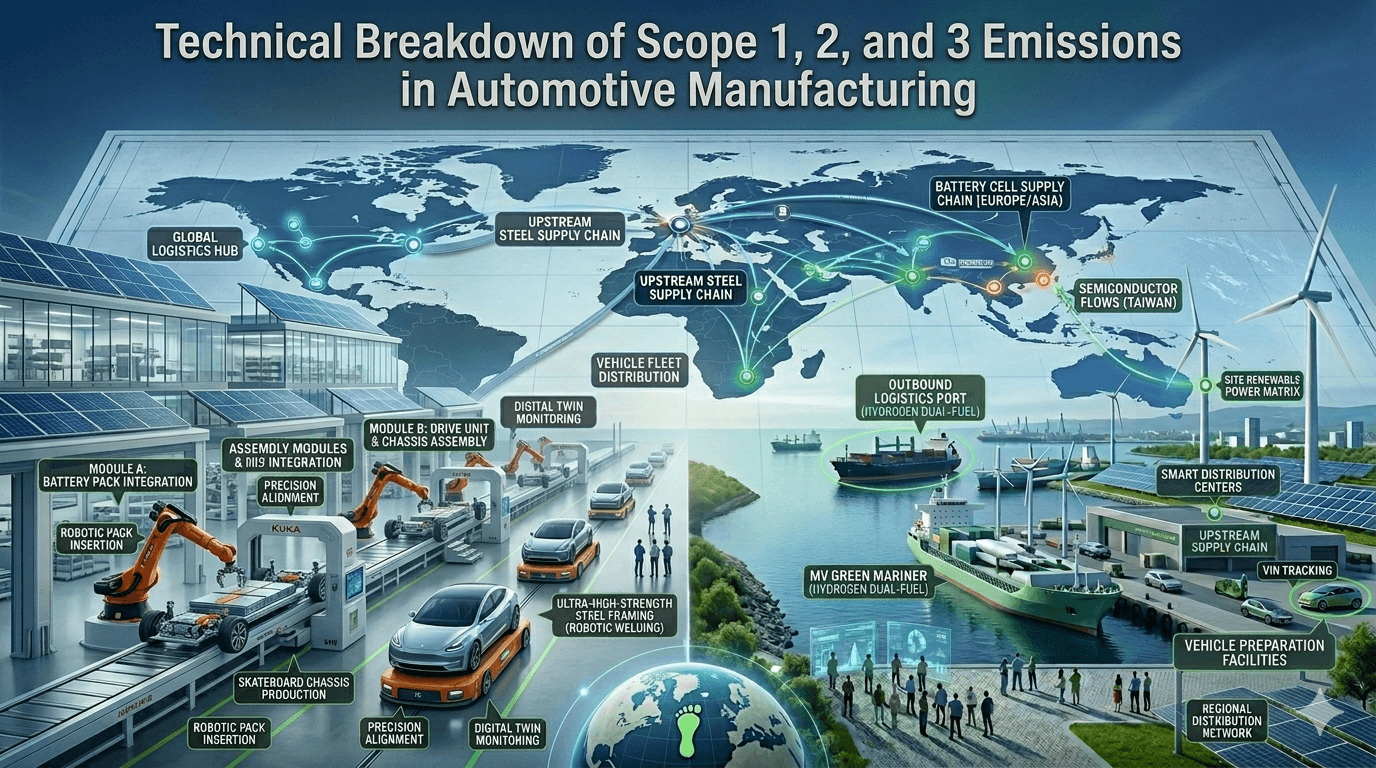
Where Does an Auto Component Manufacturer’s Carbon Footprint Come From?
For decades, the automotive industry measured success by horsepower, torque, efficiency, and line speed. Today, there is a new metric dominating the boardroom: carbon footprint.
With global regulations tightening, compliance frameworks like BRSR becoming mandatory, and international mechanisms like CBAM penalizing high-carbon imports, understanding your emissions is no longer just an environmental initiative—it is a core business requirement.
To effectively manage and reduce your carbon footprint, you first need to know exactly where it is generated. Moving past high-level generalities, a rigorous carbon accounting audit requires mapping precise operational activities to specific GHG Protocol categories. Emissions are globally categorized into three distinct buckets: Scope 1, Scope 2, and Scope 3.
Let’s break down the granular, technical breakdown of exactly what falls under these scopes within an automotive manufacturing or component supplier environment.
1. Scope 1: Direct Operational Emissions
These are emissions generated directly from assets owned or operationally controlled by your company. Tracking Scope 1 requires collecting actual fuel volumes, gas consumption data, and chemical refill logs.
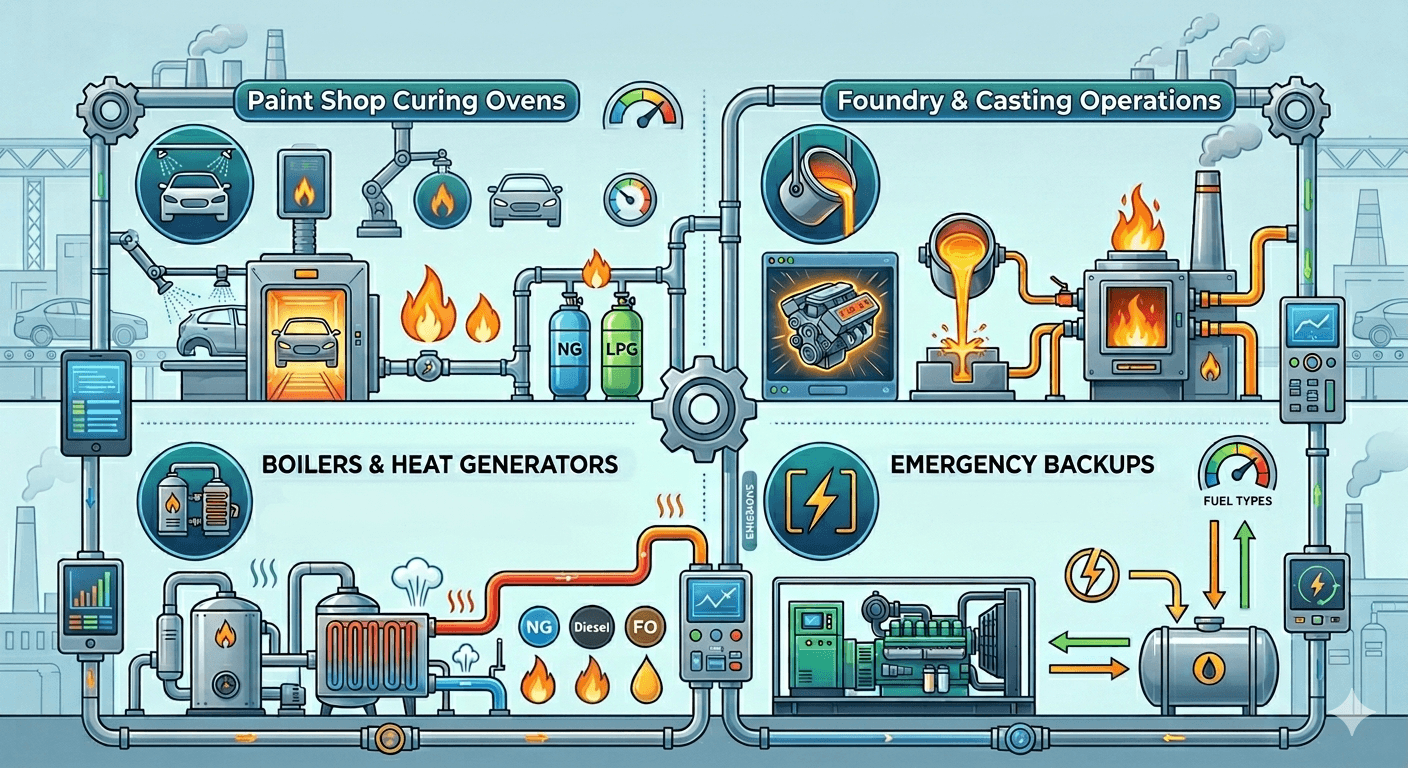
Stationary Combustion (Plant Utilities & Process Heat):
-
Paint Shop Curing Ovens: Natural gas or LPG consumed in high-temperature ovens to cure basecoats, clearcoats, and electrodeposition (ED) primers. The paint shop is traditionally the most energy-intensive part of an automotive assembly line.
-
Foundry & Casting Operations: Fuel used in melting furnaces (aluminum, iron) and core-making machines.
-
Boilers & Heat Generators: Natural gas, diesel, or FO (Furnace Oil) burned to generate steam or hot water for phosphating lines and plant heating.
-
Emergency Backups: Diesel consumed by backup generator sets (DG sets) during power outages.
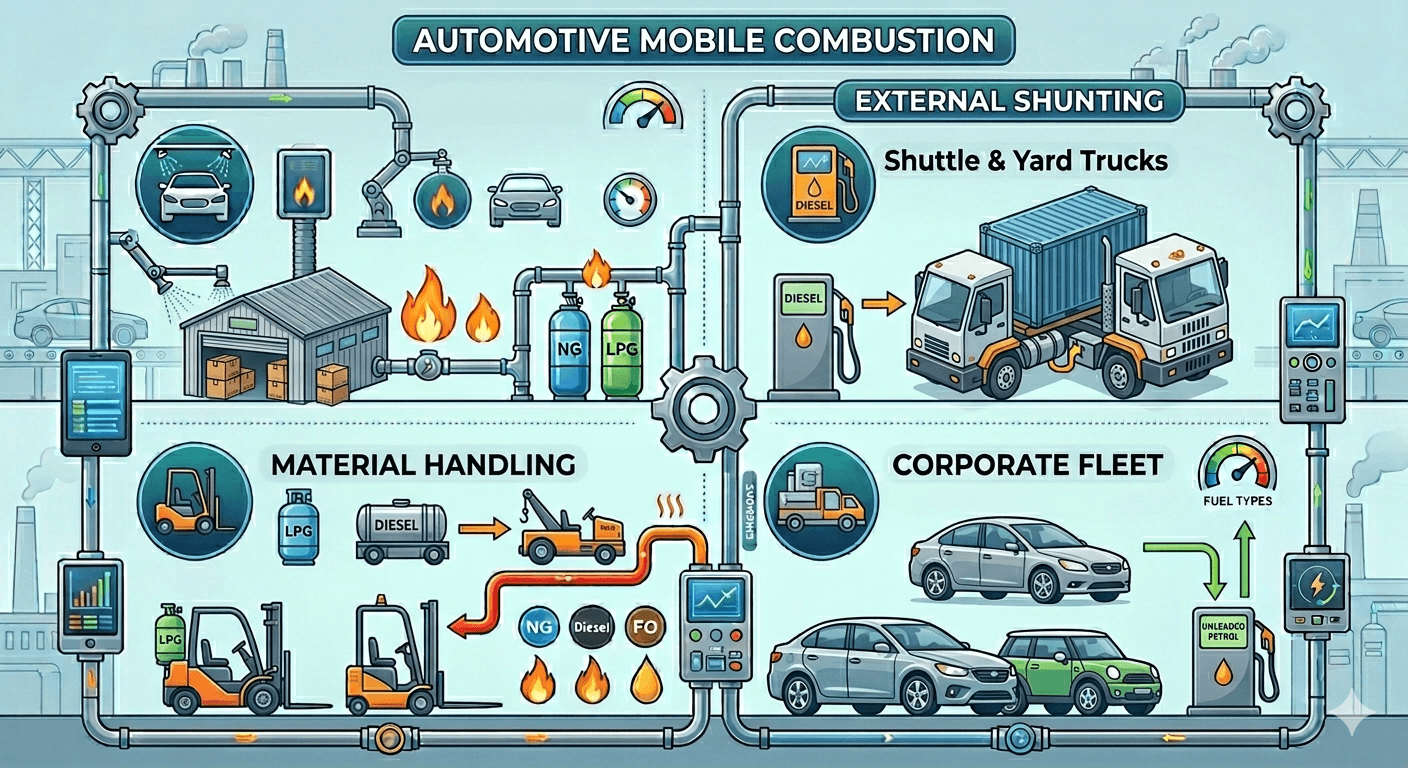
Mobile Combustion (Internal Logistics & Fleet):
-
Material Handling: Diesel, LPG, or petrol consumed by plant forklifts, tow tractors, and reach trucks moving inventory across the shop floor.
-
Shuttle & Yard Trucks: Internal shunting trucks moving trailers between the press shop, weld shop, assembly lines, and finished goods yards.
-
Corporate Fleet: Fuel consumed by company-owned or long-term leased passenger vehicles used by executives or sales teams.
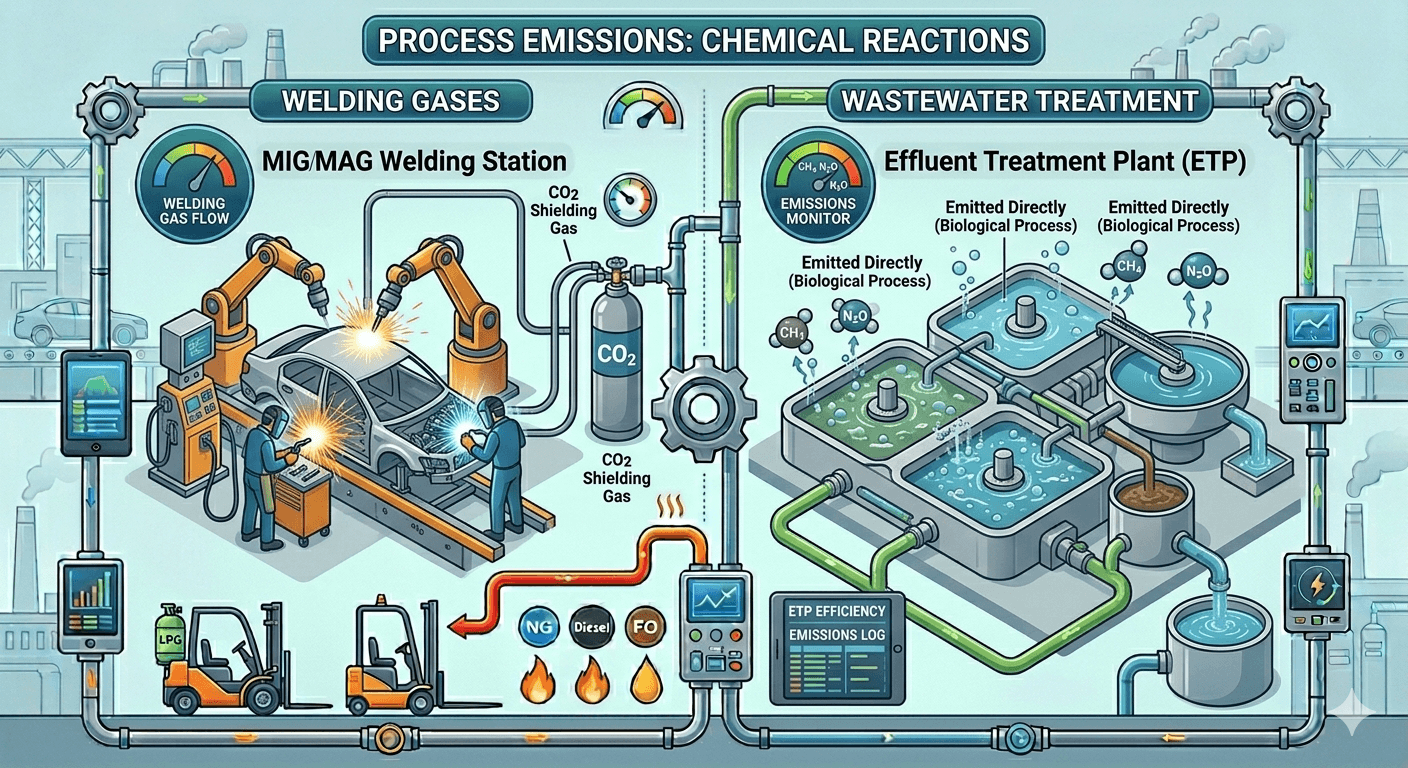
Process Emissions (Chemical Reactions):
-
Welding Gases: CO2 used as a shielding gas in MIG/MAG welding lines across the body shop.
-
Wastewater Treatment: Greenhouse gases (CH4 and N2O) emitted directly during the biological treatment of industrial effluent on-site in your Effluent Treatment Plant (ETP).
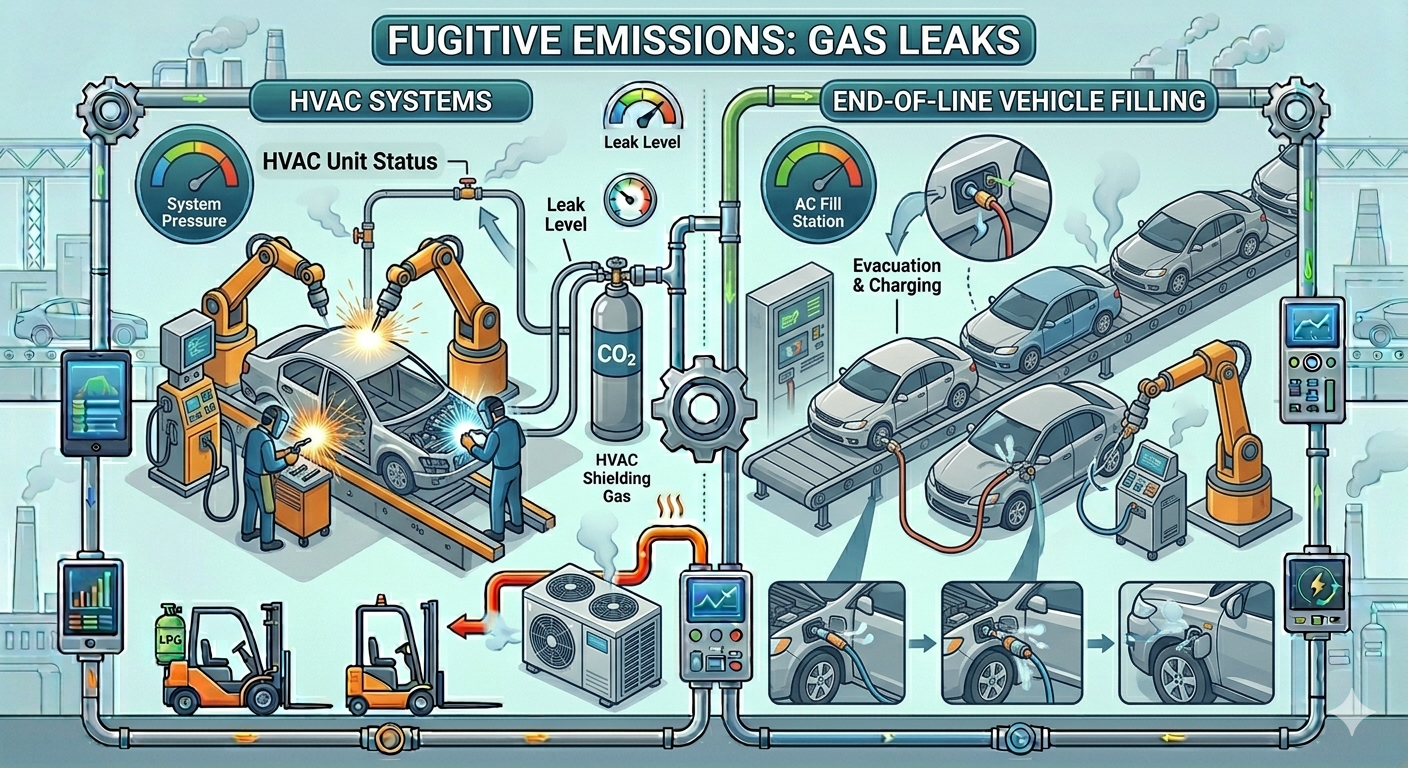
Fugitive Emissions (Gas Leaks):
-
HVAC Systems: Chiller and air conditioner refrigerant leaks (such as R-134a or R-410A) across production floors and corporate offices.
-
End-of-Line Vehicle Filling: Refrigerant losses during the evacuation and charging of vehicle AC systems on the final assembly line.
2. Scope 2: Indirect Energy Emissions
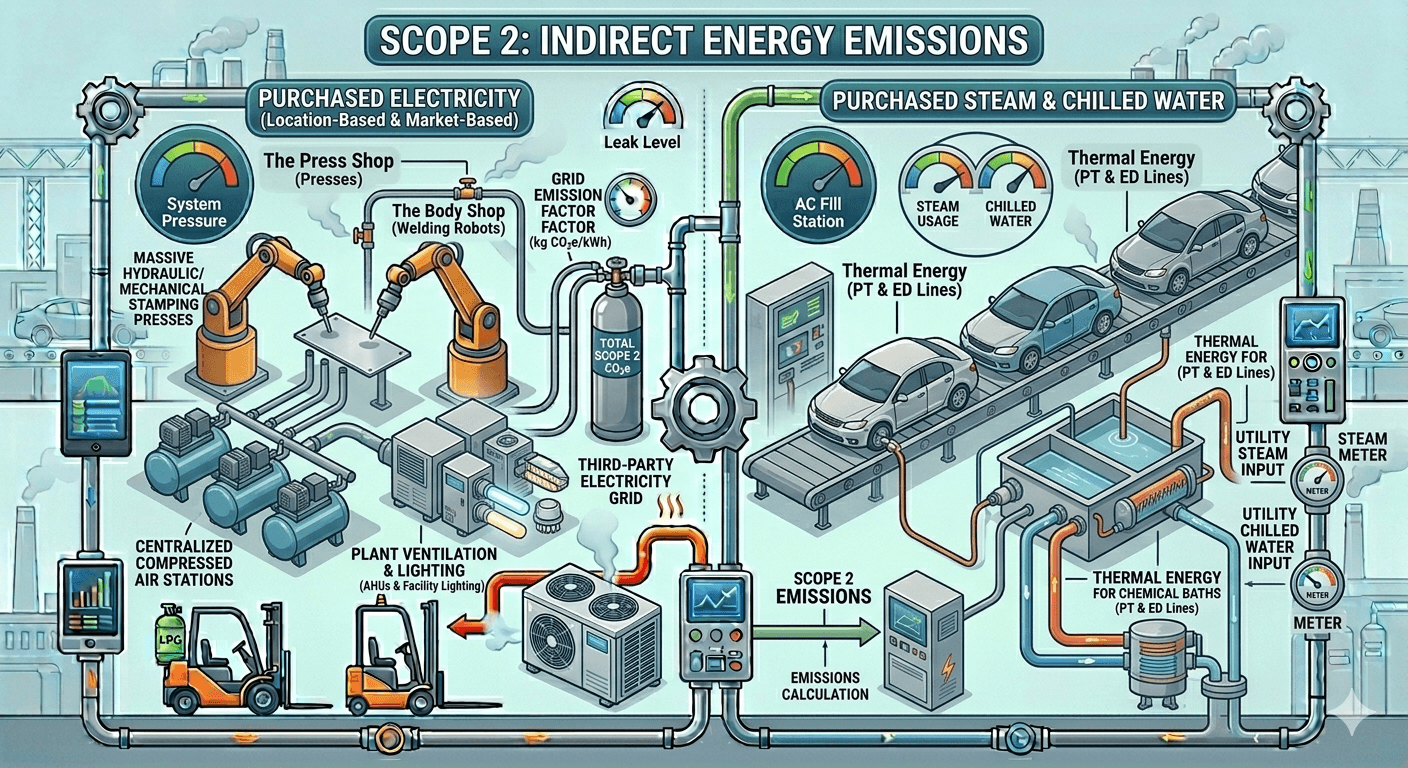
These represent emissions from electricity, steam, heat, or cooling purchased from third-party utilities. They are calculated using monthly utility bills multiplied by grid emission factors (kg CO2e/kWh).
Purchased Electricity (Location-Based & Market-Based):
-
The Press Shop: Massive power drawn by heavy hydraulic and mechanical stamping presses forming sheet metal components.
-
The Body Shop: High-frequency electrical energy drawn by hundreds of automated spot-welding robots and laser-welding systems.
-
Compressed Air Infrastructure: Centralized air compressor stations providing high-pressure pneumatic power for assembly tools and automation across the line.
-
Plant Ventilation & Lighting: High-volume air handling units (AHUs) for cleanrooms, exhaust fans, and extensive facility LED/industrial lighting.
Purchased Steam or Chilled Water:
- Thermal energy piped into the facility from a third-party utility for chemical baths in the pre-treatment (PT) and electrodeposition (ED) coating lines.
The Quick Shift: Scope 2 is often the easiest to reduce in the short term. Transitioning to renewable energy contracts (Open Access solar/wind) or installing rooftop solar can eliminate a significant portion of your Scope 2 footprint overnight.
3. Scope 3: Value Chain Emissions (The 15 Categories)
This is where the majority of an automotive company’s footprint lies, frequently accounting for 80% to 95% of an automaker or major supplier’s total carbon footprint. Under the GHG Protocol, Scope 3 is divided into 15 strict upstream and downstream categories.
Upstream (Supply Chain & Operational Support)
Category 1: Purchased Goods and Services
- Raw Materials: Embedded carbon (cradle-to-gate) from buying steel sheets, aluminum ingots, engineered plastics (PP, ABS, PA), rubber, and glass.
- Components: Tier-1 assemblies like engines, transmissions, electronic control units (ECUs), wiring harnesses, and tire assemblies.
- Consumables: Welding wires, grinding wheels, industrial lubricants, cutting fluids, and packaging materials (pallets, corrugated boxes).
Category 2: Capital Goods
- Emissions embedded in the manufacturing and installation of heavy machinery purchased by the plant: stamping dies, robotic arms, injection molding machines, CNC machining centers, and newly constructed factory bays.
Category 3: Fuel- and Energy-Related Activities (Not included in Scope 1 or 2)
- Upstream Fuel Lifecycle: Extraction, production, and transportation of the fuels your plant buys (e.g., the footprint of extracting and refining the diesel before it reaches your DG set).
- Transmission & Distribution (T&D) Losses: Electricity lost as heat in the grid lines during transmission from the power plant to your substations.
Category 4: Upstream Transportation and Distribution
- Inbound logistics paid for by your company: moving steel coils from the mill, or plastic resins from chemical plants to your facility via ocean freight, rail, or commercial trucking.
Category 5: Waste Generated in Operations
- Emissions from the disposal and treatment of your factory’s waste streams at third-party facilities: paint sludge incineration, hazardous chemical disposal, metal scrap recycling processes, and municipal solid waste sent to landfills.
Category 6: Business Travel
- Emissions from commercial flights, trains, rental cars, and hotel stays by employees traveling for supplier audits, customer meetings, or corporate events.
Category 7: Employee Commuting
- The carbon footprint of your plant operators, engineers, and office staff traveling to and from work daily via personal cars, two-wheelers, public transit, or company-contracted employee buses.
Category 8: Upstream Leased Assets
- Emissions from facilities, warehouses, or data servers operated by your company but leased from a third party (if not already accounted for in your Scope 1 and 2 operational boundaries).
Downstream (Product Lifecycle & Distribution)
Category 9: Downstream Transportation and Distribution
- Outbound logistics paid for by your customers or dealers: shipping completed vehicles or finished components from your warehouse to regional stockyards, dealerships, or global export ports.
Category 10: Processing of Sold Products
- Relevant mainly to component/Tier-1 suppliers: The energy and emissions generated by an OEM customer when they weld, paint, or assemble your specific component into the final vehicle chassis.
Category 11: Use of Sold Products (The Automotive Heavyweight)
- For OEMs: The total expected lifetime tailpipe emissions of all sold vehicles. This takes into account average fuel consumption (L/100km), expected lifetime mileage (e.g., 150,000 km), and total units sold. For Electric Vehicles (EVs), this maps the electricity drawn from local power grids over the vehicle’s lifespan.
Category 12: End-of-Life Treatment of Sold Products
- The energy required to dismantle, shred, and recycle vehicles or components at the end of their operational life, including emissions from non-recyclable materials going to scrap or landfill.
Category 13: Downstream Leased Assets
- Emissions from assets owned by your company that are leased out to others (e.g., an OEM leasing a fleet of vehicles to a corporate mobility provider).
Category 14: Franchises
- Emissions from independent automobile dealerships or authorized service centers operating under your brand name (including their direct electricity use, cooling, and heating).
Category 15: Investments
- For large automotive groups or holding companies: The proportional carbon footprint of joint ventures, equity investments, or subsidiaries where you hold a financial stake but do not exercise direct operational control.
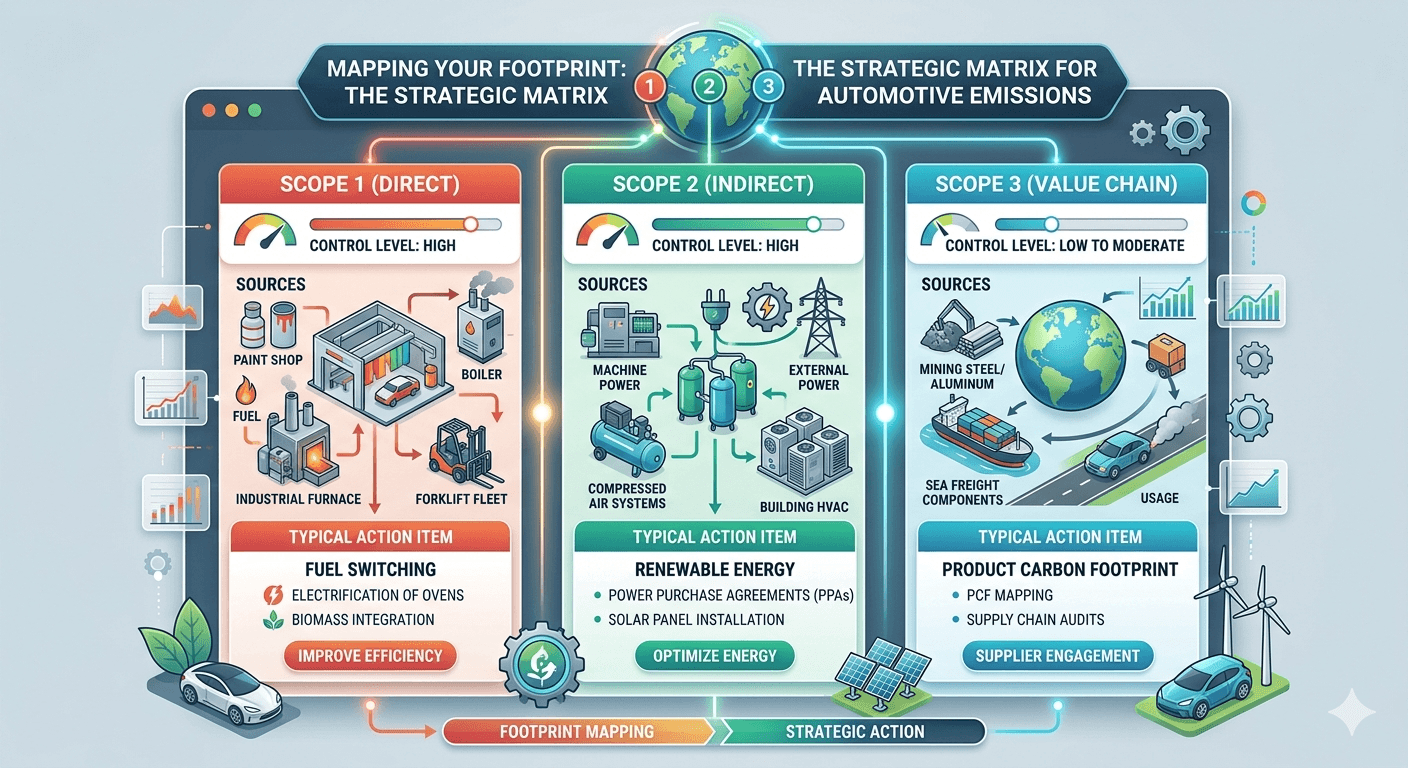
Understanding the breakdown of these scopes changes sustainability from a vague concept into an engineering and financial strategy.
When preparing for frameworks like CBAM or BRSR, you cannot simply guess these numbers or rely entirely on loose industry averages (spend-based data). True compliance requires isolating inefficiencies, protecting your business against carbon taxes, and transitioning toward actual Product Carbon Footprints (PCFs) collected directly from Tier-1 and Tier-2 suppliers. By precisely measuring your data across all three scopes, you can confidently meet the strict ESG compliance demands of international buyers and protect your bottom line.
FAQs
In automotive manufacturing, Scope 1 emissions are the direct greenhouse gases released from assets owned or controlled by the facility. This primarily includes natural gas or LPG burned in paint shop curing ovens, diesel used by backup generator sets, fuel consumed by internal material handling forklifts, and fugitive refrigerant leaks from vehicle air conditioning assembly lines.
Welding gases like carbon dioxide ($CO_2$) used as shielding agents in robotic body shops are classified as Scope 1 process emissions. Because the gas is physically released into the atmosphere on-site during the manufacturing process, it falls under direct operational control, unlike the upstream footprint of manufacturing the gas cylinder itself, which falls under Scope 3.
Scope 3 is the largest part of an automotive carbon footprint because it includes the entire lifecycle of the vehicle, from raw material extraction to vehicle usage. Upstream, manufacturing highly carbon-intensive materials like steel and aluminum accounts for massive emissions, while downstream, the lifetime tailpipe emissions of thousands of sold vehicles driven over decades overwhelm the plant’s operational energy usage.
EV battery manufacturing significantly shifts an automaker’s carbon footprint by drastically increasing upstream Scope 3 Category 1 (Purchased Goods) emissions while eliminating downstream Scope 3 Category 11 (Use of Sold Products) tailpipe emissions. The heavy carbon debt incurred during critical mineral extraction (lithium, nickel, cobalt) and cell manufacturing means suppliers must provide actual Product Carbon Footprints (PCFs) rather than industry averages.
The main difference is that spend-based data calculates emissions using generalized industry averages based on financial procurement records, while activity-based data uses actual, verifiable physical measurements like kilograms of steel purchased or kilowatt-hours of electricity consumed. Regulatory frameworks like CBAM and BRSR increasingly reject spend-based estimates, requiring precise activity-based tracking.
Yes, independent car dealerships are included in an automobile manufacturer’s carbon footprint under Scope 3, Category 14 (Franchises). While the OEM does not own or operationally control these independent retail spaces, the greenhouse gases generated by their daily operations, lighting, heating, and servicing bays are an indirect consequence of the brand’s distribution model.