
Introduction
Most factories today rely heavily on liquid chemical solvents to clean parts, mix ingredients, and manufacture products. Unfortunately, making, using, and disposing of these petroleum-based chemicals releases massive amounts of greenhouse gases, creating a major roadblock for global net-zero goals.
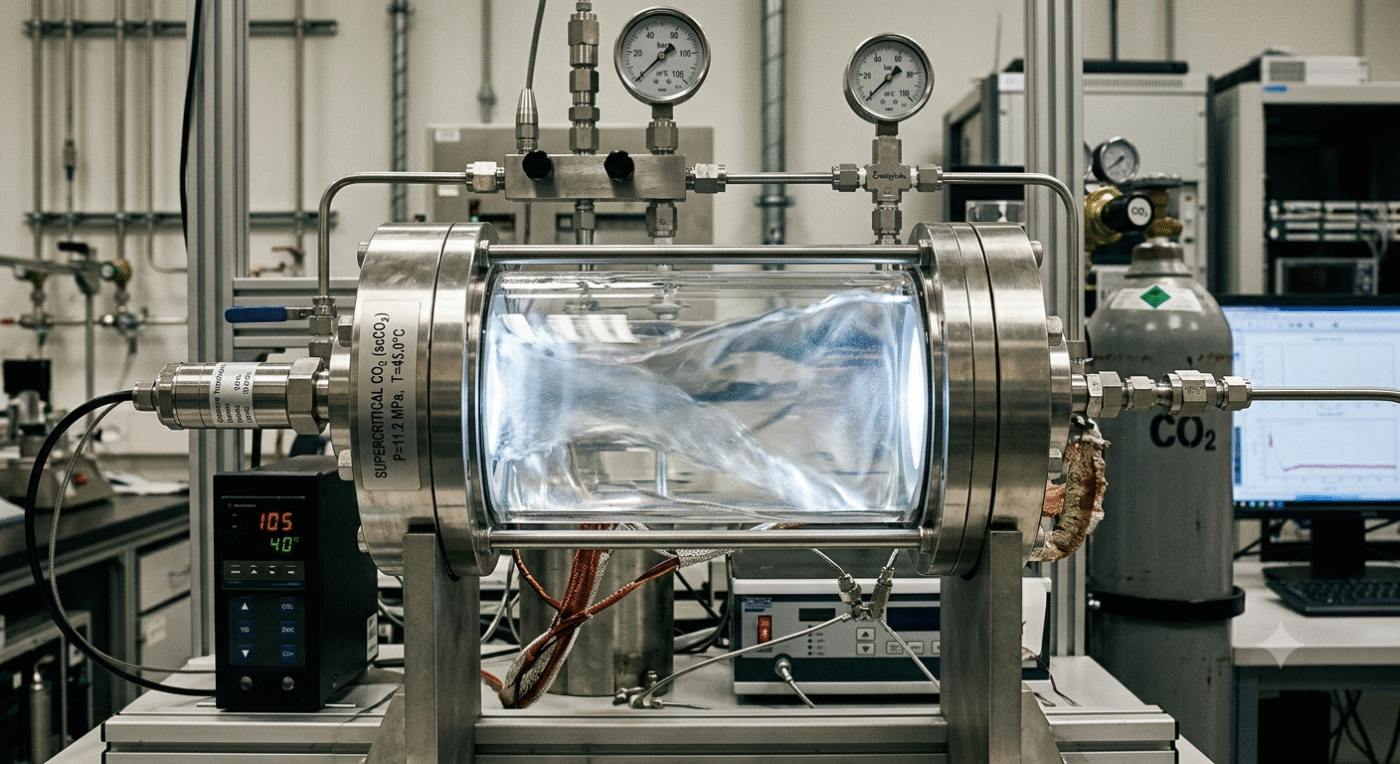
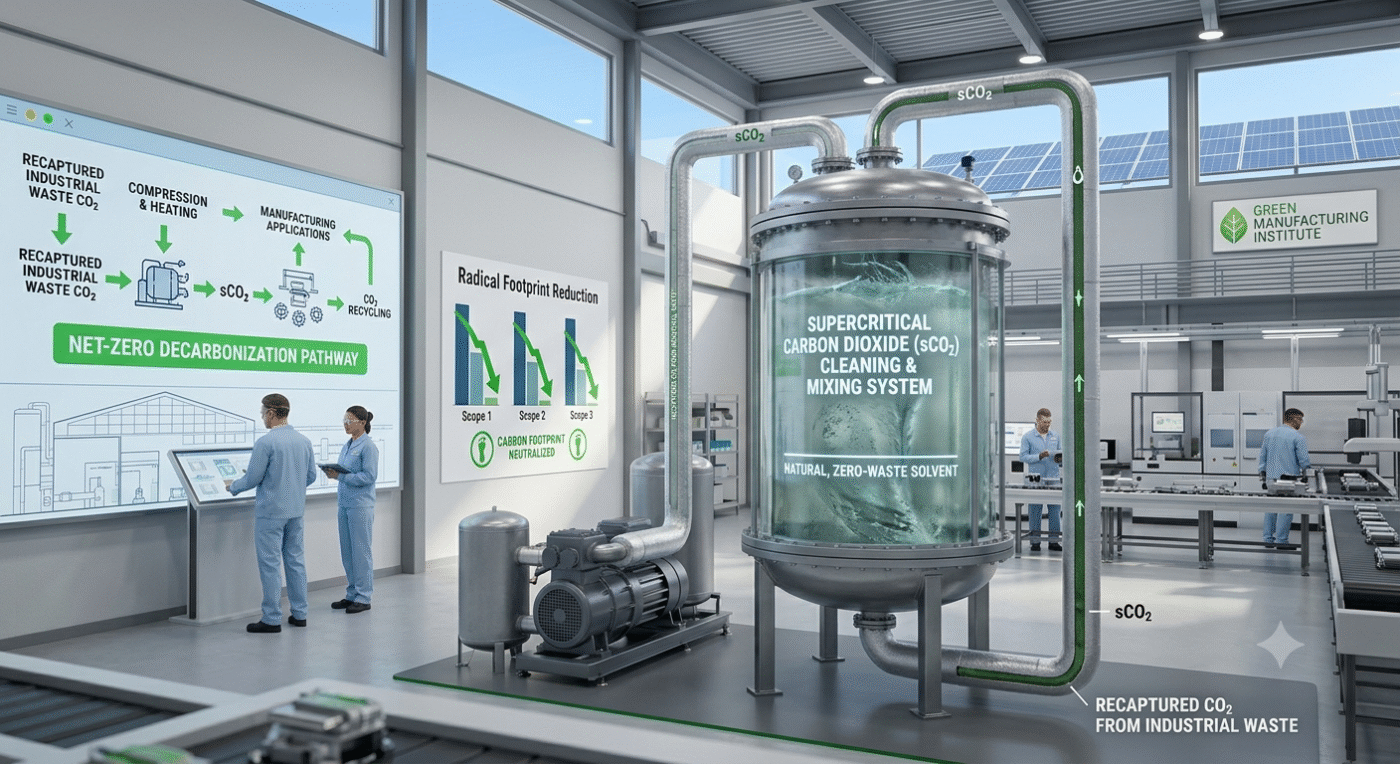
There is a cleaner alternative that drives deep industrial decarbonization: Supercritical Carbon Dioxide (sCO2). By compressing normal carbon dioxide gas—recaptured from industrial waste streams—until it adopts the properties of both a gas and a liquid, industries can create a highly effective, natural solvent. This tool allows factories to completely eliminate traditional chemical waste while radically lowering their Scope 1, 2, and 3 carbon footprints.
1. The Hidden Carbon Penalty of Everyday Chemical Solvents
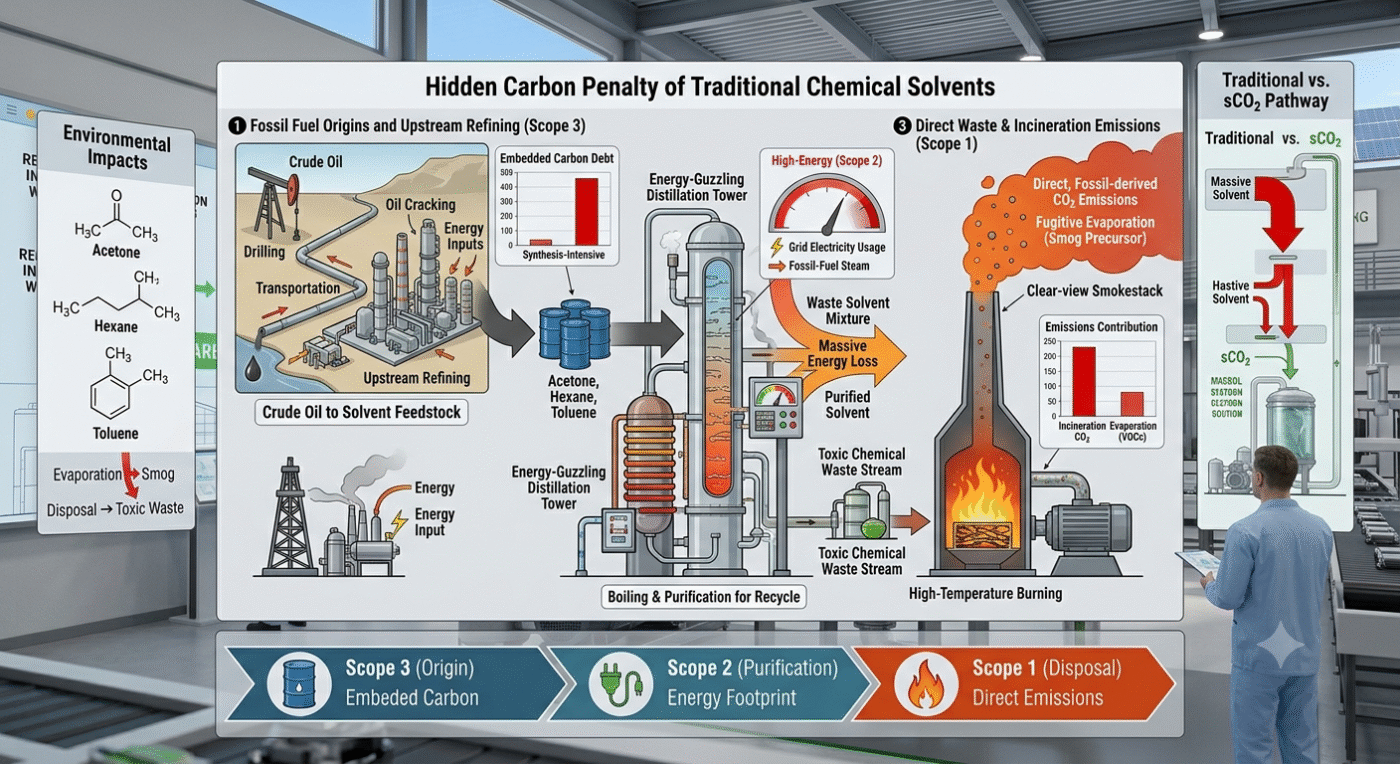
Chemical solvents like acetone, hexane, and toluene are used everywhere in manufacturing. However, their reliance on a fossil-fuel-centric lifecycle damages the environment and inflates carbon accounts in three main ways:
- Direct Waste & Incineration Emissions (Scope 1): These chemicals evaporate easily into the air, creating smog. When factories capture them as toxic waste, the standard method to destroy them is high-temperature burning (incineration), which pumps direct, fossil-derived CO2 straight into the atmosphere.
- High-Energy Boiling & Purification (Scope 2): To recycle and reuse traditional liquid solvents, factories must boil them down in massive, energy-guzzling distillation towers. Operating these towers requires a tremendous amount of electricity and high-pressure steam, which is typically generated by burning fossil fuels on the local grid.
- Fossil Fuel Origins and Upstream Refining (Scope 3): Almost all industrial solvents are synthesized directly from crude oil and petroleum feedstocks. Drilled oil requires extensive cracking and intensive upstream refining before the chemical solvent even reaches the factory floor, carrying an immense embedded carbon debt.
2. The Clean Physics of Supercritical CO2
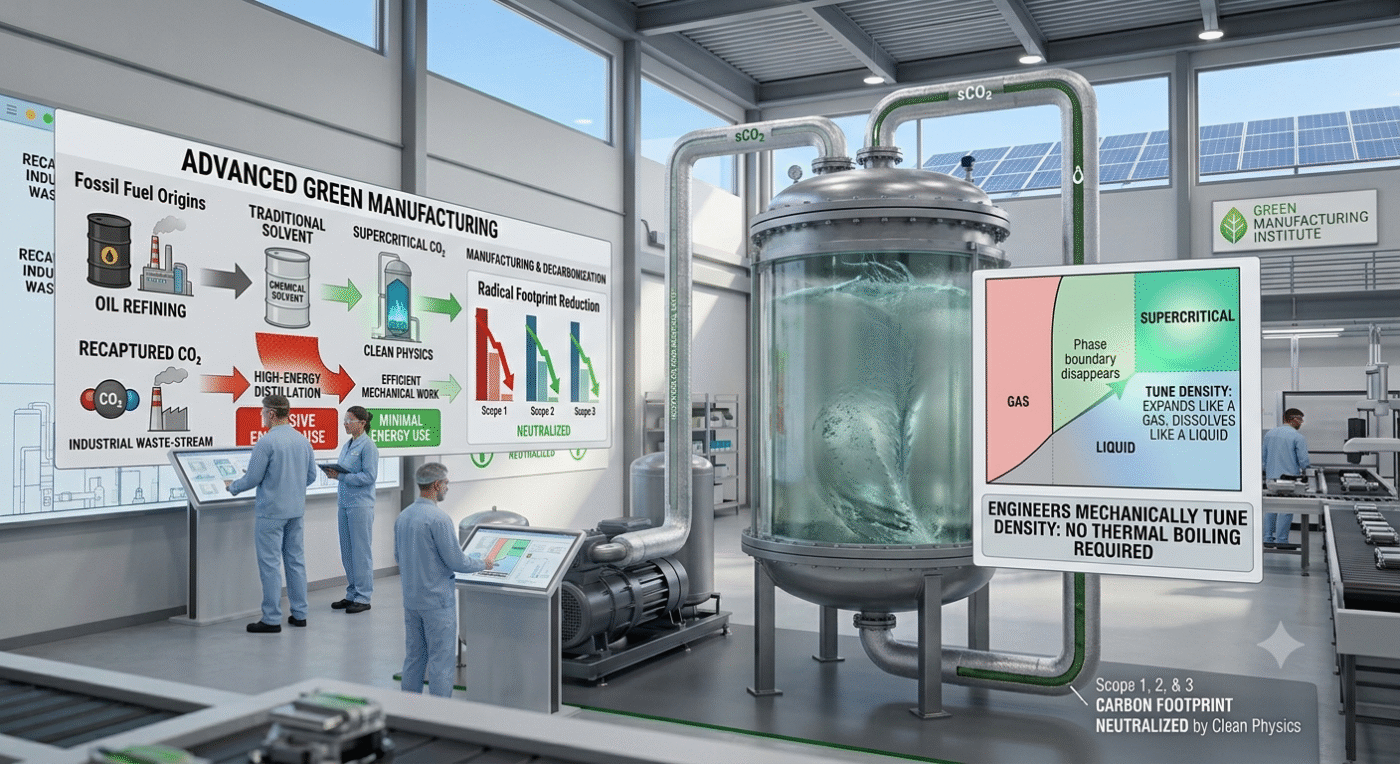
To break away from fossil-fueled solvent systems, industries must look to the unique thermodynamic properties of compressed gases. When you take normal CO2 gas and heat it above $31.1^circtext{C}$ while squeezing it under high pressure (above $73.9text{ bar}$), it enters a “supercritical” state.
In this state, the phase boundary between gas and liquid completely disappears. It behaves like a scientific hybrid: it expands to fill spaces like a gas, but it is dense enough to dissolve materials like a liquid. From a decarbonization standpoint, this is revolutionary. By making slight mechanical adjustments to the temperature or pressure, engineers can change how thick or thin the fluid is, allowing it to grab or release specific ingredients perfectly without needing any thermal boiling.
Comparing Phases of Matter to Optimize Processing Energy
|
Property |
Normal Gas |
Normal Liquid |
Supercritical CO2 (Flexible Range) |
|
Weight/Density |
Extremely Light |
Heavy |
Adjustable (Light to Heavy)
|
|
Thickness/Viscosity |
Very Thin |
Thick |
Extremely Thin (flows easily)
|
|
Movement Speed |
Very Fast |
Slow |
Fast (soaks in quickly without added heat)
|
3. The Low-Carbon Recycling Loop
Instead of consuming fossil fuels to boil a liquid solvent away to separate it from a product, a supercritical system achieves separation entirely through pressure drop-outs in a continuous, closed loop. This mechanical process eliminates the massive thermal energy demands of traditional chemical separation.
Start with Recaptured CO₂ Gas → Compress & Heat Mechanically (Turns to Supercritical State) → Use it in the Machine (Cleans or extracts items) → Drop the Pressure (CO₂ turns back to gas; ingredients drop out safely) → Cool & Reuse Gas (Ready to start over)
4. Sectoral Case Studies: Achieving Net-Zero in Three Industries
-
Medicine and Pharmaceuticals
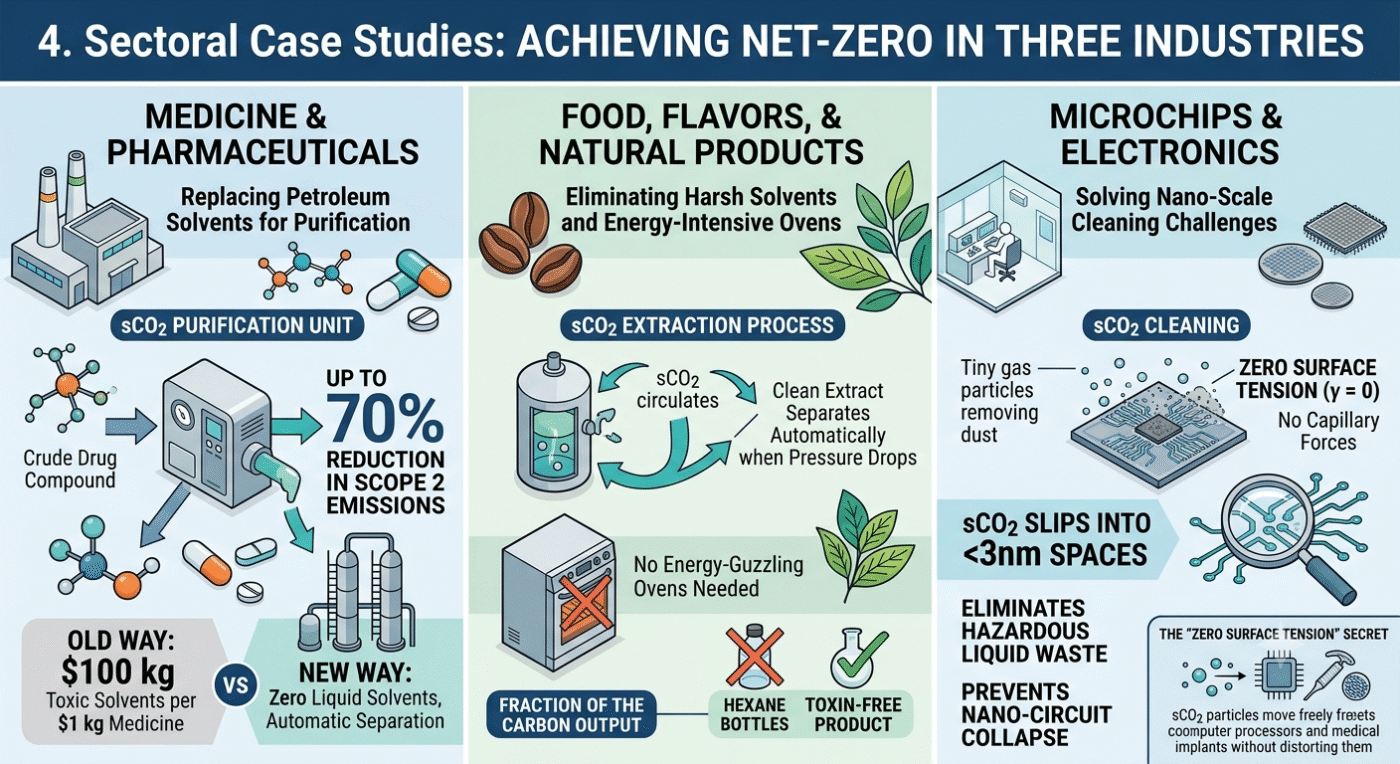
Manufacturing prescription drugs requires a staggering volume of chemicals. It often takes up to $100text{ kg}$ of toxic, petroleum-derived solvents just to isolate $1text{ kg}$ of a pure active medicine ingredient. Replacing these chemical networks with sCO2 as a purification agent completely eliminates the need for multi-stage thermal distillation. This shift cuts a pharmaceutical purification facility’s energy-related Scope 2 emissions by up to 70%.
- Food, Flavors, and Natural Products
The traditional way to extract essential oils, plant flavors, or decaffeinate coffee beans involves soaking them in harsh solvents like hexane or dichloromethane. Once the extraction is complete, factories must run energy-intensive thermal ovens for hours to evaporate the chemicals so no toxic residues remain in the food. Trading those chemicals for sCO2 changes the carbon math entirely. The gas dissolves the oils effortlessly, and when the pressure is dropped, the clean extract separates automatically. Because the CO2 flashes off completely at room temperature, it removes the need for energy-guzzling ovens and ensures a toxin-free product with a fraction of the carbon output.
- Microchips and Electronics
As the microscopic components inside smartphones and computers shrink below 3 nanometers, standard liquid chemical cleaners present a structural problem: their high surface tension creates capillary forces that can bend or collapse delicate nano-circuits. Because sCO2 acts like a gas, it has zero surface tension ($gamma = 0$). It slips into the smallest nano-sized spaces, cleans away dust and residue perfectly, and leaves no liquid trace behind. This allows the semiconductor industry to eliminate both upstream solvent processing emissions and downstream hazardous liquid waste processing overheads.
The “Zero Surface Tension” Secret Because supercritical CO2 has zero surface tension, it won’t pull or push against delicate shapes as it dries. This makes it perfect for working with fragile items like computer processors, ultra-light materials, and medical implants.
5. Quantifying the Green Transition
Table 2: Decarbonization and Safety Profile of Solvent Systems
|
Feature |
Standard Chemical Solvents (Hexane, Acetone, DCM) |
Supercritical CO2 Loop |
|
Derived from crude fossil fuels and petroleum oil refining. |
Recycled gas captured from existing industrial byproduct waste streams. |
|
High (2.5 to 5.5 kg of CO2 released per kg of solvent produced). |
Carbon neutral because it uses gas that already exists in the atmosphere. |
|
Very high; requires constant fossil-fueled boiling in distillation towers. |
Low; phase changes are controlled by basic mechanical pressure valves. |
|
High; produces toxic liquid sludge that requires fossil-powered incineration. |
Zero liquid waste; more than 95% of the gas is captured and continuously reused. |
|
Toxic and carcinogenic and leaves chemical residue risks in products. |
Completely safe, non-toxic, and naturally evaporates without leaving a trace. |
|
Highly flammable; represents a major industrial plant explosion hazard. |
It’s an inherent flame retardant and eliminates chemical fire risks in the factory. |
6. Overcoming Engineering and Financial Roadblocks
While the decarbonization benefits of transitioning to an sCO2 system are clear, widespread industrial adoption requires overcoming two primary real-world hurdles:
High Upfront Carbon and Capital Costs (CAPEX)
Building machinery that can safely withstand internal pressures greater than 74 times our atmosphere is an immense engineering task. Standard chemical reactors can be built with thinner, cheaper metal shells. In contrast, an sCO2 extraction or processing chamber requires thick-walled, ultra-high-grade stainless steel. Furthermore, industrial facilities must install specialized high-capacity compressors and dynamic metal-jacketed seals capable of containing gas at high pressure without leaking. For a small or mid-sized factory, the upfront investment required to purchase and install an sCO2 processing line can be three to five times higher than conventional atmospheric setups. This financial hurdle frequently causes leadership teams to delay upgrading, even though the machinery lowers monthly utility bills and chemical disposal fees.
7. Chemical Polarity and Co-Solvent Emissions
A fundamental law of chemistry is that “like dissolves like.” Traditional organic chemical solvents can be chosen from a massive catalog to target specific molecular structures. Some are polar (like water or acetone, which mix well with salts and sugars), while others are non-polar (like hexane, which dissolves oils and grease).
Pure carbon dioxide is fundamentally non-polar, possessing a dipole moment of exactly zero. Because of this, sCO2 behaves almost identically to oil or hexane; it easily strips lipids, petrochemical lubricants, and waxes. However, when an industry needs to extract or process highly polar compounds—such as proteins, complex sugars, or specialized pharmaceutical salts—pure sCO2 lacks the chemical power to dissolve them. To bypass this chemical limitation, process engineers have to introduce small percentages of “co-solvents” or modifiers. By blending a tiny fraction (typically 1% to 5%) of a safe polar liquid like organic ethanol into the compressed fluid stream, they can drastically shift the solvent matrix. This small addition allows the mixture to bind with polar target molecules while preserving the overall gas-liquid advantages of the supercritical cycle.
8. Financial Incentives and Carbon Accounting Credits
To combat high initial equipment costs, governments and global environmental bodies are establishing progressive carbon frameworks that make sCO2 systems financially attractive.
As international regulations tighten around greenhouse gases, factories face heavy carbon taxes on direct factory floor emissions (Scope 1) and electrical grid use (Scope 2). Conventional factories that rely on incinerating spent organic solvents are hit with massive carbon financial penalties.
By switching to a closed-loop system that utilizes captured byproduct carbon dioxide, companies can bypass these penalties entirely. Because the system prevents existing industrial greenhouse gas waste from entering the atmosphere, it can qualify the facility for direct green manufacturing subsidies, energy efficiency rebates, and carbon tax credits. Over time, these combined savings offset the initial high cost of the equipment, providing a strong financial return on investment alongside its profound environmental benefits.
Final Thoughts
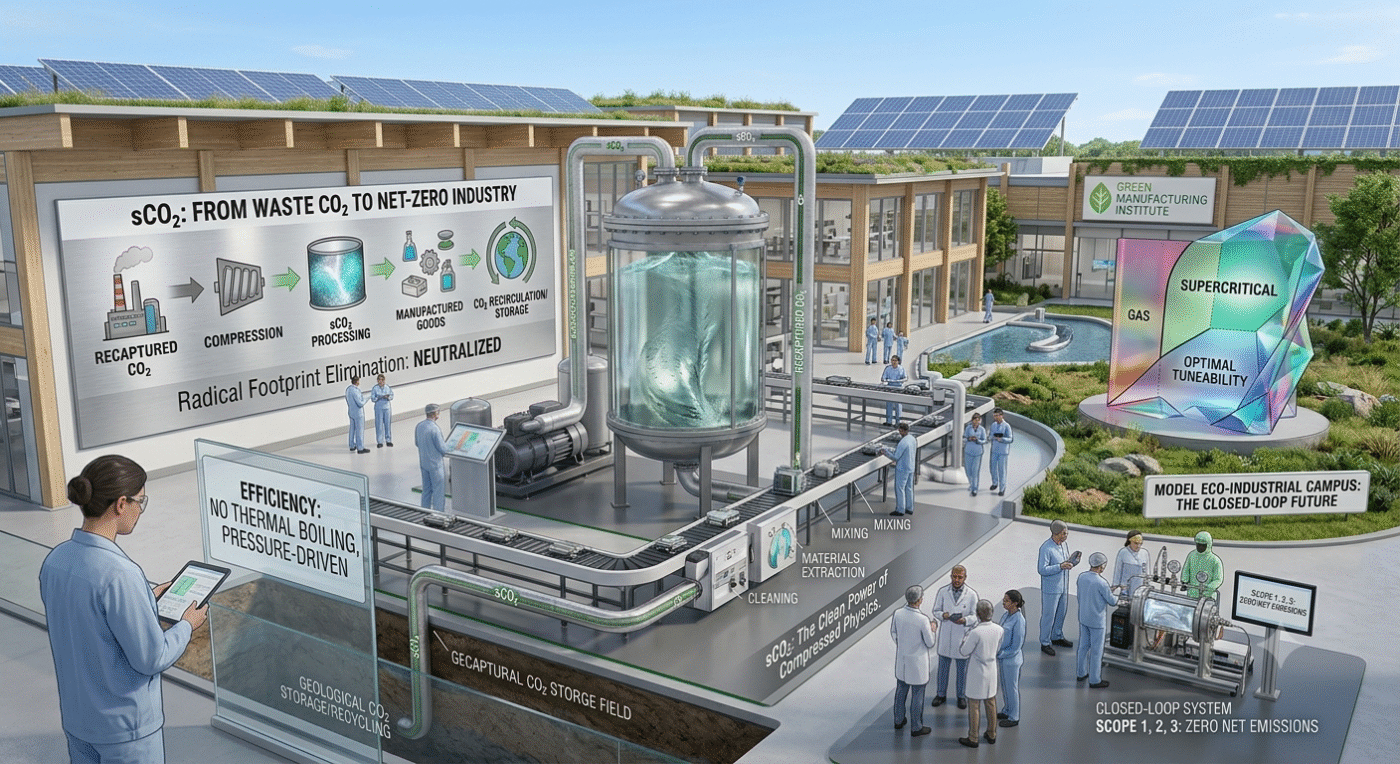
Supercritical CO2 is a powerful tool for building a net-zero future. By trading old-school, petroleum-based chemical solvents for a closed-loop sCO2 system, factories can stop burning chemical waste and eliminate massive energy bills. The unique physical behavior of sCO2—merging gas-like speed with liquid-like power—allows it to maintain process efficiency while cutting carbon footprints. As global environmental laws become stricter and carbon pricing increases, switching to high-tech, pressure-driven processes like sCO2 will change manufacturing from a heavy polluter into a highly efficient, clean industry.