

Introduction
Carbon Capture, Utilisation, and Storage (CCUS) has officially transitioned from an idealistic climate policy discussion to an indispensable operational and commercial imperative. For heavy industrial sectors—including cement, steel, chemical production, and refining—CCUS represents the only technologically mature pathway to achieve deep decarbonization while preserving trillions of dollars in existing capital assets.
As global regulatory frameworks tighten, companies that delay mitigation face escalating financial, compliance, and market-access risks. However, deploying CCUS is not a standard procurement exercise; it is a capital-intensive, infrastructure-dependent strategic transformation. Commercial success requires aligning concentrated, low-cost $text{CO}_2$ sources with accessible transport networks, permanent geological storage infrastructure, and supportive regulatory frameworks.
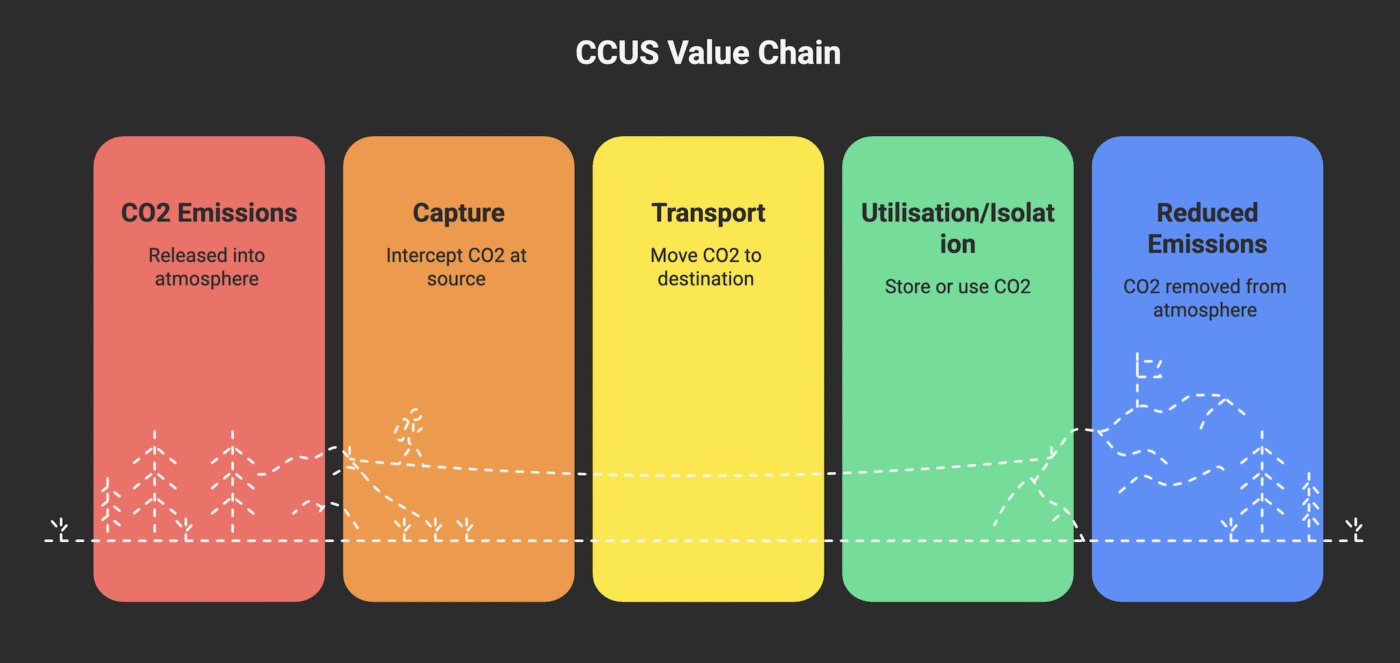
1. Decoding the Industrial CCUS Value Chain
To successfully execute a CCUS strategy, corporate leaders must view the technology as a multi-stage industrial value chain. Disruptions or inefficiencies at any stage can undermine the economic viability of the entire project.
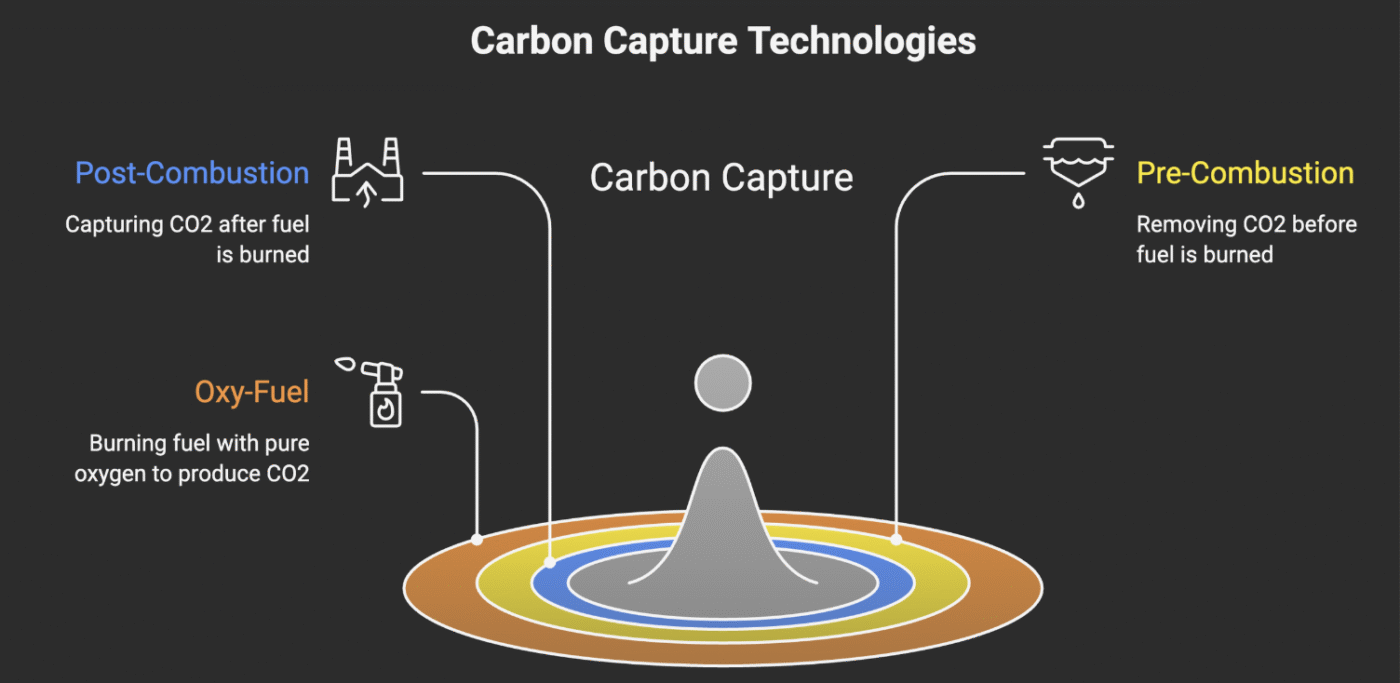
- Carbon Capture: The process of separating $text{CO}_2$ from industrial flue gases or process streams using chemical absorption, physical separation, membrane permeation, or cryogenic cooling. This phase is the most capital- and energy-intensive segment, typically accounting for 60% to 80% of total life-cycle project costs.
-
Carbon Transport: Captured $text{CO}_2$ is compressed into a dense, supercritical state (typically above 74 bar and 31.1°C) to optimize volume and flow characteristics. It is then moved via high-pressure pipelines for onshore networks or refrigerated shipping carriers for cross-border and offshore destinations.
-
Carbon Utilisation: The conversion of captured $text{CO}_2$ into commercially valuable products. These pathways include cyclical applications like synthetic aviation fuels (SAF) or permanent binding applications such as concrete mineralization.
-
Carbon Storage: The permanent isolation of $text{CO}_2$ from the atmosphere via injection into deep, secure subterranean geological formations, serving as the primary mechanism for gigaton-scale emissions reductions.
2. The Strategic Business Case for Hard-to-Abate Sectors
For institutional investors and executive leadership, CCUS is fundamentally an asset-preservation and risk-mitigation tool.
-
Abating Inherent Process Emissions
In sectors like cement and integrated steel, up to 60% of emissions are “process emissions” inherent to the chemical transformation of raw materials. A prime example is the calcination of limestone:

-
Mitigating Carbon Asset Stranding
Industrial facilities such as blast furnaces, steam crackers, and fluid catalytic cracking units (FCCUs) involve massive capital expenditure and possess lifespans spanning 30 to 50 years. Retrofitting these setups with CCUS prevents the premature write-down of capital assets, allowing facilities to fulfill their useful economic life while meeting net-zero mandates.
-
Regulatory Protection and Market Access
In regions governed by compliance markets like the European Union Emissions Trading System (EU ETS), carbon pricing imposes long-term operational penalties on unmitigated emissions. Furthermore, modern protectionist mechanisms like the Carbon Border Adjustment Mechanism (CBAM) penalize high-carbon imports, turning CCUS into a baseline requirement for maintaining access to premium international export markets.
3. Techno-Economic Matrix: Matching Industry to Technology
The economic viability of a CCUS project depends directly on the concentration of $text{CO}_2$ in the flue gas or process stream, as lower concentrations require significantly more energy and capital to separate.
Industrial Suitability Matrix
| Industry Sector | Main Emission Source | CO2 Concentration (Vol%) | Typical Capture Cost (USD/tCO2) | Strategic Value |
| Fertilisers / Ammonia |
Shift converter process gas |
95% – 99% |
$15 – $25 |
Purest industrial stream; lowest barrier to entry for immediate abatement. |
| Hydrogen (SMR) |
Process off-gas / Syngas |
30% – 90% |
$20 – $35 |
Enables low-carbon “Blue” $text{H}_2$ for refining and chemical synthesis. |
| Cement |
Limestone calcination & kilns |
15% – 30% |
$60 – $100 |
Critical technology; no other scalable alternative for process emissions. |
| Steel (BF-BOF) |
Blast furnace / Coke oven gas |
20% – 30% |
$60 – $90 |
Decarbonizes existing integrated steel mills during blast furnace life. |
| Refineries & Chems |
FCCU, steam crackers, reformers |
5% – 25% |
$50 – $90 |
Abates complex, distributed, multi-point emission hubs. |
| Power Generation |
Natural gas combustion |
4% – 14% |
$60 – $110 |
Provides low-carbon, dispatchable baseload power to back up renewables. |
4. Commercial Realities of Utilisation and Geological Storage
Operations teams must distinguish between small-scale, cyclical carbon utilization and permanent, gigaton-scale geological storage.
Utilisation Pathways
While Enhanced Oil Recovery (EOR) remains the most commercially mature utilization avenue, its long-term net-decarbonization value faces strict stakeholder scrutiny. Synthetic e-fuels offer a massive addressable market but remain highly energy-intensive, requiring enormous amounts of green electricity to produce the necessary hydrogen feedstocks.
The most scalable, circular option within building materials is concrete mineralization. Injecting $text{CO}_2$ into fresh concrete permanently locks the gas into a solid mineral matrix:

This reaction traps carbon permanently, improves the concrete’s compressive strength, and reduces baseline cement requirements.
Geological Storage Options
For true climate-scale abatement, permanent geological storage is the primary solution. Deep Saline Aquifers (permeable rock formations filled with saltwater 1 to 3 kilometers underground) offer the largest global storage capacity through structural and dissolution trapping. Depleted oil and gas reservoirs provide geologically proven containment structures with existing well infrastructure and seismic data, minimizing early exploratory risks.
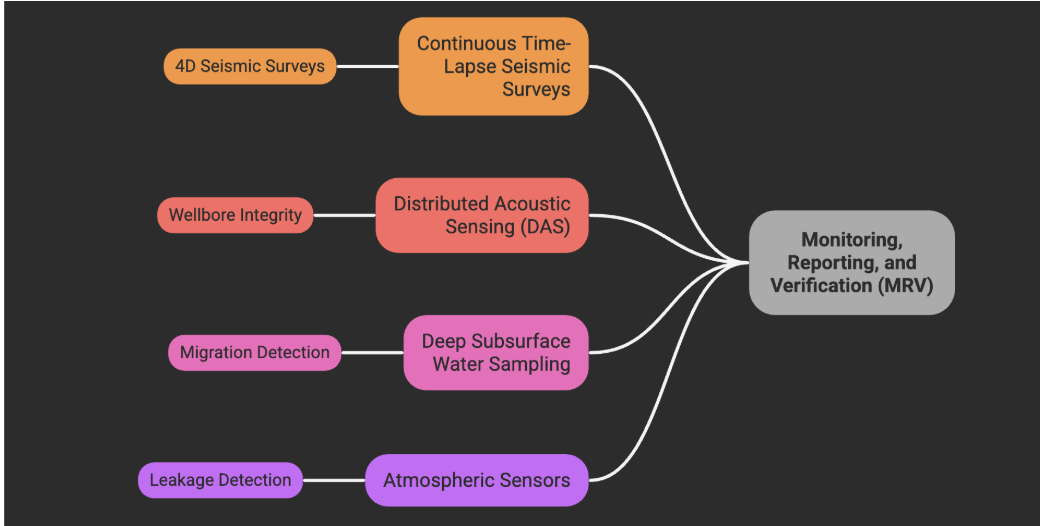
To manage liability, operators must run robust Monitoring, Reporting, and Verification (MRV) frameworks. This includes continuous 4D time-lapse seismic surveys to track subterranean plumes, Distributed Acoustic Sensing (DAS) along wellbores, and deep water sampling to monitor containment integrity
5. Global Policy Catalysts and Real-World Precedents
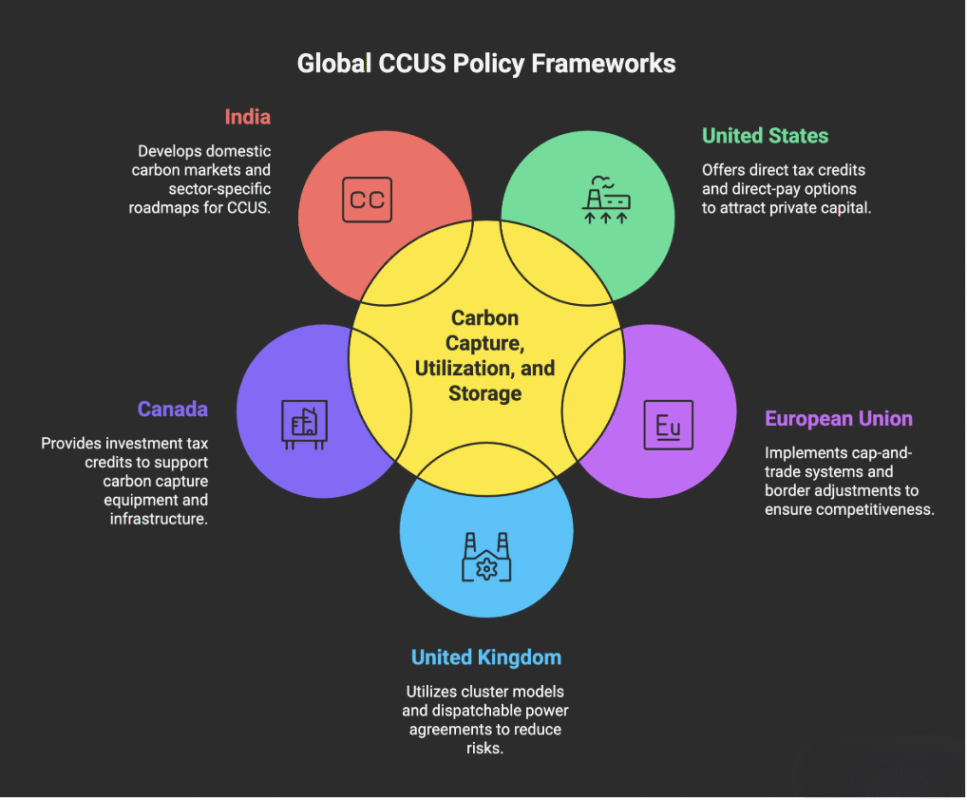
National policies play a primary role in bridging the “green premium” associated with CCUS deployment.
-
United States (45Q Tax Credit): Offers a performance-based tax credit of up to $85 per metric tonne for permanent geological storage and up to $60 per tonne for utilization/EOR, featuring direct-pay mechanisms that successfully attract private capital.
-
European Union: Implements a strict cap-and-trade system via the EU ETS alongside CBAM border adjustments to ensure domestic investments remain competitive against unmitigated imports.
-
United Kingdom: Utilizes a cluster-based model and “Dispatchable Power Agreements” to fund regional infrastructure hubs, minimizing individual infrastructure risks.
-
Canada: Provides refundable investment tax credits covering up to 50% of carbon capture equipment costs and 37.5% for midstream infrastructure.
-
India: Developing its domestic Carbon Credit Trading Scheme (CCTS) paired with sector-specific roadmaps for steel and cement to preserve global export advantages.
Landmark Projects to Study
-
Jilin Oil Field (PetroChina, China): Captures 1.0 Mtpa from chemical/gas processing plants for EOR, demonstrating that matching high-purity sources with nearby reservoirs eliminates long-distance transport costs.
-
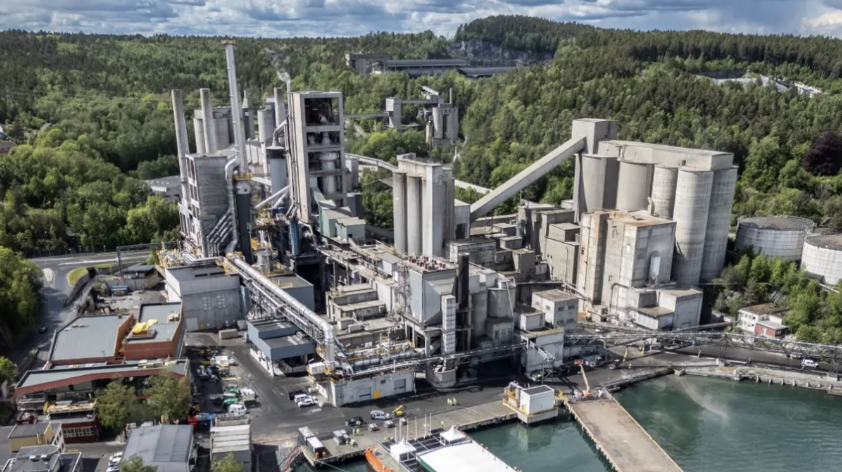
Brevik CCS (Heidelberg Materials, Norway): Captures 400,000 tonnes per annum via advanced amine post-combustion technology. The captured gas is liquefied and shipped via the “Longship” network to deep saline aquifers, proving that shared open-access storage enables premium, certified net-zero commodity sales.
-
Boundary Dam Unit 3 (SaskPower, Canada): A 1.0 Mtpa design capacity coal-fired power retrofit using amine absorption. It highlights that first-of-a-kind, standalone industrial projects face higher initial capital hurdles and require robust solvent optimization to control operational maintenance costs
6. The Executive Playbook: Strategic Suitability and Risk Mitigation
Before launching a full-scale Front-End Engineering Design (FEED) study, corporate leaders must screen their portfolios using clear operational frameworks.
When is CCUS Justified?
A facility is highly suited for deployment if it checks multiple strategic boxes: high-purity process streams ($>30%$ $text{CO}_2$), a long remaining asset lifespan ($>15$ years), high exposure to aggressive regional carbon penalties, and immediate geographic access (within 50 km) to an open-access shared transport pipeline or deepwater shipping hub.
When Should You Halt or Pivot?
Executives should halt CCUS development if the emission sources are highly dilute and physically scattered across an older site, which drastically drives up engineering complexity and pushes abatement costs past $120–$150 per tonne. Similarly, if a facility is geographically isolated from geological storage sinks, faces severe on-site space and utility constraints, or has cheaper, direct decarbonization alternatives (like low-temperature electrification), capital should be directed away from CCUS.
7. Emerging Industrial Cluster Models: The India Case Study
To bypass individual storage bottlenecks, emerging economies are actively shifting toward shared industrial hubs. In India, for instance, NITI Aayog’s evolving roadmap highlights distinct regional cluster alignments:
-
The Gujarat-Western Coast Cluster: Combines high point-source density from refining and petrochemical hubs with immediate access to the Cambay basin’s depleted reservoirs and deepwater ports.
-
The East India Mineral Belt Cluster: Focuses on heavy steel and coal baseload power plants, requiring shared rail and pipeline transport networks to move captured carbon to offshore storage formations in the Bay of Bengal
8. Regulatory Action Plan
To navigate this transition successfully, corporate leaders should align their planning with NITI Aayog’s evolving CCUS roadmap:
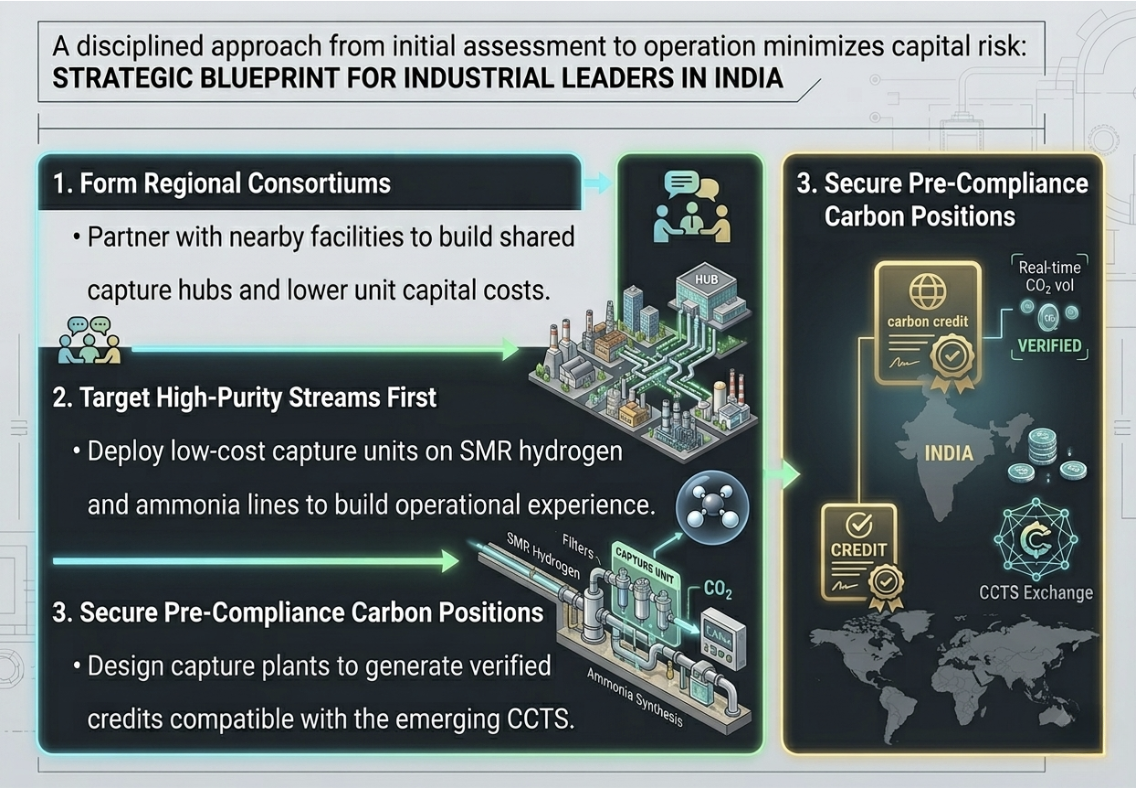
By focusing on these practical, immediate steps, Indian manufacturers can mitigate long-term compliance risks, lower their all-in cost of capture, and position themselves as highly competitive players in a global, decarbonized marketplace.
Conclusion
CCUS is no longer an optional sustainability initiative; it is a critical infrastructure requirement for heavy industry operating in a decarbonizing economy. While the capital requirements are substantial, the financial risks of inaction—including carbon penalties, stranded assets, and lost export markets—are significantly higher.
Ready to Deepen Your CCUS Strategy?
While this blog post outlines the high-level roadmap, executing a multi-million dollar CCUS strategy requires granular engineering, economic, and policy frameworks.
Download the Complete CCUS Guide Now: https://wudbox.in/carbon-capture-utilization-and-storage-ccus_a-complete-guide-for-industrial-decarbonization/
Partner with Wudbox Sustainability Insights
Need hands-on assistance translating sustainability intent into operationally sound, auditable, and future-ready frameworks?
Whether you need to form regional industrial consortiums, screen your asset portfolio for carbon liability, or build internal ESG governance, Wudbox works directly with manufacturing and industrial organizations to sustain long-term environmental performance.
Email: [email protected]
Phone no: 9811126365