
Introduction
For heavy manufacturing and forging enterprises, the transition toward deep decarbonization has rapidly evolved from a corporate citizenship metric into a core operational priority. As global carbon pricing frameworks tighten, export compliance standards intensify, and domestic energy tariffs experience systemic volatility, industrial leadership faces an urgent mandate: drastically compress greenhouse gas (GHG) emission intensity per ton of manufactured product without disrupting output or deteriorating operating margins.
While long-term capital strategies often target macro-level shifts—such as green hydrogen adoption or full-scale facility electrification—these pathways present complex grid-capacity constraints and prolonged return-on-investment timelines. Conversely, immediate, low-risk, and highly verifiable carbon reductions can be unlocked by optimizing the latent thermodynamic energy already contained within the plant boundary.
In high-pressure forging shops, industrial steam systems represent a massive, frequently under-optimized repository of high-grade waste heat. Transitioning from legacy open-loop configurations to a digitally managed, closed-loop thermal recovery framework offers senior executives a direct mechanism to slash absolute Scope 1 emissions, defend against fuel cost escalations, and fulfill strict ESG commitments.
Capturing Heat from Recovered Steam
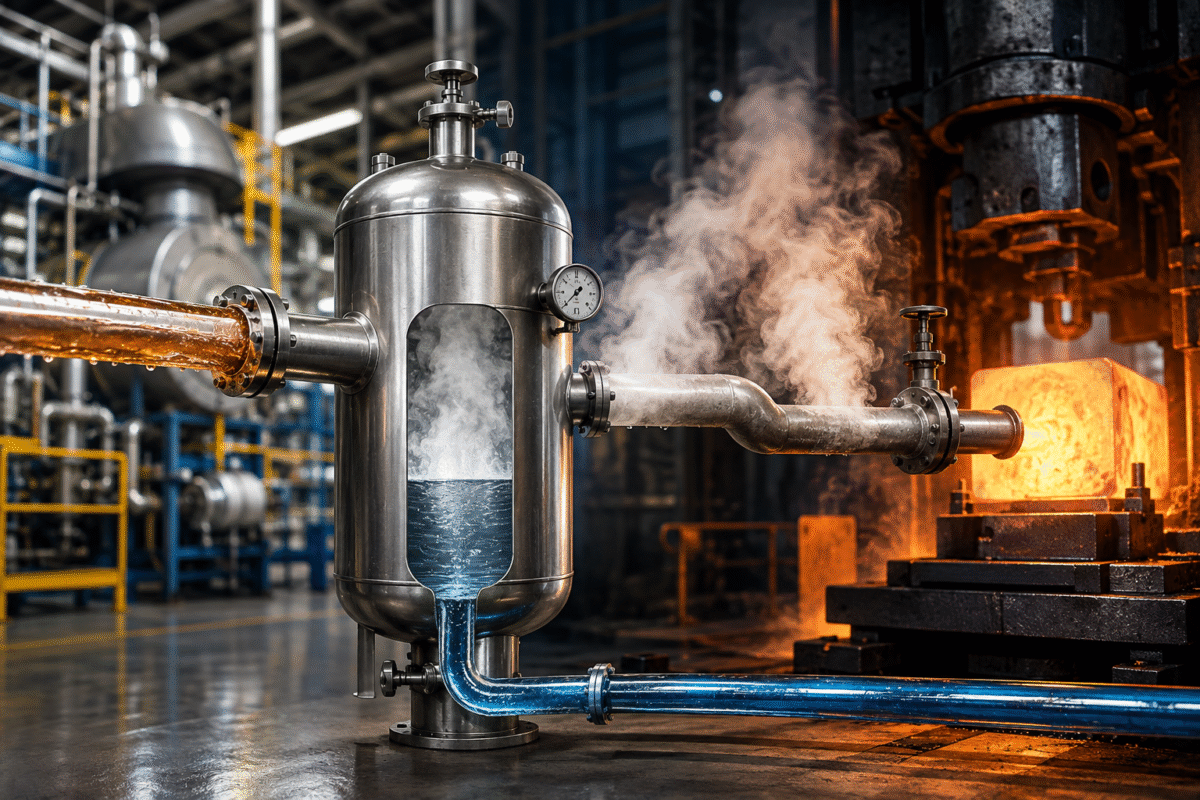
Steam remains the premier utility for high-energy thermal transfer in heavy manufacturing due to its high latent heat capacity. It is critical for heavy equipment cleaning, chemical process heating, and raw material conditioning. However, once steam surrenders its latent heat to a process, it undergoes a phase change, reverting into high-pressure, high-temperature liquid condensate.
In standard industrial configurations, this condensate is discharged through a series of steam traps, depressurized, and either vented to the atmosphere as waste steam or directed to gravity drains. This operational layout represents a significant structural loss of both thermal energy and treated water.
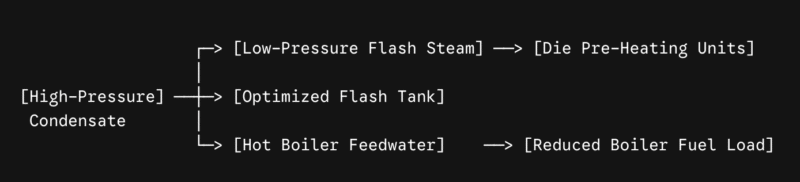
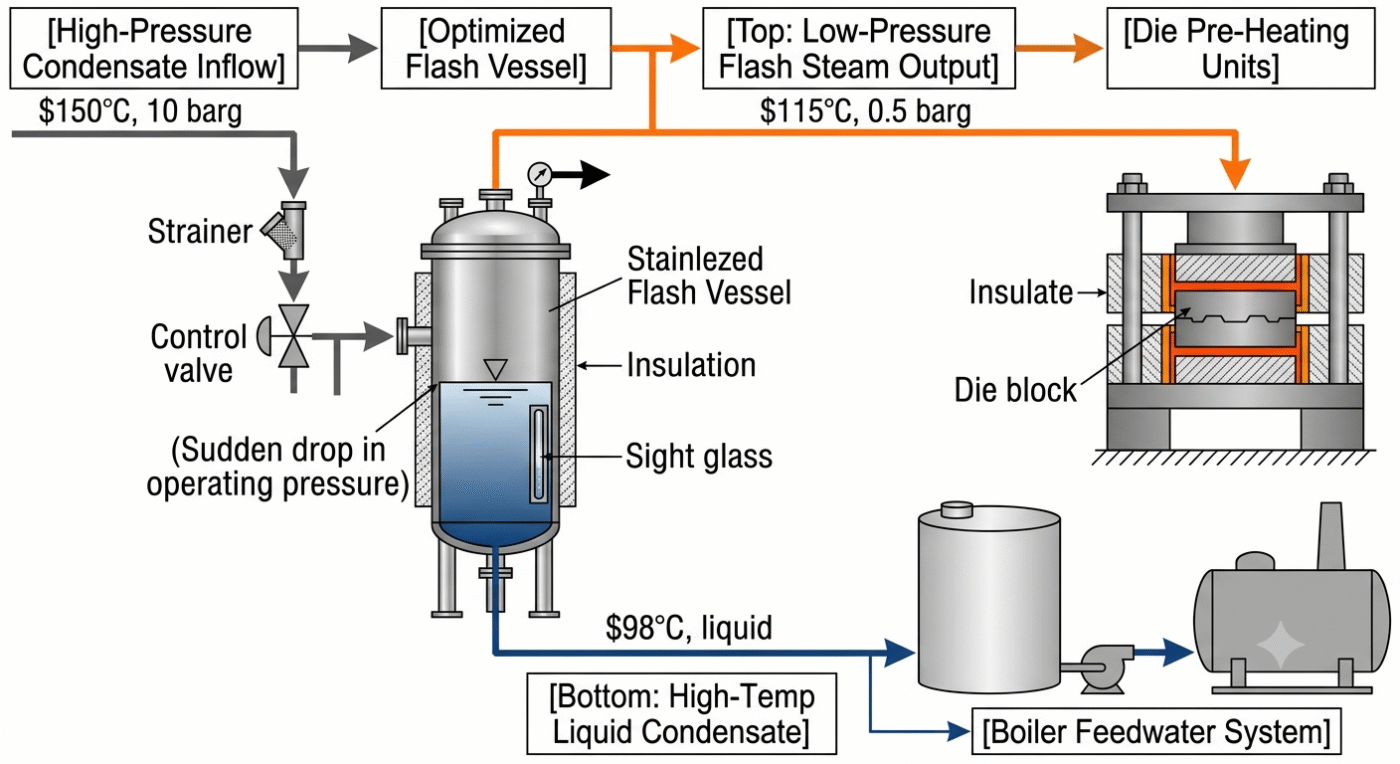
Optimizing this system via precisely calibrated flash tanks changes the economic equations through a three-stage sequence:
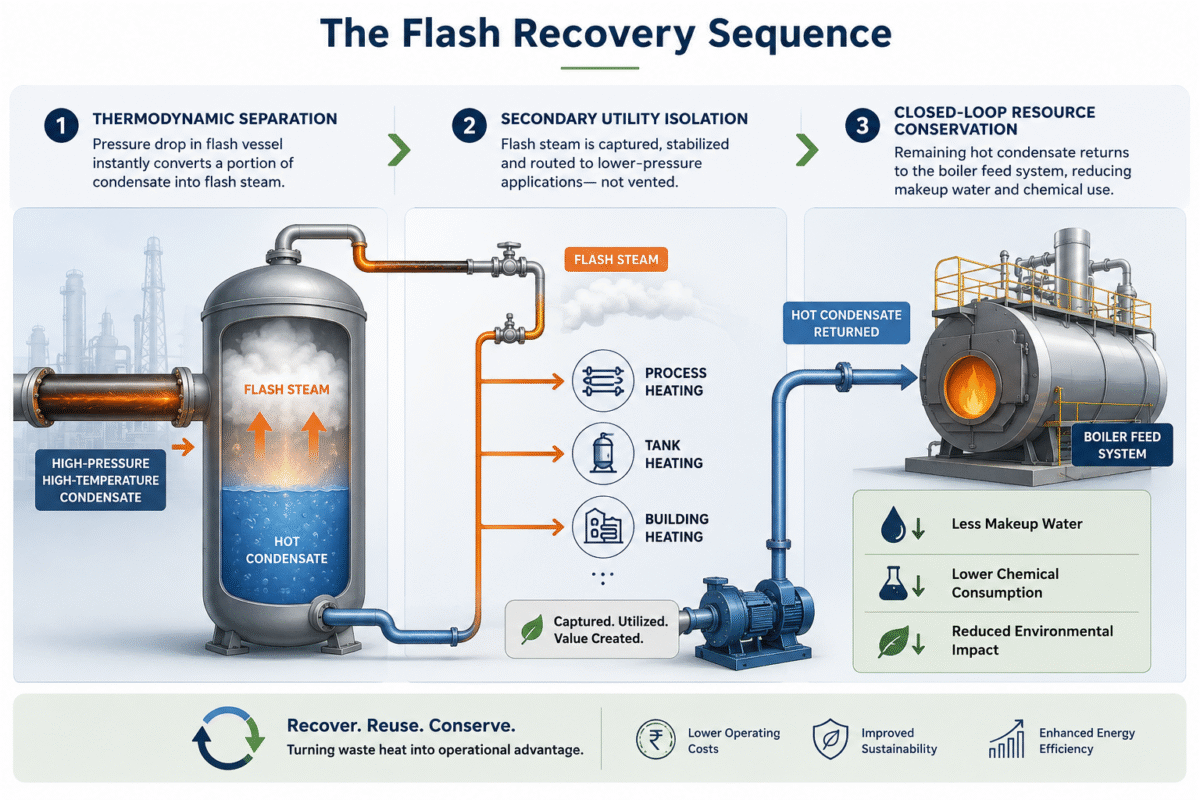
The Flash Recovery Sequence
Stage 1: Thermodynamic Separation: When high-pressure, high-temperature condensate enters a lower-pressure flash vessel, the sudden drop in pressure causes a specific percentage of the liquid to instantly re-evaporate. This process yields low-pressure steam, technically classified as flash steam.
Stage 2: Secondary Utility Isolation: Instead of allowing this flash steam to vent into the atmosphere as an environmental and financial liability, an optimized recovery infrastructure captures, stabilizes, and routes it directly to secondary, lower-pressure thermal applications across the plant floor.
Stage 3: Closed-Loop Resource Conservation: The remaining high-temperature liquid condensate is pumped directly back into the boiler feed system. This dramatically minimizes the volume of raw, cold makeup water required, while reducing the consumption of water-treatment chemicals and oxygen scavengers.
Decarbonizing Die Pre-Heating with Recycled Steam: From Fossil Fuel Dependance to Circular Heat
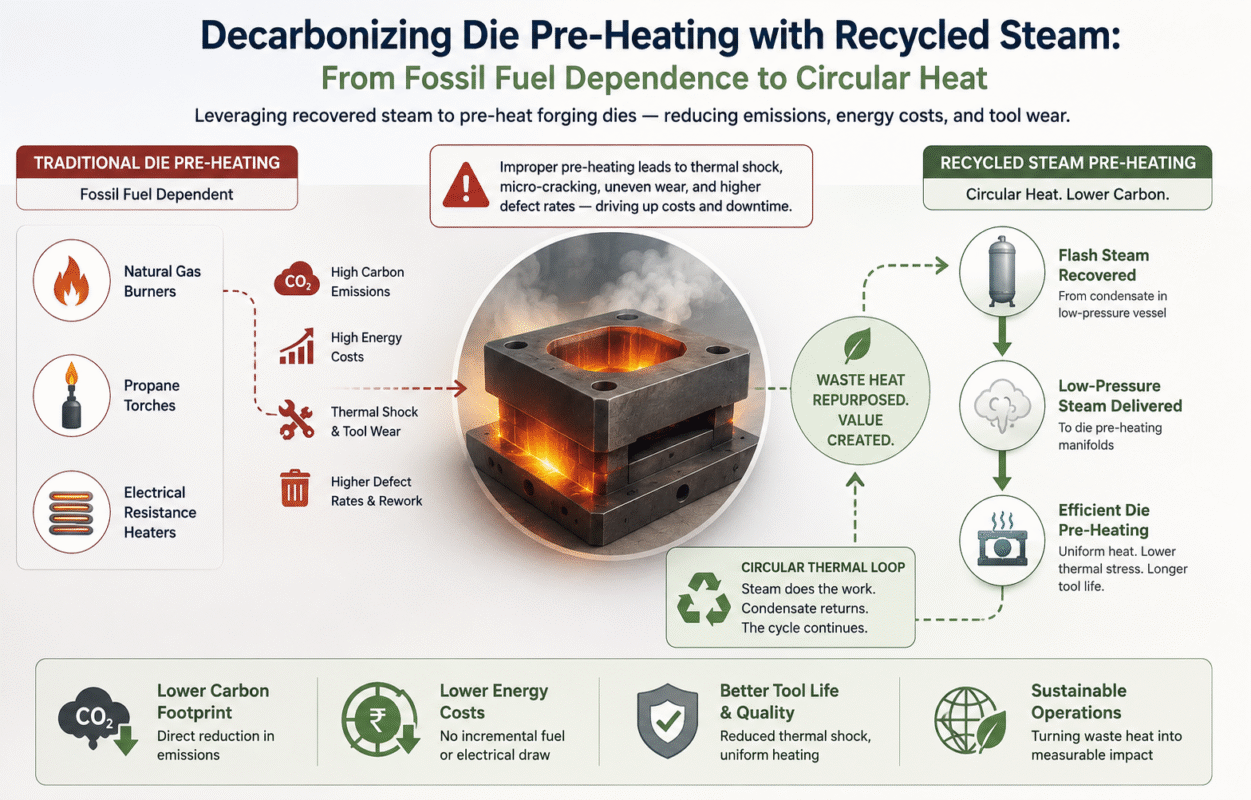
High-pressure forging dies operate under extreme cyclic thermal and mechanical stresses. Bringing these substantial tool steel blocks up to target operational temperatures before production runs is non-negotiable; insufficient pre-heating exposes the tooling to catastrophic thermal shock, accelerated micro-cracking, uneven surface wear, and premature structural failure. Furthermore, improper die stabilization leads to high component defect rates, including incomplete cavity filling, surface deformities, and dimensional variances that require costly rework.
Traditionally, forging operations rely on dedicated natural gas burners, open propane torches, or high-draw electrical resistance heating elements to pre-heat dies. While functionally effective, these methods carry heavy carbon footprints and inflate energy costs.
Replacing or supplementing these external energy sources with recovered low-pressure flash steam establishes a highly effective circular thermal loop. By leveraging waste heat that has already been purchased and generated during the primary boiler cycle, the plant eliminates the need for incremental fuel combustion or electrical draw during the pre-heating phase. This creates a direct, measurable reduction in the facility’s localized carbon footprint.
The Business Case: Financial and Savings Potential
Optimizing flash tank networks yields distinct financial dividends that align operational expenditure with corporate sustainability metrics.
|
Strategic Value Driver |
Operational Reality |
Corporate & ESG Impact |
Financial Return Profile |
|
Direct Fuel Displacement |
Displaces natural gas, LPG, or grid electricity used in conventional die pre-heating loops with zero-carbon waste heat. |
Verifiable reduction in Scope 1 emissions and direct contraction of monthly utility overheads. |
Slashes fuel expenditure directly linked to auxiliary heating loops, creating a robust shield against energy pricing spikes. |
|
Boiler Plant Optimization |
Returns high-temperature condensate (90 degree celsius to the boiler house rather than cold raw makeup water (20-25 degree celsius). |
Reduces the thermal load on the boiler, dropping the fuel-to-steam ratio and expanding boiler operating capacity. |
Shortens boiler firing cycles, generating structural reductions in heavy fuel consumption and utility asset degradation. |
|
Tooling Asset Protection |
Delivers uniform, controlled steam-based thermal transfer to forging dies, eliminating localized stress points caused by open flames. |
Lowers tooling CAPEX requirements by mitigating thermal shock and extending the operational lifecycle of expensive dies. |
Shrinks tooling replacement budgets and prevents expensive production downtime caused by unexpected die cracking. |
|
Water Stewardship Metrics |
Recovers high-purity condensed water, minimizing raw water withdrawal and industrial effluent discharge volumes. |
Strengthens water circularity indices, supporting compliance with stringent localized environmental mandates. |
Lowers cost of water procurement, raw water treatment chemicals, and municipal effluent treatment fees. |
Operational Risk Mitigation and Capital Challenges
Transforming brownfield forging networks into high-efficiency thermal loops requires addressing specific technical considerations:
-
System Pressure Cascading and Balance: Forging plants generally operate on highly variable production schedules with fluctuating steam demands. Designing a resilient flash recovery network requires accurate pressure balancing across the facility. The low-pressure flash steam must maintain sufficient pressure to overcome the hydraulic resistance of the die-heating loops without generating excessive backpressure upstream, which could stall primary production machinery or cause water hammer in the condensate lines.
-
Digital Monitoring and Thermal Integrity: The financial return of a flash steam recovery investment depends on continuous thermal containment. Organisation should authorize the integration of real-time digital monitoring tools alongside hardware installation. Smart steam traps equipped with acoustic and temperature sensors can immediately identify and report bypass leaks, ensuring the captured energy is directed to the die pre-heating units rather than leaking out unnoticed. High-grade, durable insulation must also be applied across all new pipelines to prevent convective heat losses.
-
Phased Capital Implementation: Retrofitting legacy piping networks requires precise engineering mapping to ensure that hardware installation does not trigger unscheduled production downtime. Implementing a phased execution model—where pipeline re-routing and flash tank integration coincide with planned plant turnarounds—mitigates operational risks and ensures smooth deployment.
Conclusion
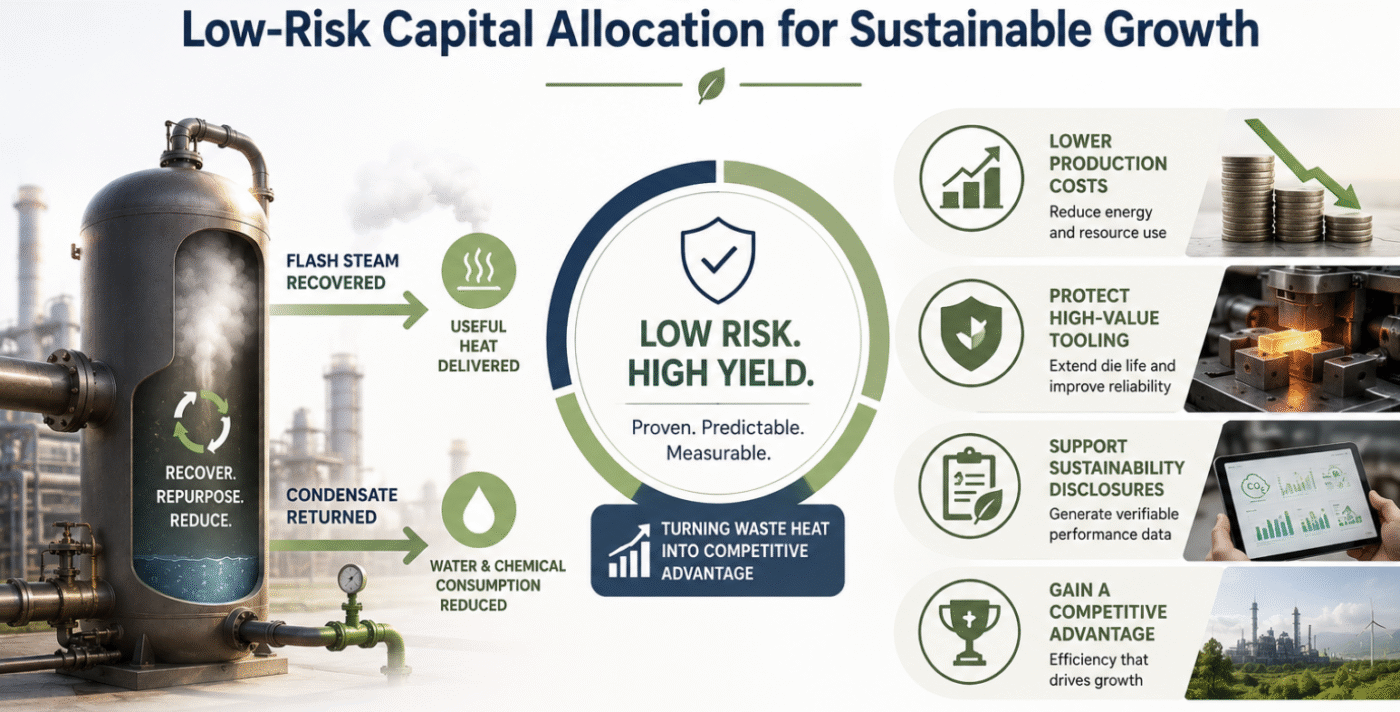
For organisations evaluating capital allocation strategies to satisfy corporate decarbonization targets, steam and condensate optimization represents one of the lowest-risk, highest-yield initiatives available in heavy manufacturing. Unlike speculative green technology investments, the physics of flash steam recovery are completely predictable, highly replicable, and easily measured using standard industrial instrumentation.
By converting thermal waste into an active operational asset, forging enterprises can simultaneously compress production costs, safeguard high-value tooling infrastructure, and generate verifiable data to support international sustainability disclosures. Maximizing flash tank performance changes energy efficiency from a compliance cost into a distinct competitive advantage.