
Introduction
For manufacturing and industrial organisations, achieving decarbonisation targets requires more than identifying opportunities to reduce greenhouse gas emissions. It requires a structured approach to determining which interventions should be implemented, how much investment they require, when the capital needs to be deployed and how the expected emissions reductions will be delivered.
Organisations may have established net-zero commitments, developed emissions inventories and identified potential reduction opportunities across their operations and value chains. However, these activities do not automatically create a financially viable transition plan.
A reduction opportunity must be translated into a defined project. The project must be technically feasible, financially evaluated, prioritised against competing investments and supported by an appropriate funding mechanism. It must also have an accountable owner, implementation timeline and performance measurement framework.
This introduces an important business challenge: How can organisations align their emissions reduction pathways with financial planning and capital allocation decisions?
Decarbonisation investment planning addresses this challenge by connecting emissions targets with project economics, investment priorities, funding requirements and operational execution.
For leadership teams, the objective is to move beyond a list of sustainability initiatives and establish a structured investment portfolio that demonstrates how the organisation intends to achieve its emissions reduction milestones while maintaining financial and operational viability.
1. Why Net-Zero Targets Do Not Automatically Become Funded Plans
A corporate emissions reduction target describes an intended outcome. A funded transition plan explains how the organisation will achieve it through changes in assets, processes, energy sourcing, products and value chains.
The gap between the two usually emerges because climate planning and financial planning operate independently.
Sustainability teams may develop emissions reduction pathways, while finance teams manage annual budgets, capital expenditure and investment approvals. Operations teams, meanwhile, must ensure that any proposed intervention does not compromise production, safety, quality or reliability.
Unless these functions work within a common planning framework, emissions reduction opportunities can remain disconnected from actual business decisions.
Common planning gaps and their business implications
i) Targets remain outside business planning
When climate commitments are not integrated into long-range planning and annual capital expenditure cycles, the investments needed to achieve them may not receive adequate consideration.
ii) Reduction opportunities are not converted into projects
Identifying energy efficiency, electrification or process improvement opportunities is not sufficient. Each material intervention requires defined technical scope, cost estimates, implementation timelines, project ownership and expected emissions reductions.
iii) Financial assumptions are inconsistent
Projects assessed using different energy prices, asset lives, discount rates, carbon assumptions and system boundaries cannot be compared reliably. This can result in inconsistent investment decisions.
iv) Only direct financial savings are considered
Evaluating projects only on immediate cost savings may overlook their contribution to regulatory preparedness, operational resilience, customer requirements, energy security and long-term competitiveness.
v) Capital is approved one project at a time
An individual project may appear financially attractive, but approving projects independently can leave dependencies, infrastructure requirements and gaps in the overall emissions reduction pathway unidentified.
vi) Targets are not refreshed as business conditions change
Production growth, acquisitions, asset replacements, changing energy prices and technology developments can affect both the emissions pathway and the investment pipeline.
What changes when the transition plan is funded?
The organisation moves from maintaining a list of initiatives to managing a structured investment portfolio.
Each project should have:
-
A defined contribution to the emissions reduction pathway.
-
Estimated capital and operating expenditure.
-
A financial business case and sensitivity assessment.
-
An implementation timeline and operational dependencies.
-
A funding route and approval status.
-
An accountable project owner.
-
A baseline and post-implementation measurement plan.
It is equally important to distinguish between identified opportunities, feasibility-stage projects, business-case-ready projects, approved capital and committed expenditure. The value of an identified project pipeline should never be presented as equivalent to an approved transition budget.
2. Translating the Emissions Pathway into Operational Levers
A credible investment plan begins with the organisation’s emissions inventory and reduction pathway.
The objective is to determine which physical, commercial and value-chain interventions can deliver the required emissions reductions at the appropriate time.
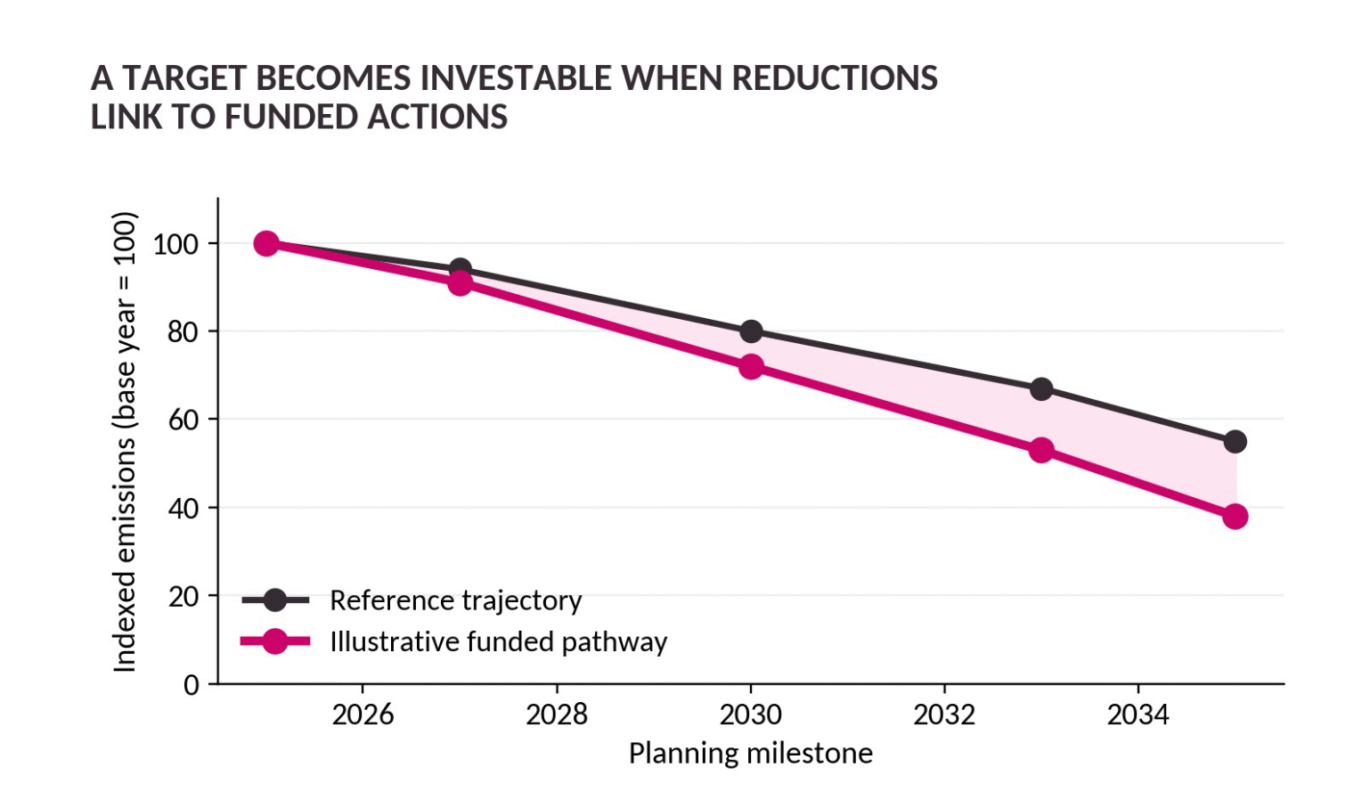
Rather than applying an assumed annual reduction rate, organisations should identify specific operational levers and quantify their expected contribution.
Identifying opportunities across emissions scopes
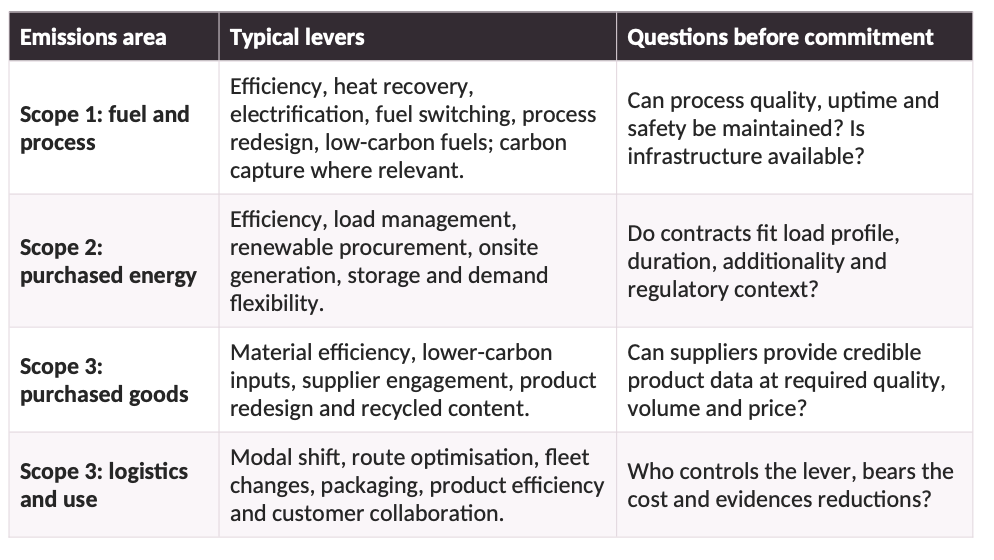
Building the bridge from emissions pathways to projects
The transition from emissions targets to investment planning should follow a defined sequence:
-
Break the emissions reduction pathway into annual or milestone-based emissions budgets.
-
Map the budgets to individual scopes, sites, processes or business units.
-
Identify the emissions sources responsible for the largest reduction gaps.
-
Map technically feasible interventions against these sources.
-
Estimate emissions reductions, capital requirements, operating impacts and dependencies.
-
Reconcile project-level reductions with the corporate emissions pathway.
This process provides the foundation for developing an investment-ready project portfolio.
3. Building a Decarbonisation Project Portfolio
Once operational levers have been identified, organisations need to structure them into a project portfolio.
A portfolio approach helps leadership understand how individual projects contribute to the overall transition pathway, how they depend on one another and how investment requirements should be sequenced.
Five broad categories can be used to organise decarbonisation projects.
3.1 No-regret operational improvements
These typically include compressed-air optimisation, steam system improvements, insulation, process controls, leak reduction and heat recovery.
Such opportunities can often be developed relatively quickly. However, organisations should validate the baseline, expected savings and implementation requirements before assigning emissions reduction benefits.
Smaller projects may also be bundled where individual transaction and implementation costs are relatively high.
3.2 Efficiency and electrification
This category includes motor upgrades, heat pumps, electric process heating, variable-speed drives and process integration.
Investment decisions should account for grid capacity, energy prices, equipment compatibility, downtime requirements and production constraints.
3.3 Energy-system transformation
Renewable electricity procurement, onsite generation, battery storage, thermal storage and demand response can support changes in the organisation’s energy system.
These projects require evaluation of load profiles, contract risks, grid charges, energy availability, firming requirements and counterparty considerations.
3.4 Asset and process transformation
Major production route changes, low-carbon fuels, process retrofits, material substitution and carbon capture where justified can involve substantial investment and longer development periods.
Such projects require strategic stage gates covering technology maturity, engineering feasibility, infrastructure availability and asset-life implications.
3.5 Value-chain programmes
Supplier decarbonisation, lower-carbon materials, logistics redesign and customer collaboration extend the investment portfolio beyond the organisation’s direct operations.
These interventions may require procurement commitments, supplier partnerships, shared investment models and commercial agreements.
Making project maturity visible
Not all identified projects are ready for capital approval. Each project should move through defined stages:
| Project stage | Minimum evidence required |
|---|---|
| Opportunity identified | Emissions source, potential intervention, indicative abatement and accountable sponsor |
| Screened | Technical fit, indicative costs, operational constraints and dependencies |
| Pre-feasibility | Options assessment, preliminary engineering, site data and risk register |
| Business case | Defined scope, CAPEX, OPEX, financial appraisal, abatement estimates, funding route and sensitivities |
| Approved / executing | Sanctioned budget, procurement plan, permits, delivery owner and measurement plan |
| Operating / verified | Commissioning evidence, actual performance, cost variance and lessons learned |
This maturity framework prevents organisations from assigning full emissions reduction credit to projects that are still at the opportunity identification or preliminary feasibility stage.
Gross technical potential and risk-adjusted expected contributions should be reported separately.
4. Evaluating Projects on Financial and Carbon Performance
Decarbonisation investments need finance-grade business cases. The fact that a project contributes to emissions reduction does not remove the requirement to assess its financial viability, operational implications and implementation risks.
Each project should be evaluated using consistent financial and carbon performance parameters.
Key financial evaluation metrics
a) Capital expenditure (CAPEX)
CAPEX includes the initial investment required for equipment, installation, replacement, integration and enabling infrastructure. Organisations should also account for commissioning costs, downtime and relevant end-of-life considerations.
b) Operating expenditure (OPEX)
OPEX assessment should identify changes in energy consumption, fuel costs, maintenance, labour and consumables.
A project that requires substantial initial capital may generate recurring operational savings. These should be evaluated using realistic energy prices and expected operating performance rather than relying only on current tariffs.
c) Payback period
Payback measures the time required for cumulative net cash benefits to recover the initial investment.
Although useful for preliminary screening, payback does not account for cash flows beyond the recovery period or the time value of money. It should therefore not be used as the sole investment criterion.
d) Net Present Value (NPV)
NPV evaluates the present value of expected cash flows after accounting for the initial investment.
It helps assess whether a project is expected to generate value over its investment life. Consistent discount rates, project lifetimes and residual value assumptions are necessary for meaningful comparisons.
e) Internal Rate of Return (IRR)
IRR represents the discount rate at which the project’s NPV equals zero.
It can support comparisons of investment returns, but may mis-rank mutually exclusive projects or produce misleading results under unusual cash-flow patterns.
f) Cost of abatement
Cost of abatement measures the incremental cost associated with avoiding a defined quantity of emissions over a specified period or lifecycle.
A simplified calculation is:
Cost of abatement = Annualised incremental cost compared with the reference case ÷ Annual emissions avoided.
For lifecycle comparisons, discounted incremental costs and discounted emissions reductions should be considered over the same period.
The calculation should clearly state its system boundaries, timeframe, discounting assumptions and whether the project represents positive-cost or negative-cost abatement.
Importantly, a low cost per tonne of emissions avoided does not automatically make a project the best investment. Some interventions may provide enabling infrastructure, protect production, reduce regulatory exposure or unlock larger investments.
The strategic rationale should be documented alongside the financial assessment.
5. Making Project Economics Comparable
Capital committees need a consistent basis for comparing decarbonisation projects across different sites, technologies and business units.
Standardising financial assumptions improves decision quality while allowing project-specific risks to remain visible. The following assumptions should be established across the investment planning process.
| Assumption | Assessment requirement |
|---|---|
| Reference case | Define what would happen without the project, including maintenance, asset replacement and production changes |
| Energy and input prices | Apply consistent corporate assumptions and distinguish contracted prices from market estimates |
| Carbon price / shadow value | Clarify whether the value represents a policy cost, internal shadow price or scenario variable |
| Discount rate and financing | Use approved corporate conventions and separately identify project-specific risks |
| Asset life and residual value | Align with engineering life, expected replacement and transition-related obsolescence |
| Production and utilisation | Account for realistic throughput, ramp-up, downtime and demand |
| Emissions factors | Record source, geography, reporting year, scope, methodology and version |
| System boundaries | Include relevant upstream energy and material lifecycle effects where methodologically appropriate |
Running decision-relevant sensitivities
Financial models should not rely exclusively on a central forecast. They should test the effect of changes in critical assumptions.
Important sensitivity variables include:
-
Energy prices: Low, central and high scenarios, including contract expiry and fuel-price changes.
-
Carbon and policy exposure: Relevant compliance, taxation, border and customer requirements.
-
Technology performance: Efficiency, availability, degradation, yield and maintenance.
-
Project cost and schedule: Capital escalation, permitting delays, grid connections and commissioning risks.
-
Production assumptions: Changes in utilisation, growth, product mix and demand.
A robust business case should demonstrate how the investment performs under different operating and market conditions. It should also identify the assumptions that must hold for the project to remain viable.
6. Establishing a Decision Framework for Capital Allocation
Once projects have been assessed, organisations need a transparent process for determining which investments should receive priority. A two-stage decision framework can help achieve this.
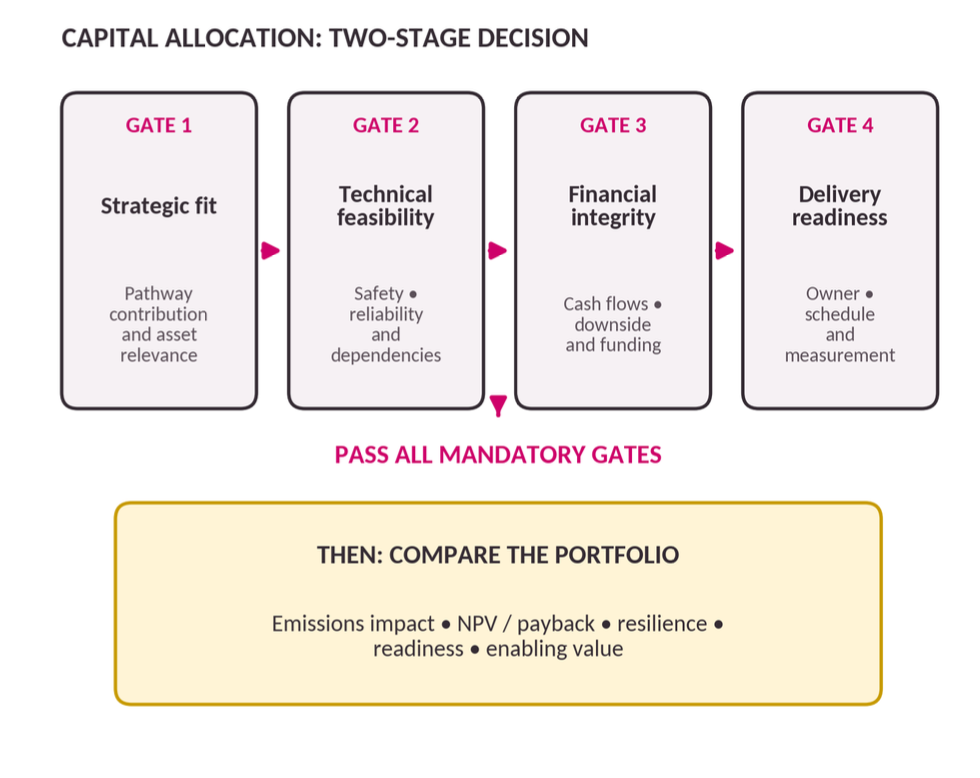
Stage 1: Mandatory investment gates
Projects should first meet essential requirements before being compared through a weighted scorecard.
Strategic fit: Does the project contribute to a defined emissions reduction pathway milestone or an essential enabling requirement?
Technical feasibility: Are engineering requirements, safety, reliability, process quality and operational constraints understood?
Financial integrity: Have costs, cash flows, discounting assumptions and downside sensitivities been reviewed by finance?
Delivery readiness: Are project ownership, schedules, procurement, permits, infrastructure and dependencies identified?
Measurement readiness: Are the baseline, calculation methodology, data owner and post-implementation measurement arrangements defined?
A project that fails a mandatory gate should not progress simply because it has a high overall score on other parameters.
Stage 2: Weighted project portfolio assessment
Projects that pass the mandatory requirements can be compared using a common scorecard.
An illustrative assessment framework is:
| Assessment criterion | Illustrative weight |
|---|---|
| Emissions contribution | 25% |
| Financial attractiveness | 25% |
| Strategic resilience | 15% |
| Technical and delivery readiness | 15% |
| Dependencies and enabling value | 10% |
| Co-benefits and wider impacts | 10% |
The criteria assess expected annual and lifecycle emissions reductions, NPV, lifecycle costs, payback, energy security, customer requirements, regulatory exposure, technology maturity, implementation capability and wider operational benefits.
These weights are illustrative. Organisations should establish their own criteria and weightings based on business priorities.
Unweighted financial and emissions metrics should also remain visible. A combined score should support management judgement, not replace it.
7. Balancing the Portfolio Across Impact, Economics and Readiness
Capital allocation should not focus exclusively on projects with the highest immediate financial returns or the lowest cost per tonne of emissions avoided.
A balanced portfolio considers three dimensions:
-
Emissions impact: How much reduction can the project deliver, and how relevant is it to the required pathway milestone?
-
Financial attractiveness: What are the investment requirements, expected returns, lifecycle costs and downside risks?
-
Project readiness: How mature is the technology, how well defined is the engineering scope and how capable is the organisation of implementing it?

A portfolio assessment can help classify projects into different investment categories.
i) High readiness, attractive economics and meaningful abatement: These projects may be advanced towards business-case approval while preserving the resources required for delivery.
ii) High abatement with high capital or technology risk: These projects may require staged investment, engineering studies, pilots or enabling infrastructure before full capital commitment.
iii) Strong strategic value with modest direct financial returns: Their value should be assessed in the context of regulatory exposure, resilience, customer requirements and asset transition dependencies.
iv) Low pathway relevance and weak economics: These projects may be deferred, redesigned or stopped unless mandatory safety or compliance requirements apply.
A portfolio map can make these trade-offs visible to investment committees.
However, portfolio scoring should remain a decision-support tool. NPV, CAPEX, expected emissions reductions, project schedules, risks and dependencies should always be retained for individual projects.
8. Reconciling the Emissions Pathway with the Investment Pipeline
A transition plan is credible only when the required emissions reductions can be traced to specific interventions and the capital needed to deliver those interventions is visible.
This requires a reconciliation between the corporate emissions pathway and the investment pipeline.
For every planning year, organisations should compare the emissions reduction required with the abatement supported by projects at different stages of maturity.
The reconciliation should cover eight layers:
-
Business-as-usual emissions forecast: What would emissions look like without additional transition interventions?
-
Target pathway: What emissions level must be achieved, and by when?
-
Required abatement: What reduction is needed relative to the business-as-usual forecast?
-
Identified project pipeline: Which opportunities could potentially close the gap?
-
Business-case-ready projects: Which projects have sufficiently developed technical and financial assessments?
-
Approved and funded projects: Which interventions have received formal investment approval?
-
Expected abatement from funded projects: How much of the pathway is supported by approved investments?
-
Residual emissions and funding gap: What remains uncovered, and what additional capital may be required?
Illustrative emissions-to-investment reconciliation
Consider the following example for an industrial organisation planning to achieve its 2030 emissions target.
| Parameter | 2030 example |
|---|---|
| Business-as-usual emissions | 1,000 ktCO₂e |
| Target pathway emissions | 650 ktCO₂e |
| Required abatement | 350 ktCO₂e |
| Identified project pipeline | 420 ktCO₂e |
| Abatement from approved projects | 240 ktCO₂e |
| Uncovered abatement gap | 110 ktCO₂e |
The identified project pipeline offers potential reductions of 420 ktCO₂e, which exceeds the required reduction of 350 ktCO₂e.
However, only 240 ktCO₂e is supported by approved investments. The remaining gap is: 350 ktCO₂e − 240 ktCO₂e = 110 ktCO₂e
This means the organisation still needs to identify additional interventions, develop the relevant business cases and allocate capital to close the gap.
The distinction between identified and approved projects is critical.
An identified project may be technically immature, unfunded, delayed or dependent on another intervention. Even an approved project represents expected reductions until commissioning and measured performance confirm delivery.

Controls for reliable reconciliation
Organisations should establish consistent controls across the emissions pathway and project assessments.
These include:
-
Maintaining consistent organisational boundaries, baselines, time horizons and emissions factors.
-
Accounting for project commissioning and ramp-up periods before assigning annual abatement.
-
Removing double counting across projects.
-
Accounting for dependencies, production growth, asset closures and changes in business-as-usual assumptions.
-
Separating gross technical potential, risk-adjusted expected abatement, approved-project abatement and realised reductions.
-
Translating residual emissions gaps into estimated additional capital requirements, with assumptions and uncertainties clearly documented.
The final output should provide leadership with a year-by-year view of required abatement, investment coverage, approved capital, expected funded reductions and residual emissions and funding gaps.
9. Connecting the Emissions Pathway to Approved Capital
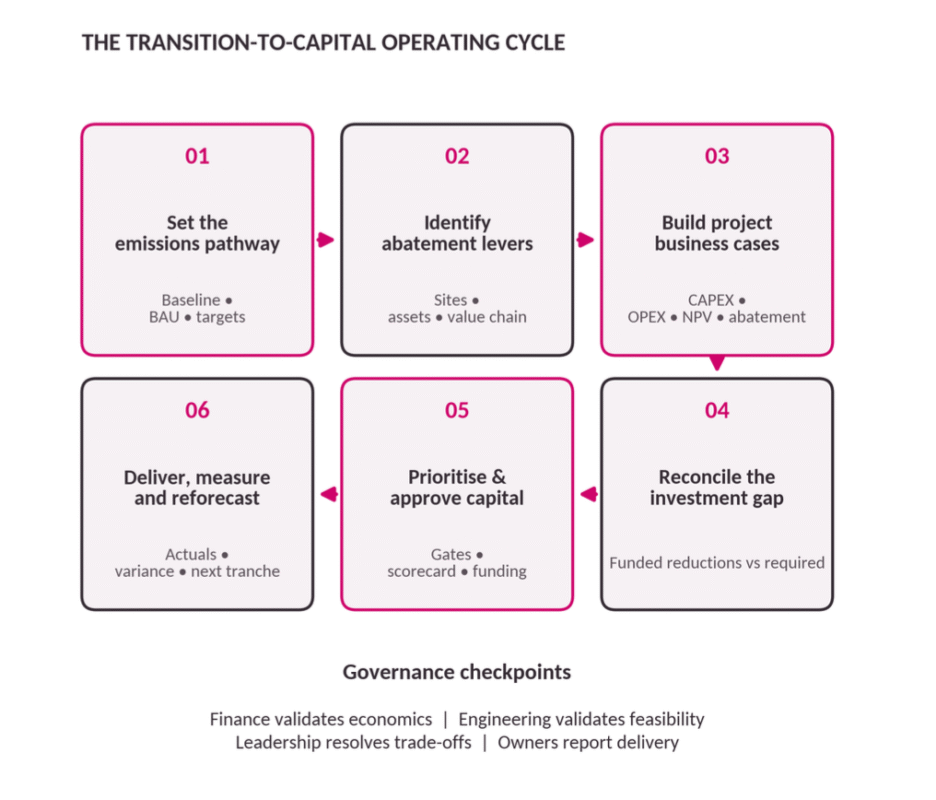
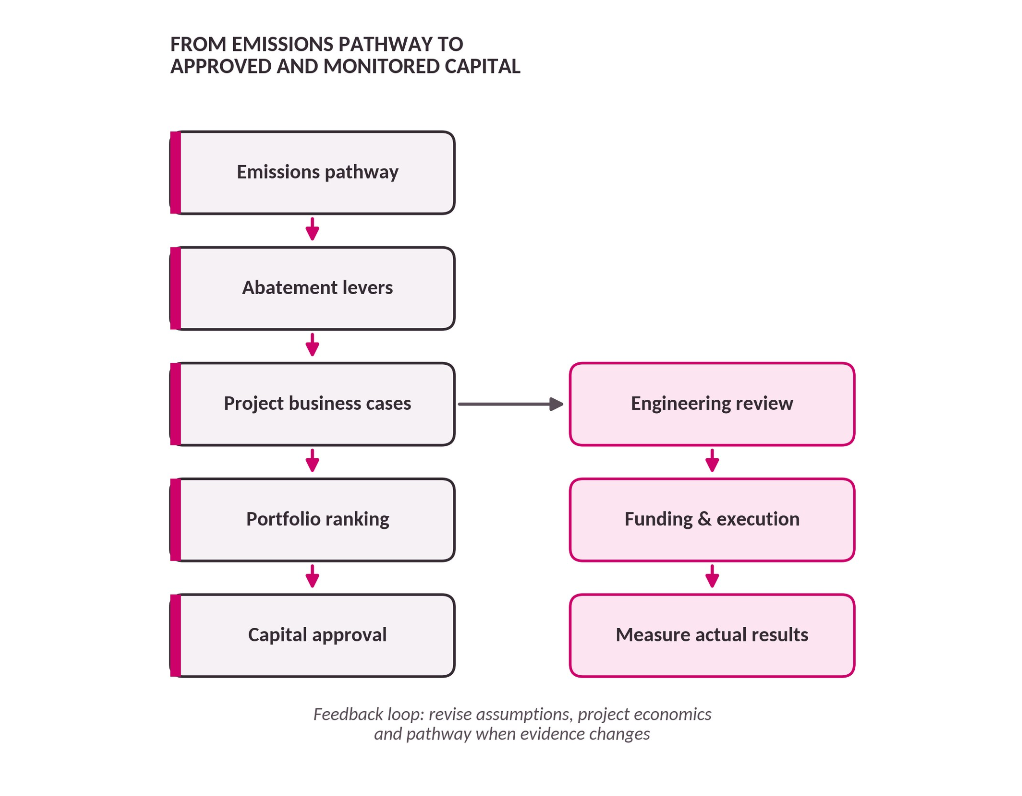
The transition from emissions strategy to capital approval should follow a structured operating cycle.
The process connects sustainability, strategy, engineering, finance and operations through defined stages.
Stage 1: Set the emissions pathway
Confirm the emissions baseline, target milestones and business-as-usual assumptions.
Stage 2: Identify abatement levers
Map operational interventions across assets, processes, energy systems and the value chain.
Stage 3: Build project business cases
Develop technical and financial assessments covering CAPEX, OPEX, NPV, expected emissions reductions, dependencies and sensitivities.
Stage 4: Reconcile the investment gap
Compare the reductions required with the abatement supported by the project pipeline and approved investments.
Stage 5: Prioritise and approve capital
Apply mandatory investment gates, compare projects using agreed criteria and establish funding requirements.
Stage 6: Deliver, measure and reforecast
Monitor actual expenditure, operational performance and emissions reductions. Reassess project assumptions and the corporate pathway when material changes occur.
Governance checkpoints
| Stage | Required output | Accountable lead |
|---|---|---|
| Pathway and baseline | Approved baseline, target milestones and gap analysis | Sustainability / strategy |
| Abatement levers | Technical options and dependencies | Operations / engineering |
| Business cases | Costed scope, cash flows and sensitivities | Project sponsor + finance |
| Portfolio ranking | Comparable assessment and capital demand | Strategy / capital committee |
| Capital approval | Funding route, approval conditions and delivery milestones | CFO / investment committee |
| Performance review | Actual expenditure, operational performance and emissions impact | Project owner + finance + sustainability |
The process should be iterative. If actual abatement, project costs, production or enabling conditions differ from the approved business case, both the project forecast and corporate pathway should be updated.
10. Designing the Funding Architecture
Once projects are prioritised, organisations must determine how individual interventions will be financed.
The funding mechanism should match the project’s cash-flow profile, asset ownership, risk allocation and strategic importance.
Potential funding mechanisms
i) Corporate capital expenditure
Suitable for core process changes, energy efficiency improvements and strategic asset investments.
These projects compete with other capital requirements, including growth, maintenance and safety. They therefore require clear portfolio prioritisation.
ii) Operating expenditure
Can support energy optimisation, process controls, audits, service contracts and certain supplier programmes.
Organisations should establish the recurring savings, budget ownership and nature of the operating costs.
iii) Leasing and equipment-as-a-service
May be suitable for equipment with identifiable performance and service responsibilities.
The assessment should consider total contract costs, ownership, residual value and performance guarantees.
iv) Power and energy service contracts
Can support renewable electricity procurement, onsite generation and energy services.
Contract duration, energy volumes, price structures, credit exposure, regulatory considerations and termination conditions should be assessed.
v) Supplier and customer co-investment
Can support value-chain interventions where financial and operational benefits are shared.
Commercial agreements should define data rights, cost-sharing, offtake arrangements, product quality, volumes and verification requirements.
vi) Incentives and concessional finance
Relevant projects may qualify for applicable government schemes or lender programmes.
However, incentives should be treated as conditional until eligibility and disbursement are confirmed.
vii) Project finance and green debt
May be considered for large-scale investments or projects with clearly defined financing purposes and performance criteria.
Covenants, reporting requirements, use-of-proceeds conditions and financing costs should be evaluated.
Separating project economics from financing structures
An important distinction in investment planning is the difference between project viability and financing arrangements. The underlying project should first be evaluated using consistent financial assumptions.
Only after establishing its economics should the organisation compare how debt, leasing, grants, contracts, incentives or supplier contributions affect cash flows, risks and control.
This also helps prevent double-counting energy savings, incentives, carbon value or supplier contributions.
11. Making Asset-Level Decisions Before Capital Is Locked In
Industrial decarbonisation frequently involves long-lived assets with substantial capital requirements.
Decisions about equipment replacement, process redesign, electrification and retrofits can influence emissions performance for many years.
Organisations should therefore assess whether an existing asset should be optimised, retrofitted, electrified, replaced, repurposed or retired.
| Asset decision | When it may be appropriate | Evidence required |
|---|---|---|
| Optimise existing asset | Near-term efficiency improvements without compromising output or reliability | Energy baseline, operational constraints and measured savings |
| Retrofit | Existing asset remains useful and retrofit reduces emissions at acceptable cost | Engineering study, remaining asset life and lifecycle economics |
| Electrify / fuel switch | Lower-emissions energy is available and process performance can be maintained | Power or fuel supply, grid capacity and equipment compatibility |
| Replace / redesign | Existing technology is inefficient, nearing end of life or incompatible with the transition pathway | Replacement timing, technology maturity and lock-in assessment |
| Repurpose / retire | Continued operation creates material transition risk or no credible reduction pathway exists | Demand outlook, closure costs, workforce and community transition |
Avoiding carbon-intensive asset lock-in
New asset investments should be assessed against expected operating life, plausible policy and market scenarios, infrastructure availability, product demand and future retrofit options.
A short-term efficiency improvement should not automatically justify extending the operational life of an asset that is structurally inconsistent with the organisation’s long-term transition pathway.
Before approving major asset investments, leadership should require a clear assessment of how the asset performs under the organisation’s emissions reduction pathway and what options remain if underlying assumptions change.
12. Extending Capital Planning into the Value Chain
For many industrial organisations, a substantial share of transition requirements depends on suppliers, logistics providers, customers and shared infrastructure.
Consequently, value-chain decarbonisation cannot rely solely on supplier engagement targets. It requires commercial arrangements and investment mechanisms that enable actual emissions reductions.
Key value-chain investment opportunities
a) Lower-carbon materials
Long-term offtake commitments, volume agreements, product specifications and supplier co-investment can support the adoption of lower-carbon materials.
Organisations should establish requirements for product emissions evidence, quality, price premiums, allocation and chain-of-custody.
b) Supplier process upgrades
Technical support, purchase commitments, financing partnerships and shared-savings models can support supplier investments in process improvements.
These arrangements require clear ownership, baseline data, equipment responsibilities and benefit-sharing mechanisms.
c) Logistics decarbonisation
Route and mode contracts, fleet partnerships and charging or refuelling infrastructure can support logistics-related emissions reductions.
The commercial assessment should include reliability, total landed cost, utilisation and infrastructure access.
d) Product redesign and circularity
Investment in research and development, product design, recycled inputs, repair systems and take-back arrangements can contribute to value-chain emissions reduction.
Product performance, customer acceptance, lifecycle impacts and reverse logistics must be considered.
e) Customer-side reductions
Efficient products, service-based models and customer collaboration may support reductions during product use.
Organisations should clearly establish use-phase assumptions, customer adoption, emissions attribution and double-counting controls.
Prioritising suppliers and procurement categories
Supplier and value-chain interventions should be prioritised using:
-
Emissions contribution and procurement spend.
-
Supplier concentration and strategic importance.
-
Technical and commercial feasibility.
-
Availability and quality of supplier-specific emissions data.
-
Potential for long-term procurement commitments and shared investments.
Supplier engagement activity alone should not be treated as achieved emissions reduction. Organisations must monitor actual supplier coverage, emissions intensity and verified outcomes.
13. Integrating the Transition Plan into Corporate Governance
A financially viable transition plan requires clear accountability and integration with existing corporate governance systems.
A parallel sustainability-only process may lack the authority required to influence capital allocation, production decisions and long-term asset investments.
Responsibilities should therefore be established across the organisation.
| Function | Core accountability |
|---|---|
| Board / committees | Oversight of ambition, risk appetite, major trade-offs and progress |
| CEO / executive committee | Alignment of transition with business strategy, growth and operations |
| CFO / capital committee | Financial assumptions, capital allocation, funding strategy and approval gates |
| Sustainability / climate strategy | Emissions inventory, reduction pathway, abatement calculations and target alignment |
| Business-unit / plant leaders | Site-level implementation, operational changes and performance |
| Engineering / procurement | Technical scope, supplier capability, technology and implementation risk |
| Risk, legal and internal audit | Assumptions, controls, policy exposure, compliance and assurance readiness |
Embedding transition planning into recurring decisions
The transition plan should become part of existing business processes.
i) Annual strategy and long-range planning: Refresh the emissions pathway, asset portfolio, market assumptions and capital envelope.
ii) Annual budget and CAPEX cycle: Identify transition-related capital requirements and assess their contribution to emissions reduction milestones.
iii) Quarterly portfolio review: Monitor project approvals, expenditure, implementation schedules, expected abatement and emerging risks.
iv) Project stage gates: Release capital only when technical, financial and delivery evidence meets the required thresholds.
v) External reporting: Maintain consistency between strategy, actions, financial implications, performance metrics, targets and governance disclosures.
The underlying governance principle is straightforward: sustainability teams own the emissions logic, finance owns financial integrity, operations own execution, and leadership owns the trade-offs.
14. Measuring Investment Delivery, Not Just Commitments
A transition plan must demonstrate whether investments are being deployed as intended and whether the expected operational and emissions outcomes are materialising.
Capital approvals and announced investment commitments are not sufficient measures of progress.
Organisations should establish performance indicators that connect financial deployment with actual project and emissions outcomes.
| Performance indicator | What it reveals | Suggested review frequency |
|---|---|---|
| Transition CAPEX / total CAPEX | Alignment of investment with transition priorities | Annual / quarterly |
| Committed and spent capital vs plan | Whether approved funding is translating into implementation | Monthly / quarterly |
| Expected vs realised abatement | Whether projects deliver expected emissions reductions | Quarterly / annual |
| Projects by maturity stage | Readiness of the pipeline for future milestones | Quarterly |
| Pathway covered by approved projects | How much of the required reduction is supported by approved investments | Quarterly |
| Cost and schedule variance | Whether delivery risks are affecting economics or abatement | Monthly / quarterly |
| Energy and material intensity | Changes in underlying operational performance | Monthly / quarterly |
| Scope 3 supplier coverage and data quality | Progress beyond supplier engagement towards value-chain reductions | Quarterly / annual |
These indicators should be reviewed against approved baselines and investment assumptions.
Where actual project performance differs from expectations, organisations should identify the cause, quantify the impact and determine whether corrective action or additional investment is required.
15. A Practical 90-Day Roadmap for Decarbonisation Investment Planning
Organisations do not need to develop the entire investment portfolio at once. A structured mobilisation process can establish the foundation for more systematic capital planning.
A practical 90-day approach can be divided into three phases.
Days 0–30: Establish the emissions and investment baseline
Priority actions:
-
Confirm the emissions inventory and target pathway.
-
Map major asset-level and value-chain emissions.
-
Identify existing and potential decarbonisation projects.
-
Establish the gap between required reductions and the current project pipeline.
Expected deliverable: Pathway-to-project gap map and opportunity register.
Days 31–60: Evaluate and prioritise projects
Priority actions:
-
Screen technical and operational feasibility.
-
Apply consistent financial assumptions.
-
Evaluate capital requirements and emissions reduction potential.
-
Identify project dependencies and long-lead investment decisions.
-
Develop a preliminary project ranking.
Expected deliverable: Ranked project portfolio, assumptions register and pre-feasibility plan.
Days 61–90: Develop business cases and funding plans
Priority actions:
-
Develop business cases for priority projects.
-
Validate financial assumptions and investment requirements.
-
Identify appropriate funding mechanisms.
-
Assign project owners and approval stage gates.
-
Establish a governance and performance monitoring dashboard.
Expected deliverable: First funded investment tranche and governance dashboard.
At the end of this process, leadership should have visibility into the emissions pathway, projects supporting each milestone, capital requirements, approval status, accountable owners and the expected delivery schedule.
Conclusion: Connecting Emissions Reduction with Financial and Operational Decisions
The effectiveness of a decarbonisation strategy depends on an organisation’s ability to translate its emissions reduction commitments into technically feasible projects, financially viable investments and measurable operational outcomes.
This requires a structured approach that connects emissions pathways with project economics, portfolio prioritisation, capital allocation, funding mechanisms and corporate governance.
It also requires a shift in how organisations evaluate decarbonisation opportunities. Projects should not be assessed only on immediate financial returns or their estimated emissions reduction potential. Their contribution to operational resilience, energy security, regulatory preparedness, long-term competitiveness and the wider transition pathway must also be considered.
Most importantly, organisations need to maintain a clear distinction between identified opportunities, projects under development, approved investments and realised emissions reductions.
A credible transition plan is one in which every major emissions reduction milestone can be connected to defined projects, investment requirements, funding decisions, accountable owners and measurable delivery outcomes.
Decarbonisation investment planning brings these elements together, making emissions reduction an integral part of corporate financial planning and business strategy.
Download the Practical Guide
Building a Financially Viable Decarbonisation Plan
Moving from emissions reduction targets to approved capital requires a structured approach to investment evaluation, project prioritisation and funding decisions.
Wudbox’s detailed guide explores the frameworks and assessment methods organisations can use to:
-
Translate emissions pathways into operational projects.
-
Evaluate projects on financial and carbon performance.
-
Establish capital allocation and project prioritisation criteria.
-
Reconcile emissions reduction requirements with approved investments.
-
Identify funding mechanisms and investment gaps.
-
Integrate decarbonisation into corporate governance and performance monitoring.
Download the guide to build a more structured and financially viable approach to industrial decarbonisation: https://wudbox.in/wudbox_from-net-zero-targets-to-a-funded-transition-plan_-linking-emissions-pathways-to-capital-allocation/