Executive Overview: The Invisible Carbon Trap
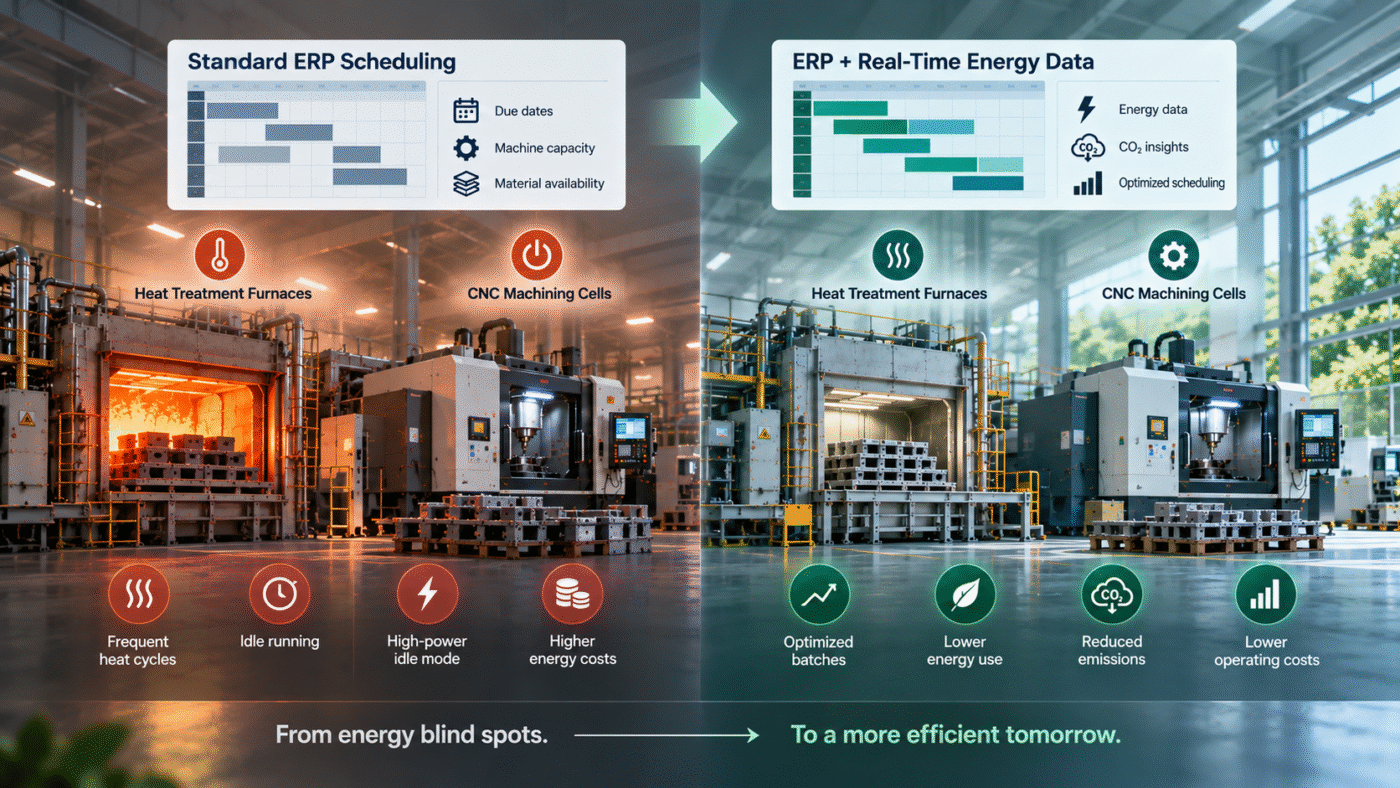
In discrete manufacturing, energy is often treated as a fixed utility cost—an inevitable expense for running the plant. Standard Enterprise Resource Planning (ERP) systems schedule production based on customer due dates, machine capacity, and material availability. However, standard ERP systems are blind to energy intensity and carbon emissions.
This blind spot creates massive energy waste in two primary shop-floor areas:
-
Heat Treatment Furnaces: Kept hot during low-volume runs, subjected to frequent cooling and heating cycles, or left idling between small batches.
-
CNC Machining Cells: Left running in high-power idle modes while waiting for materials, setup changes, or batch approvals.
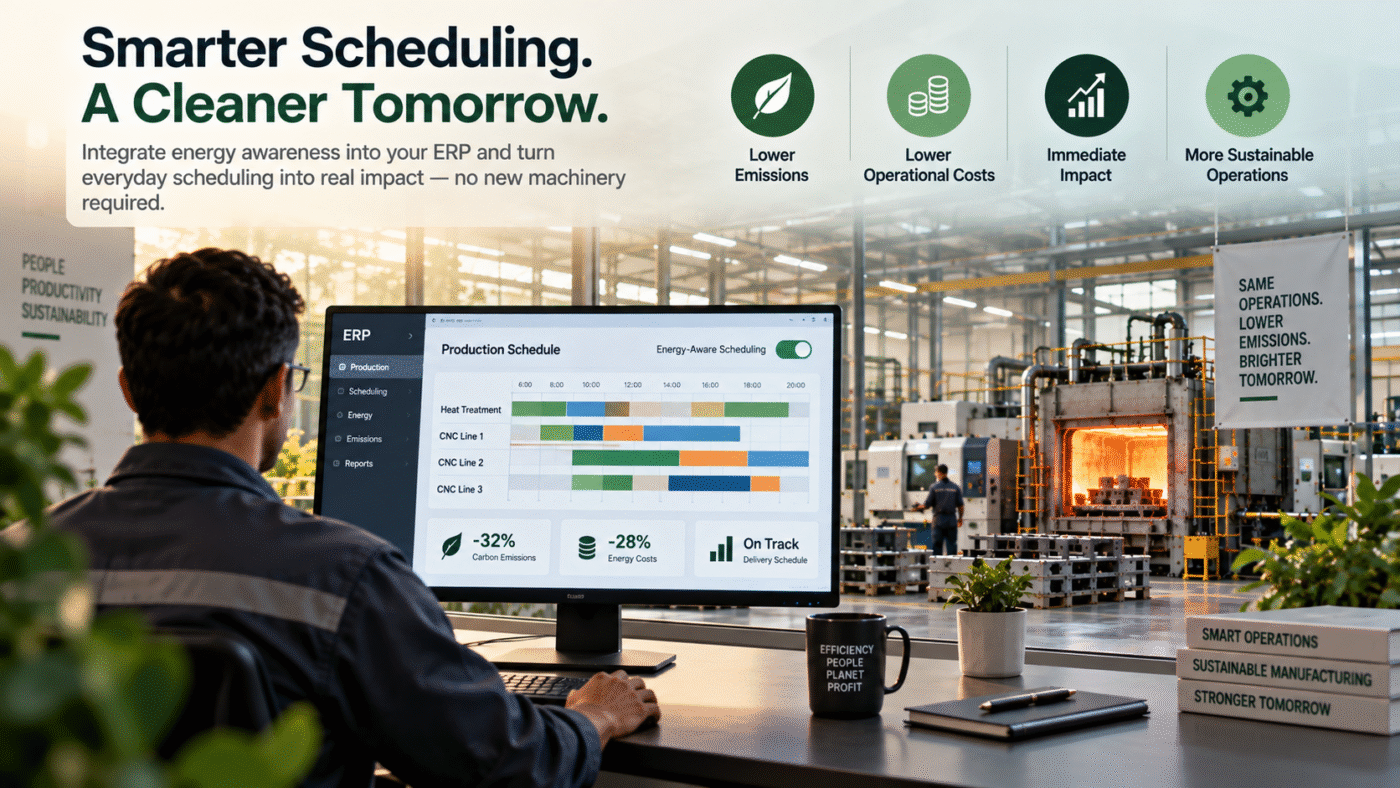
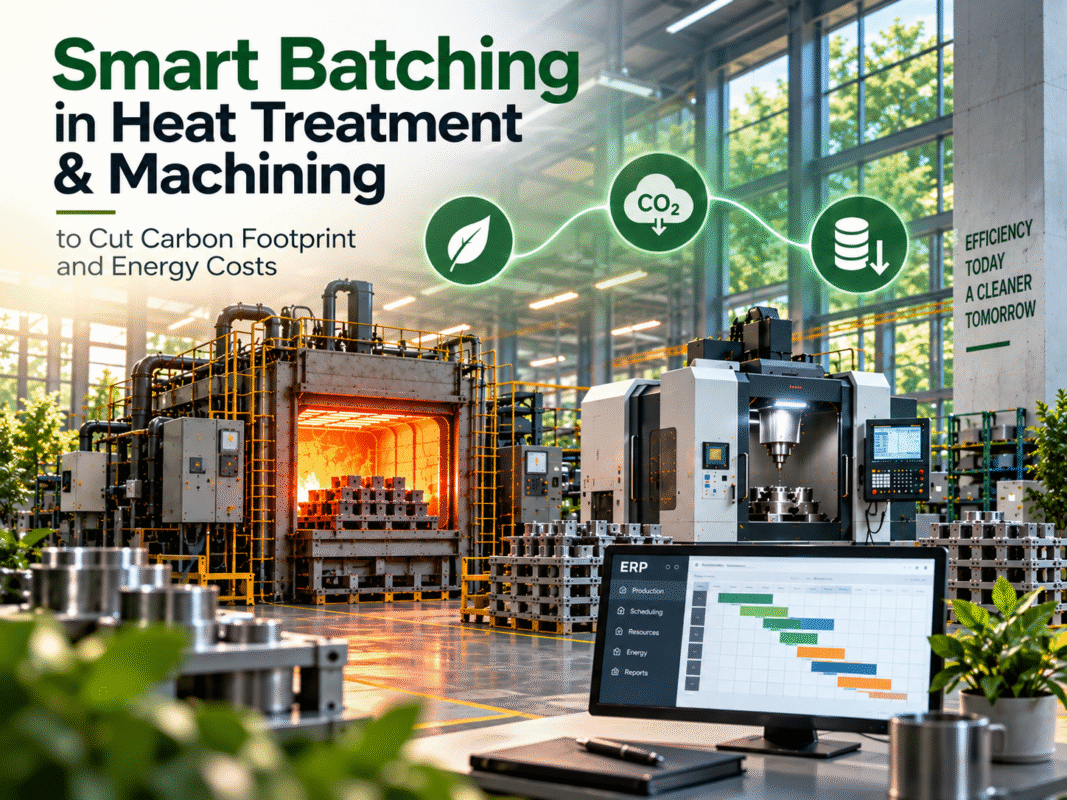
Connecting your ERP system with real-time energy data turns production scheduling into a powerful decarbonization engine. By intelligent batching of heat treatment and machining jobs, plants can reduce carbon output, lower energy bills, and maintain delivery schedules without spending tens of millions on new machinery.
Key Takeaway: Over 60% of furnace energy in typical manufacturing facilities is consumed just maintaining operating temperatures. Scheduling jobs by thermal recipe rather than arrival time instantly eliminates wasted heat cycles.
The Problem: How Standard ERP Schedules Fuel Carbon Emissions
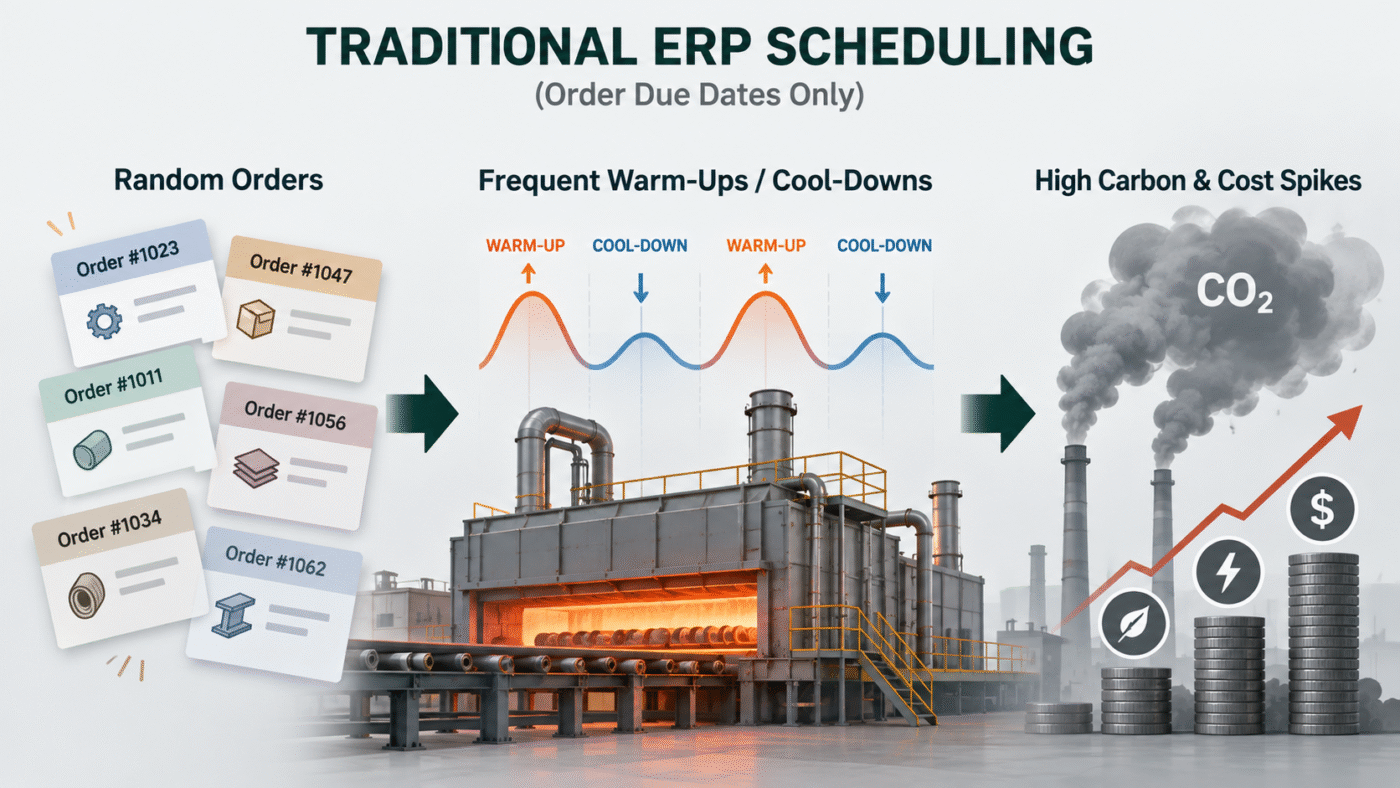
Standard ERP logic operates on a FIFO (First-In, First-Out) or priority-date model. While this keeps order queues moving logically, it creates severe energy inefficiencies.
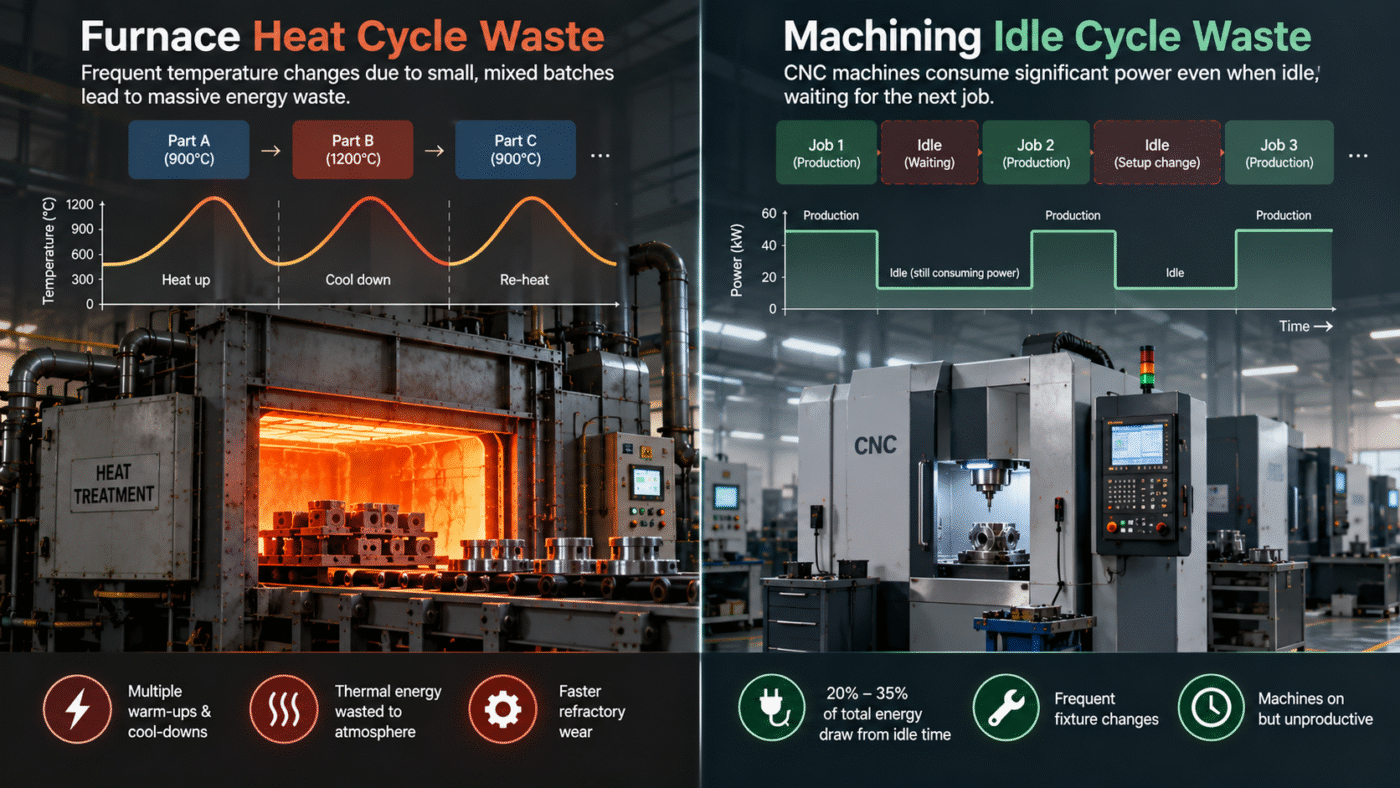
A. Furnace Heat Cycle Waste
Heating an industrial furnace from ambient temperature to 900°C–1200°C requires an enormous amount of natural gas or electricity. When an ERP schedules a small batch of Part A, followed by Part B requiring a different temperature, and then Part C requiring the original temperature:
-
The furnace undergoes multiple warm-ups, cool-downs, and re-heats.
-
Massive thermal energy is dumped into the atmosphere without doing productive work.
-
Refractory linings wear out faster due to thermal stress.
B. Machining Idle Cycle Waste
Modern multi-axis CNC machines draw substantial baseline power even when idle—running hydraulics, chip conveyors, coolant pumps, and spindle chillers.
-
Unplanned idle gaps between small jobs account for 20% to 35% of a machine shop’s total energy draw.
-
Fragmented production schedules lead to frequent fixture changes, leaving machines powered on but unproductive.
The Solution: ERP-Energy Integrated Production Planning
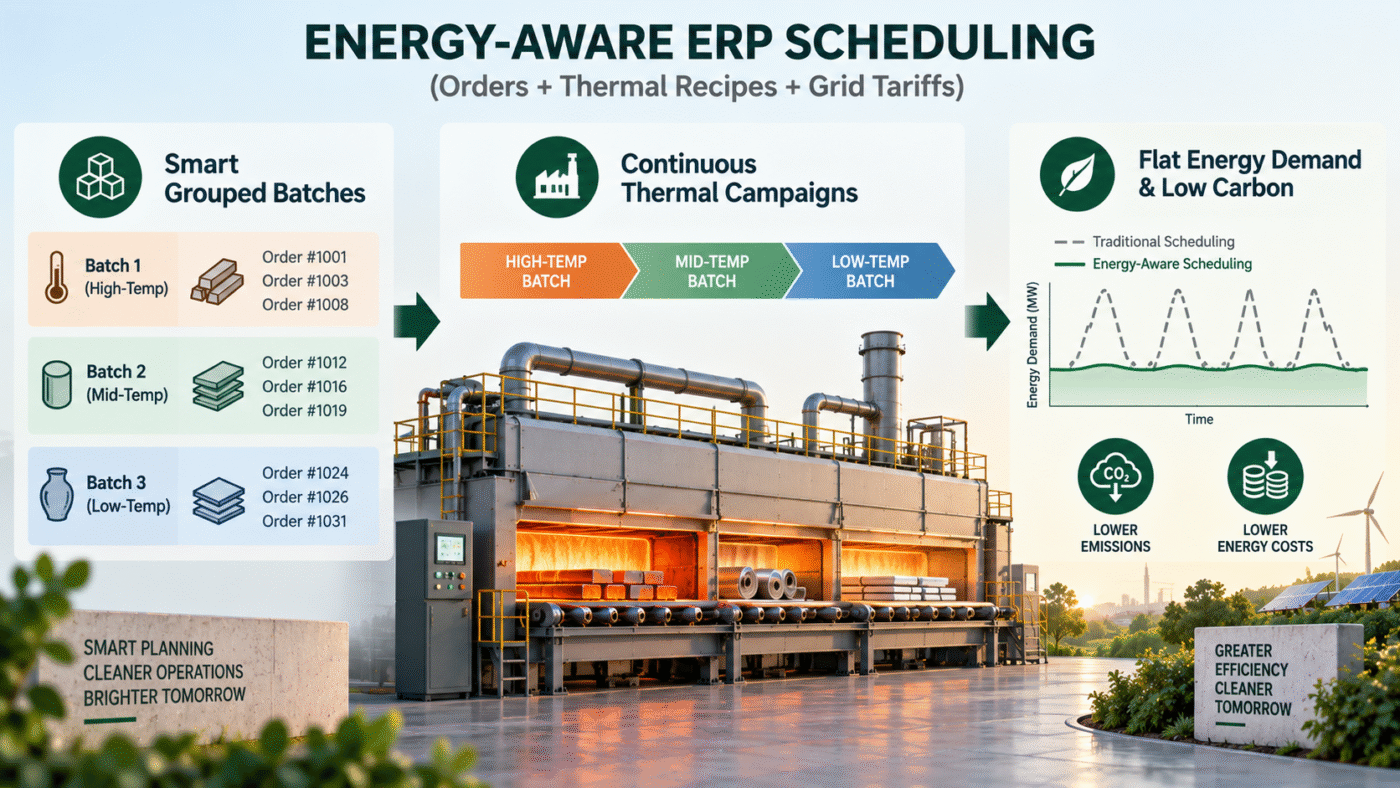
An ERP Energy Integration layer links production order queues directly with Energy Management Systems (EMS) and smart meters. It replaces static scheduling with dynamic, energy-aware job batching.
Heat Treatment Optimization: Recipe and Thermal Sequencing
Heat treatment processes (carburizing, hardening, tempering, annealing) are the heaviest carbon emitters on the factory floor. Optimizing these requires three smart batching practices:
A. Thermal Campaigning (Grouping by Temperature & Recipe)
Instead of processing parts strictly by order arrival, the system groups parts across different customer orders that require the exact same thermal cycle (e.g., 850°C quench and temper).
-
Continuous High Load: Keeps furnaces running at full volumetric capacity, maximizing output per kilowatt-hour or cubic meter of gas.
-
Recipe Stair-Casing: Schedules high-temperature jobs first, followed by medium and lower-temperature jobs. This uses natural furnace cooling productively instead of forced rapid cooling.
B. Thermal Load Maximization (Volumetric Chamber Optimization)
Combining partial batches across orders ensures maximum heat transfer efficiency per furnace cycle.
-
Full-Chamber Scheduling: Combines partial batches from different orders to ensure the furnace operates at 85%+ volumetric capacity rather than running 30%–50% full.
-
Thermal Mass Balancing: Groups parts with similar mass and geometry to ensure uniform heat absorption and prevent unnecessarily extended soak times.
C. Off-Peak and Renewable Grid Alignment
The ERP syncs with local electrical grid carbon-intensity forecasts and utility tariff structures.
-
High-energy furnace warm-ups and heavy ramp-up phases are automatically scheduled during hours when renewable energy (solar/wind) dominates the grid.
-
Avoids energy-intensive warm-ups during peak demand hours, cutting both carbon footprint and peak demand utility charges.
Machining Optimization: Eliminating Idle Energy Cycles
In machining centers, decarbonization is achieved by compressing idle times and grouping tooling setups.
A. Tooling and Fixture Family Batching
When CNC machines switch between completely different parts, setup times can range from 30 minutes to several hours. During this period, auxiliary systems remain powered.
-
The digital planner groups parts by raw material type, holder fixtures, and cutting tool combinations.
-
Setup times drop by 50% to 70%, directly eliminating unproductive energy drain.
B. Automated Sleep Mode and Eco-State Triggering
Integrating ERP job scheduling with machine controllers (PLCs) enables automated power management.
-
If the ERP detects a gap in job scheduling exceeding 15 minutes, it sends a command to transition the machine into a deep eco-sleep mode.
-
Chillers, hydraulic pumps, and chip conveyors are powered down automatically, coming back online 5 minutes before the next batch is scheduled to load.
Comparison: Traditional vs. Energy-Integrated ERP
|
Process Area |
Traditional Operating Model |
Energy-Integrated ERP Model |
Carbon Impact |
Financial Impact |
|
Furnace Warm-Ups |
Cold starts before every small batch run. |
Grouped continuous runs; warm-ups reduced by 60%. |
High Carbon Cut |
Major gas/electricity savings |
|
Furnace Loading |
Partial chamber loading (30%–50% full). |
Batching to guarantee 85%+ volumetric loading. |
High Efficiency |
Lower energy cost per part |
|
CNC Standby Power |
Auxiliaries run continuously between jobs. |
Automatic sleep triggers for gaps > 15 mins. |
Medium Carbon Cut |
Direct electricity bill savings |
|
Machining Setups |
Random order scheduling requires frequent changes. |
Tooling family batching reduces setups by 50%+. |
Reduced Footprint |
Higher machine uptime (OEE) |
Step-by-Step Implementation Strategy
Phase 1: Metering & Data ➔ Phase 2: Master Data ➔ Phase 3: Smart Batch ➔ Phase 4: Dynamic Integration Enrichment Rules Setup Closed-Loop
Phase 1: Install IoT Meters and Connect Data Lines
Connect digital smart meters to all furnaces, heat-treat lines, and major CNC machine cells. Feed energy consumption data back into your industrial IoT network.
Phase 2: Enrich ERP Master Data
Update part routing records in your ERP. Include thermal parameters (soak temperature, cycle duration, quench media) and tooling families alongside standard labor time and operation sequences.
Phase 3: Configure Energy-Aware Scheduling Algorithms
Configure the ERP production planning module to prioritize batch grouping based on energy profiles. Establish buffer rules that allow non-urgent orders to wait slightly longer in the queue if it enables a full furnace load.
Phase 4: Enable Closed-Loop Feedback Control
Connect the smart schedule directly to machine controllers. Enable automatic power-state transitions (sleep/wake) and real-time floor alerts when machines are left idling unnecessarily.
Winning on Cost and Carbon Together
Decarbonizing manufacturing does not always require purchasing expensive new production equipment or switching to costly alternative fuels overnight.
By integrating energy awareness into daily ERP scheduling, plant management can achieve immediate, measurable reductions in carbon emissions and operational costs. Smart batching in heat treatment and machining turns operational scheduling into one of the most effective tools for sustainable manufacturing leadership.