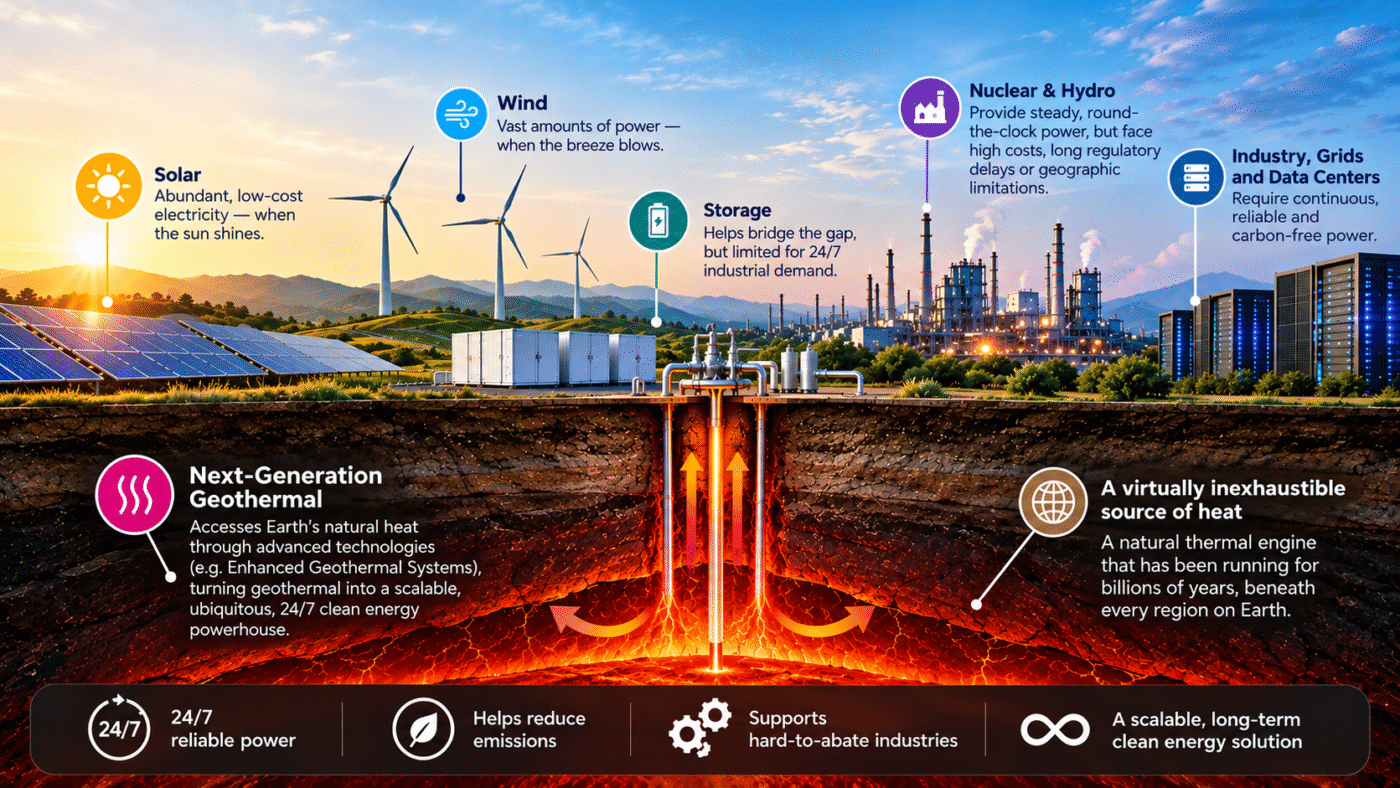
For decades, the search for clean energy has faced a persistent catch-22. Solar panels generate abundant, inexpensive electricity, but only when the sun shines. Wind turbines produce vast amounts of power, but only when the breeze blows. While lithium-ion batteries and grid-scale storage help bridge these gaps, powering heavy industry, grid baseloads, and data centers around the clock requires energy that is both continuous and carbon-free.
Nuclear energy and traditional hydroelectric dams offer steady, round-the-clock power, but they come with high upfront costs, lengthy regulatory delays, or strict geographic limitations.
This has led scientists, engineers, and energy leaders to look directly beneath our feet. Beneath the Earth’s surface lies a virtually inexhaustible reservoir of heat—a natural thermal engine that has been running for billions of years. Traditional geothermal energy, however, was historically restricted to rare geographic “hotspots” where underground steam or hot water naturally bubbled close to the surface, such as in Iceland, New Zealand, or parts of California.
That constraint is disappearing. A new wave of technologies—collectively known as Next-Generation Geothermal—is transforming geothermal from a niche geographic resource into a scalable, ubiquitous, 24/7 clean energy powerhouse.
The Core Limitation of Conventional Geothermal
To understand why next-generation geothermal is such a breakthrough, it helps to understand how traditional geothermal power works.
Conventional geothermal relies on three key ingredients existing simultaneously:
-
Heat: Hot rocks located deep underground.
-
Fluid: Water trapped in underground natural reservoirs.
-
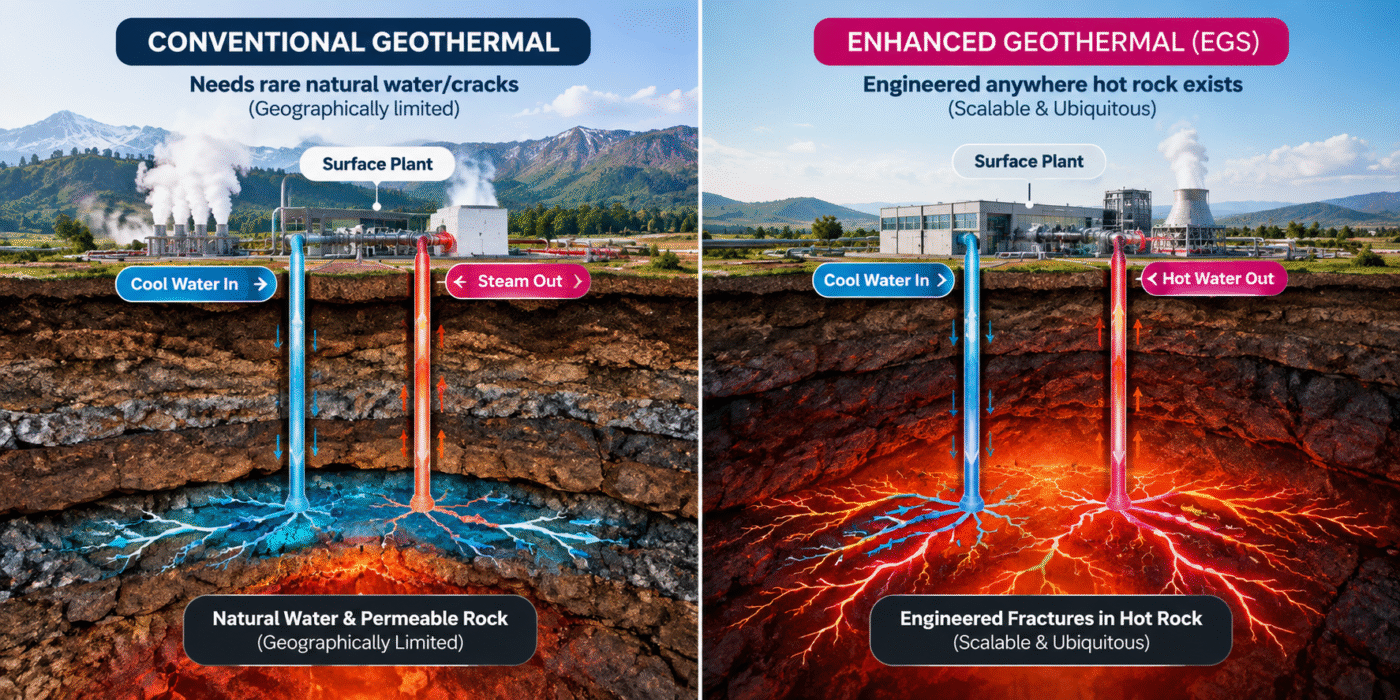
Permeability: Natural cracks and channels in the rock that allow the water to flow, absorb heat, and rise to the surface as steam or high-temperature water.
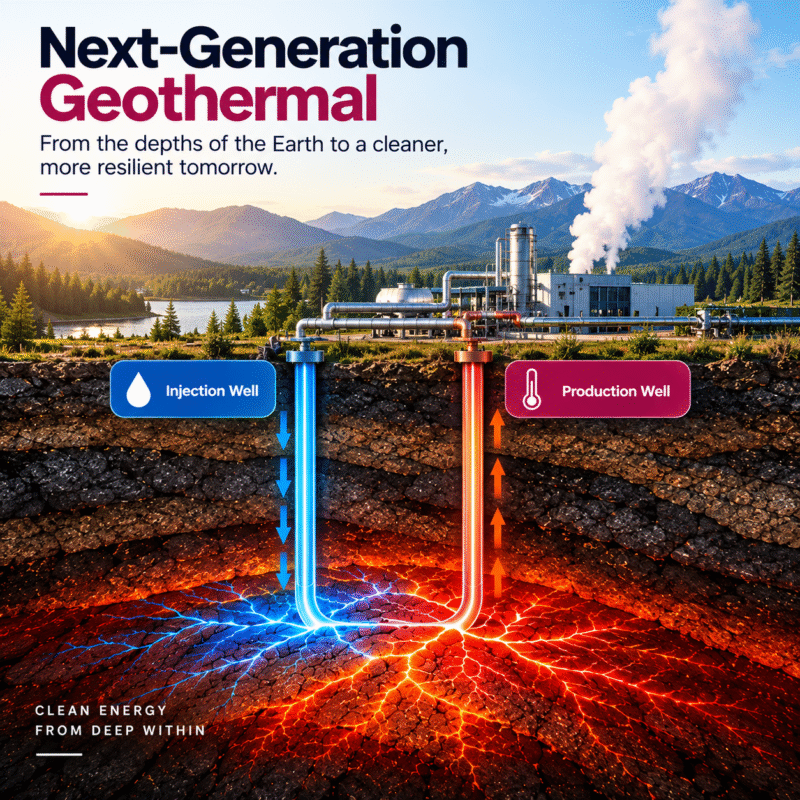
When all three align naturally, you get an ideal geothermal site. Engineers drill a well into the underground fluid reservoir, bring the steam to the surface to spin a turbine, convert that mechanical energy into electricity, and reinject the cooled water back into the ground to repeat the cycle.
The problem is that these three conditions do not naturally occur together everywhere. In many locations, hot rock exists deep underground, but sufficient natural fluid or permeability is absent, limiting the development of conventional geothermal resources.
The Breakthroughs: How Next-Gen Geothermal Works
Next-generation geothermal seeks to overcome some of the geographic limitations of conventional geothermal by using advanced drilling, subsurface characterisation, reservoir engineering, and closed-loop fluid systems. Rather than relying entirely on naturally occurring geothermal reservoirs, these approaches can expand development into a wider range of geological settings, subject to suitable underground temperatures, geology, drilling conditions, and project economics.
Two major next-generation approaches are Enhanced Geothermal Systems (EGS) and closed-loop geothermal. EGS has progressed further toward utility-scale electricity generation, while closed-loop systems aim to avoid hydraulic stimulation and reduce dependence on naturally permeable reservoirs.
a) Enhanced Geothermal Systems (EGS)
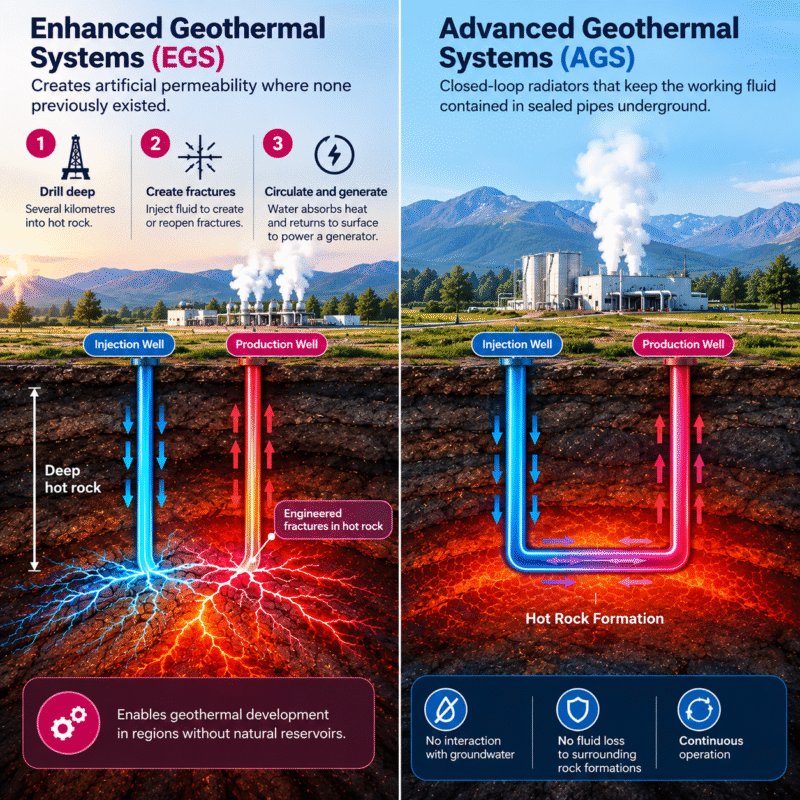
EGS creates artificial permeability where none previously existed.
-
Engineers drill several kilometres into hot rock, using advanced directional and horizontal drilling techniques adapted in part from the oil and gas sector.
-
They inject fluid under carefully controlled pressure to create or reopen fractures in the rock, establishing a permeable heat-exchange reservoir.
-
A second well is drilled into this newly created network. Water is pumped down the injection well, passes through the hot fractured rock, absorbs thermal energy, and ascends through the production well to power a surface generator.
By engineering permeability within hot rock, EGS can potentially enable geothermal development in regions that lack the natural reservoirs required by conventional geothermal systems
b) Advanced Geothermal Systems (AGS) / Closed-Loop Radiators
While EGS opens micro-cracks in rock, Closed-Loop Systems keep the working fluid entirely contained inside sealed pipe networks underground.
Think of an AGS system as a massive subterranean radiator:
-
Deep wells are drilled and connected horizontally deep inside hot rock formations.
-
A working fluid (such as supercritical carbon dioxide or specialized organic fluids) is circulated down into the loop, heated by the surrounding rock through conductive heat transfer, and returned to the surface.
Because the system is completely closed:
-
Fluid does not interact directly with natural groundwater, eliminating contamination risks.
-
No working fluid is lost to surrounding subterranean rock formations.
-
Operations run continuously without requiring complex underground pressure or fluid balance management.
Why Next-Gen Geothermal Is a Game-Changer
Next-generation geothermal offers a combination of characteristics that few other energy sources can match:
|
Characteristic |
Solar & Wind |
Battery Storage |
Nuclear |
Next-Gen Geothermal |
|
Availability |
Weather Dependent |
Hours-limited |
24/7 Baseload |
24/7 Baseload |
|
Land Footprint |
Large |
Small to Medium |
Small |
Extremely Small |
|
Fuel Costs |
Zero |
Zero |
Moderate |
Zero |
|
Geographic Flexibility |
Regional |
Flexible |
Regulatory Dependent |
High (Everywhere at depth) |
-
Continuous, Weather-Independent Baseload
Unlike solar panels that stop generating at dusk or wind turbines that go idle during calm weather, geothermal energy delivers a steady output 365 days a year. It provides true baseload power—the constant minimum level of electricity required by power grids, industrial plants, and data centers around the clock.
-
Minimal Land Footprint
Solar fields and wind farms require vast acreage to generate hundreds of megawatts. Geothermal plants extract their energy vertically. A commercial next-gen geothermal facility requires a compact surface footprint—often just a few acres for wellpads and power generation equipment—making it ideal for industrial integration or urban edge deployment.
-
Thermal Energy Storage & Flexible Load Following
Beyond providing constant power, next-gen geothermal plants can double as giant underground thermal storage units. By controlling fluid circulation rates or holding fluid underground under pressure, plant managers can ramp output up or down to match grid demand.
Real-World Deployments: Where Next-Gen Geothermal Is Already Operating
Next-generation geothermal is no longer limited to computer simulations or laboratory trials. Across North America and Europe, commercial facilities and dedicated field research sites are proving that deep Earth heat can power modern grids, corporate infrastructure, and municipal heating systems.
a. Fervo Energy: Project Red (Nevada, USA)
-
Technology Used: Enhanced Geothermal System (EGS) with horizontal drilling.
-
Operational Scope: Located in northern Nevada, Fervo Energy completed a 30-day well test at its Project Red site, drilling to vertical depths exceeding 7,000 feet and extending horizontally over 3,000 feet into hot granite rock. The facility generated 3.5 Megawatts (MW) of continuous power—setting an output benchmark for commercial EGS systems.
-
Commercial Impact: Project Red served as Fervo’s commercial pilot and demonstrated sustained EGS power production. Fervo’s subsequent Cape Station development has secured major corporate offtake agreements, including a 396 MW PPA with Google announced in September 2026
b. Fervo Energy: Cape Station (Utah, USA)
-
Technology Used: Multi-well commercial-scale Enhanced Geothermal Systems (EGS).
-
Operational Scope: Cape Station is being developed in Beaver County, Utah, with 500 MW of capacity under construction across its planned phases. Phase I, comprising approximately 100 MW, is currently undergoing commissioning, with first test power expected in Q4 2026 and full production anticipated by year-end.
-
Commercial Impact: Fervo has signed offtake agreements with major energy buyers, including a 396 MW PPA with Google announced in September 2026. The agreement relates to power from Cape Station and is expected to support Google’s future data-centre operations in Utah.
c. Eavor Technologies: Geretsried Project (Bavaria, Germany)
-
Technology Used: Advanced Geothermal System (AGS) / Closed-Loop Architecture (Eavor-Loop™).
-
Operational Scope: Located south of Munich, this site is the world’s first commercial-scale deep closed-loop geothermal facility. Engineers drilled dual vertical wells to depths of approximately 4,500 meters, connecting horizontal laterals underground to form a closed radiator loop without hydraulic fracturing or extracting groundwater.
-
Commercial Impact: The facility delivers 8.2 MW of electricity to the German electrical grid alongside 64 MW of thermal energy for municipal district heating in Geretsried.
d. U.S. DOE FORGE Facility (Milford, Utah, USA)
-
Technology Used: Dedicated Frontier Observatory for Research in Geothermal Energy.
-
Operational Scope: Funded by the U.S. Department of Energy, FORGE is a underground field laboratory designed to test and optimize EGS technologies. It features angled wells drilled into hot granite at temperatures exceeding 200°C, erving as a testbed for drill bits, seismic sensors, and stimulation tools.
-
Commercial Impact: Provides open-source operational data and engineering protocols that commercial developers use to de-risk geothermal project execution.
e. GreenFire Energy: Coso Geothermal Field (California, USA)
-
Technology Used: Retrofit Closed-Loop Advanced Geothermal System (AGS).
-
Operational Scope: Located in California, this project demonstrated retrofitting underperforming traditional hydrothermal wells using a closed-loop tube-in-tube heat exchanger. The demonstration utilized supercritical CO₂ as the subterranean circulating working fluid to harvest thermal heat without drawing from depleted natural groundwater reservoirs.
-
Commercial Impact: Proves that legacy geothermal fields with declining steam pressure can be revitalized using closed-loop technology.
Key Engineering Challenges to Overcome
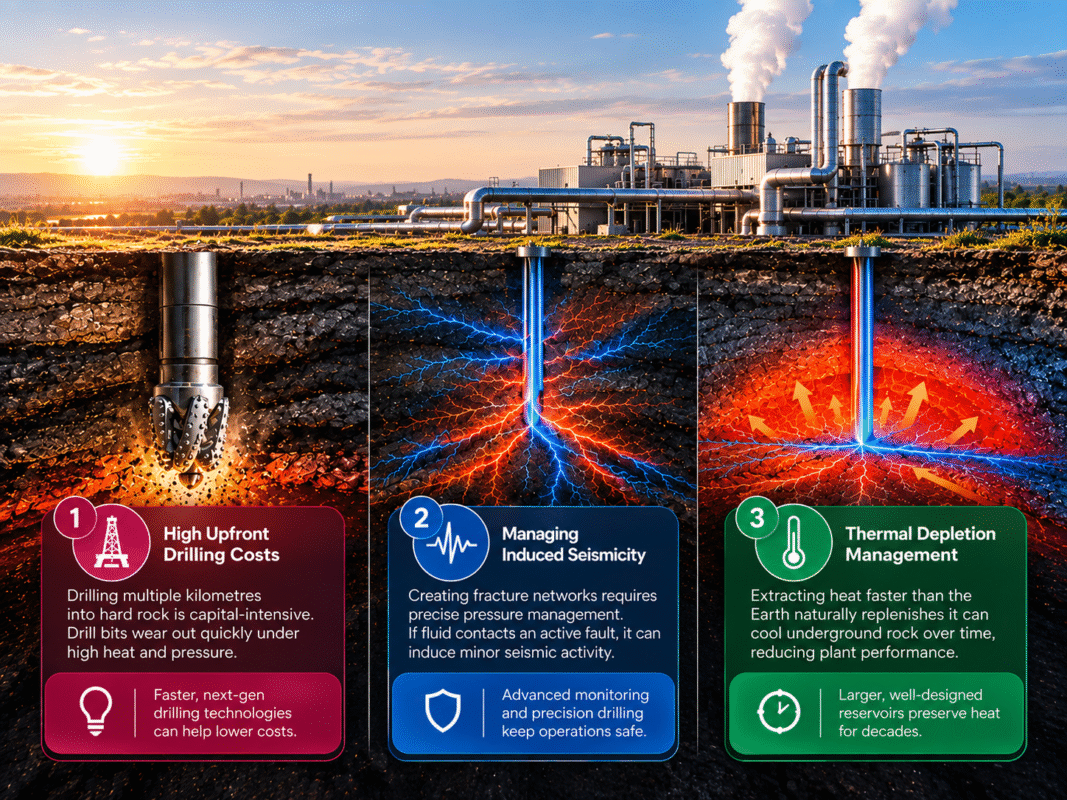
While commercial deployments prove that next-generation geothermal works, scaling the technology globally requires addressing key engineering and economic hurdles:
-
High Upfront Drilling Costs: Drilling multiple kilometers into hard granite or basalt rock remains capital-intensive. Drill bits wear out rapidly under high heat and pressure. Lowering capital expenditure requires faster drilling technologies, such as contactless thermal drilling, plasma jets, or high-energy millimeter-wave beams.
-
Managing Induced Seismicity: Creating underground fracture networks requires precise fluid pressure management. If injected fluid contacts an active geological fault, it can induce minor seismic activity. EGS operators manage this risk through real-time micro-seismic monitoring, AI-guided precision drilling, and low-pressure stimulation.
-
Thermal Depletion Management: Extracting heat faster than the Earth’s natural conductive flow replenishes it can cause subterranean rock temperatures to drop over time. Engineering expansive, well-distributed underground surface areas prevents localized cooling and preserves plant operational life for decades.
The Path Ahead: Clean, Firm Power for the Global Transition
Next-generation geothermal is moving from experimental technology toward early commercial deployment—but its ultimate scalability depends on drilling costs, subsurface performance, induced-seismicity management and long-term economics. A resilient, low-carbon power system will require firm sources of electricity that can complement variable renewables and support energy-intensive demand regardless of weather or time of day.
By integrating advanced drilling, subsurface characterisation, reservoir engineering and closed-loop fluid systems, next-generation geothermal approaches aim to make deep Earth heat accessible in a wider range of geological settings. Real-world projects are now demonstrating the potential of these technologies for electricity generation and district heating, while commercial-scale developments are beginning to test their ability to operate economically at larger scale. If the remaining technical and economic challenges can be overcome, next-generation geothermal could become an important source of firm, low-carbon energy in the global clean energy transition.